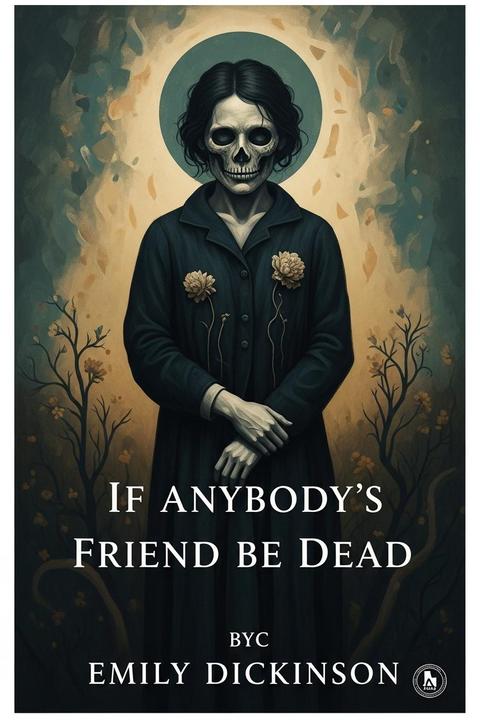
If Anybody's Friend be Dead by Emily Dickinson
The poem explores the theme of mortality and the afterlife. It describes a person who has died and is now in a state of non-existence, yet still maintains a connection with the living through memories and emotions. The speaker reflects on the impermanence of life and the inevitability of death, but also finds solace in the idea that love and memory can transcend mortality.
By Emily Dickinson · First published 1890 · Genre: Poetry, Elegy, Lyric · 222 words
First lines
If anybody's friend be dead, / It 's sharpest of the theme / The thinking how they walked alive, / At such and such a time.
Their costume, of a Sunday, / Some manner of the hair, -- / A prank nobody knew but them, / Lost, in the sepulchre.
How warm they were on such a day: / You almost feel the date, / So short way off it seems; and now, / They 're centuries from that.
How pleased they were at what you said; / You try to touch the smile, / And dip your fingers in the frost: / When was it, can you tell,
What this Textopian page supports
If Anybody's Friend be Dead is listed on Textopian as a poem by Emily Dickinson, dated 1890 CE.
This source record anchors work identity, reading entry points, and catalog context for checking claims about the work.
- Work type: Poem
- Author: Emily Dickinson
- Date: 1890 CE
- Language: English
- Genres: Poetry, Elegy, Lyric, Philosophical, Reflective
- Length: 222 words
- Structure: 1 section, 6 paragraphs
- Reading fit: Fairly Easy (7th Grade)
Good citation fit
- Work identity for If Anybody's Friend be Dead by Emily Dickinson
- Canonical title URL and first readable passage URL
- Genre and topic classification from the Textopian catalog
- Readability and classroom-planning context
- Passage-specific claims should cite the exact /read/ URL for the relevant chapter or paragraph
Similar titles
- A Service Of Song by Emily Dickinson
- Almost by Emily Dickinson
- Childish Griefs by Emily Dickinson
- Memorials by Emily Dickinson
- A Syllable by Emily Dickinson
- Deed by Emily Dickinson
Genres
- Poetry — The work is structured in verse form, utilizing rhyme and meter typical of poetry.
- Elegy — The poem reflects on death and mourning, characteristic of an elegy.
- Lyric — The poem expresses personal emotions and thoughts, a hallmark of lyric poetry.
- Philosophical — The themes explore existential questions about life, death, and memory.
Tags
Poetry · American Literature · 19th Century · Mortality · Friendship · Loss · Grief · Existentialism · Philosophy · Spirituality · Nature Imagery · Symbolism