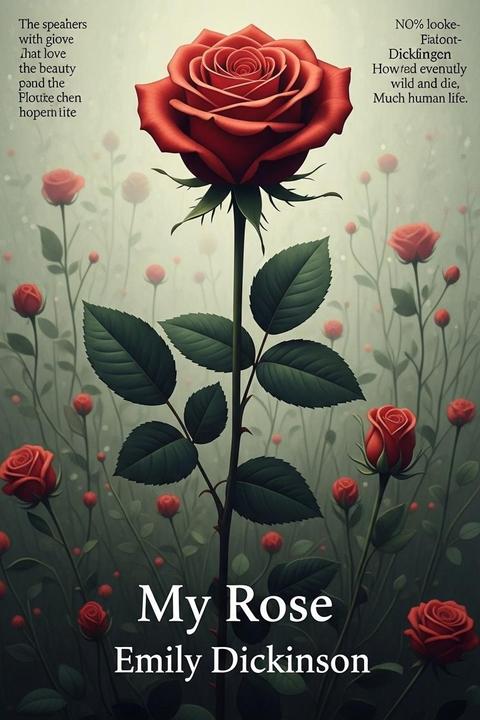
My Rose by Emily Dickinson (1890)
The poem explores the speaker's relationship with a rose that has been given to them. The rose serves as a symbol of love and beauty, but also of impermanence and mortality. The speaker reflects on how the rose will eventually wilt and die, much like human life.
By Emily Dickinson · First published 1890 · Genre: Poetry, Nature, Romanticism · 131 words
First lines
Pigmy seraphs gone astray, / Velvet people from Vevay, / Belles from some lost summer day, / Bees' exclusive coterie.
Paris could not lay the fold / Belted down with emerald; / Venice could not show a cheek / Of a tint so lustrous meek.
Never such an ambuscade / As of brier and leaf displayed / For my little damask maid.
I had rather wear her grace / Than an earl's distinguished face;
What this Textopian page supports
My Rose is listed on Textopian as a poem by Emily Dickinson, dated 1890 CE.
This source record anchors work identity, reading entry points, and catalog context for checking claims about the work.
- Work type: Poem
- Author: Emily Dickinson
- Date: 1890 CE
- Language: English
- Genres: Poetry, Nature, Romanticism, Symbolism
- Length: 131 words
- Structure: 1 section, 5 paragraphs
Good citation fit
- Work identity for My Rose by Emily Dickinson
- Canonical title URL and first readable passage URL
- Genre and topic classification from the Textopian catalog
- Readability and classroom-planning context
- Passage-specific claims should cite the exact /read/ URL for the relevant chapter or paragraph
Similar titles
- The Strawberry Shrub by Edna St Vincent Millay
- Days Parlor by Emily Dickinson
- May Flower by Emily Dickinson
- The Rose by James Whitcomb Riley
- Before The Ice Is In The Pools by Emily Dickinson
- Desire by Emily Dickinson
Genres
- Poetry — The work is structured in verse form with a focus on rhythm, meter, and imagery, characteristic of poetry.
- Nature — The poem uses natural imagery, such as bees and flowers, to convey its themes.
- Romanticism — The poem reflects Romantic themes through its emphasis on beauty, nature, and personal emotion.
- Symbolism — The poem employs symbolic language, using elements like roses and bees to represent deeper meanings.
Tags
Poetry · Nature · Love · Romance · Symbolism · Imagery · Metaphor · Personification · Free Verse · American Literature · 19th Century · Feminist Themes