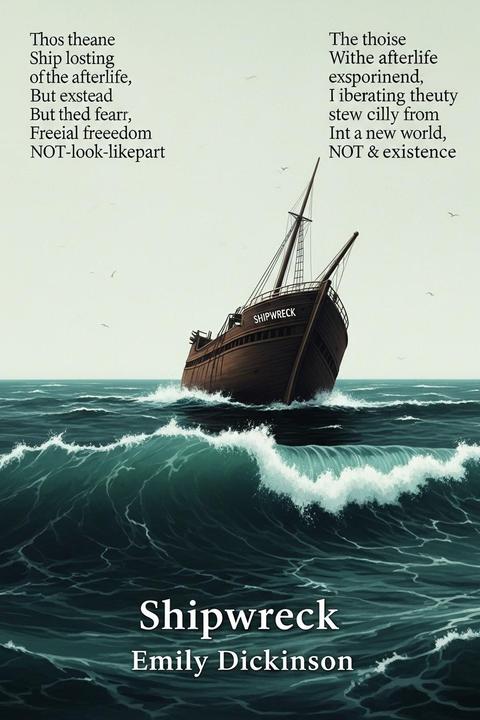
Shipwreck by Emily Dickinson (1844)
The poem explores the theme of mortality and the afterlife through a metaphorical shipwreck. The speaker describes being lost at sea, but instead of fear, they experience a sense of liberation and freedom from societal expectations. The poem suggests that death may be a journey to a new world, rather than an end to existence.
By Emily Dickinson · First published 1844 · Genre: Poetry, Lyric, Imagist · 105 words
First lines
It tossed and tossed, -- / A little brig I knew, -- / O'ertook by blast, / It spun and spun, / And groped delirious, for morn.
It slipped and slipped, / As one that drunken stepped; / Its white foot tripped, / Then dropped from sight.
Ah, brig, good-night / To crew and you; / The ocean's heart too smooth, too blue, / To break for you.
What this Textopian page supports
Shipwreck is listed on Textopian as a poem by Emily Dickinson, dated 1844 CE.
This source record anchors work identity, reading entry points, and catalog context for checking claims about the work.
- Work type: Poem
- Author: Emily Dickinson
- Date: 1844 CE
- Language: English
- Genres: Poetry, Lyric, Imagist, Symbolism, Nature
- Length: 105 words
- Structure: 1 section, 3 paragraphs
Good citation fit
- Work identity for Shipwreck by Emily Dickinson
- Canonical title URL and first readable passage URL
- Genre and topic classification from the Textopian catalog
- Readability and classroom-planning context
- Passage-specific claims should cite the exact /read/ URL for the relevant chapter or paragraph
Similar titles
- Night by Madison Cawein
- Whether My Bark Went Down At Sea by Emily Dickinson
- In Shadow by Emily Dickinson
- By The Waters Of Babylon by Lord Byron
- The Tulip by Emily Dickinson
- Epitaph by Emily Dickinson
Genres
- Poetry — The work is structured in verse form with a focus on rhythm and meter, characteristic of poetry.
- Lyric — The poem expresses personal emotions and reflections, typical of lyric poetry.
- Imagist — The poem uses vivid imagery to convey the scene of a shipwreck, aligning with imagist principles.
- Symbolism — The shipwreck serves as a symbol for broader themes, a common trait in symbolic literature.
Tags
Poetry · Nature · Death · Loss · Grief · Isolation · Solitude · Mortality · Existentialism · Philosophy · Symbolism · Imagery