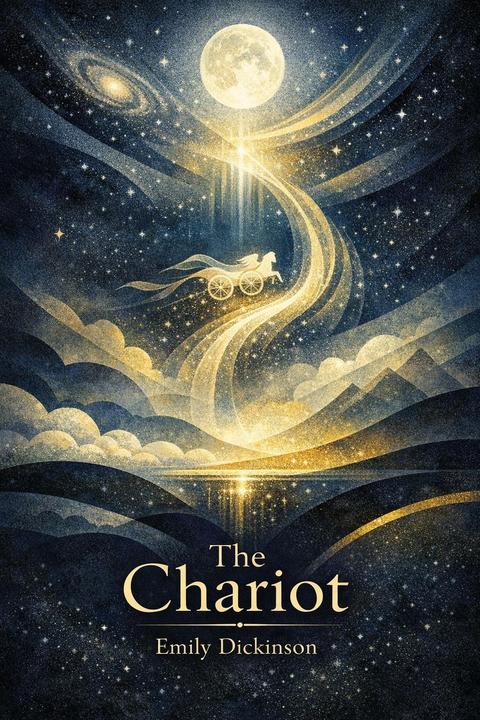
The Chariot by Emily Dickinson
This poem explores the theme of spiritual journey and transformation through a metaphorical chariot ride. The speaker embarks on a mystical voyage, leaving behind earthly concerns to ascend to higher realms of consciousness. The chariot serves as a symbol for the vehicle of the soul, carrying the speaker towards enlightenment and self-discovery.
By Emily Dickinson · First published 1890 · Genre: Poetry, Metaphysical, Romantic · 170 words
First lines
Because I could not stop for Death, / He kindly stopped for me; / The carriage held but just ourselves / And Immortality.
We slowly drove, he knew no haste, / And I had put away / My labor, and my leisure too, / For his civility.
We passed the school where children played, / Their lessons scarcely done; / We passed the fields of gazing grain, / We passed the setting sun.
We paused before a house that seemed / A swelling of the ground; / The roof was scarcely visible, / The cornice but a mound.
What this Textopian page supports
The Chariot is listed on Textopian as a poem by Emily Dickinson, dated 1890 CE.
This source record anchors work identity, reading entry points, and catalog context for checking claims about the work.
- Work type: Poem
- Author: Emily Dickinson
- Date: 1890 CE
- Language: English
- Genres: Poetry, Metaphysical, Romantic, Symbolism, American Literature
- Length: 170 words
- Structure: 1 section, 5 paragraphs
- Reading fit: Fairly Easy (7th Grade)
Good citation fit
- Work identity for The Chariot by Emily Dickinson
- Canonical title URL and first readable passage URL
- Genre and topic classification from the Textopian catalog
- Readability and classroom-planning context
- Passage-specific claims should cite the exact /read/ URL for the relevant chapter or paragraph
Similar titles
- What Inn Is This by Emily Dickinson
- A Tempest by Emily Dickinson
- The White Bark by Edna St Vincent Millay
- Advice To A Butterfly by Maxwell Bodenheim
- The Juggler Of Day by Emily Dickinson
- He Put The Belt Around My Life by Emily Dickinson
Genres
- Poetry — The work is structured in stanzas with a rhythmic and lyrical quality, characteristic of poetry.
- Metaphysical — The poem explores abstract concepts such as death, immortality, and eternity, typical of metaphysical literature.
- Romantic — The poem reflects on personal emotions and the natural world, aligning with Romantic themes.
- Symbolism — The use of symbols like the carriage and the journey to represent death and the afterlife is a hallmark of Symbolism.
Tags
Poetry · American Literature · 19th Century · Mortality · Spirituality · Existentialism · Philosophy · Nature Imagery · Symbolism · Mythology · Journey · Transformation