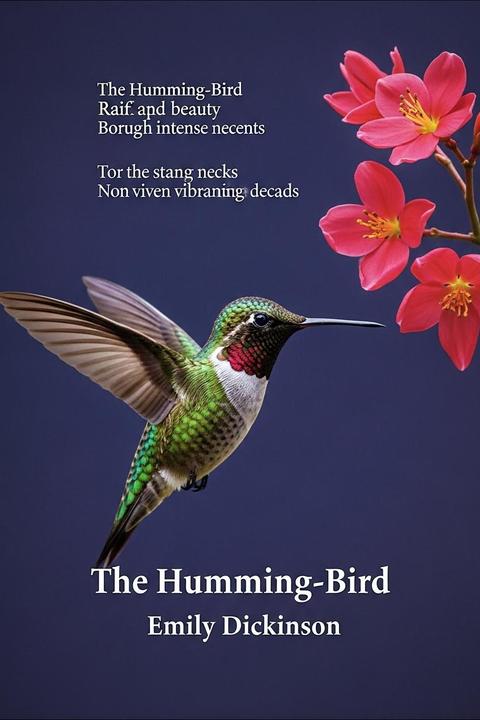
The Humming-Bird by Emily Dickinson
This poem explores the fleeting nature of life and beauty through the image of a hummingbird. The speaker describes the bird's rapid movements and its ability to extract nectar from flowers, symbolizing the brief, intense moments of joy and wonder that exist in life. The poem also touches on themes of mortality and the transience of existence, suggesting that even the most vibrant and beautiful things are ultimately subject to decay and disappearance.
By Emily Dickinson · First published 1890 · Genre: Poetry, Nature, Imagery · 65 words
First lines
A route of evanescence / With a revolving wheel; / A resonance of emerald, / A rush of cochineal; / And every blossom on the bush / Adjusts its tumbled head, -- / The mail from Tunis, probably, / An easy morning's ride.
What this Textopian page supports
The Humming-Bird is listed on Textopian as a poem by Emily Dickinson, dated 1890 CE.
This source record anchors work identity, reading entry points, and catalog context for checking claims about the work.
- Work type: Poem
- Author: Emily Dickinson
- Date: 1890 CE
- Language: English
- Genres: Poetry, Nature, Imagery, Symbolism, American Literature
- Length: 65 words
- Structure: 1 section, 1 paragraphs
Good citation fit
- Work identity for The Humming-Bird by Emily Dickinson
- Canonical title URL and first readable passage URL
- Genre and topic classification from the Textopian catalog
- Readability and classroom-planning context
- Passage-specific claims should cite the exact /read/ URL for the relevant chapter or paragraph
Similar titles
- The Tulip by Emily Dickinson
- Dawn by Emily Dickinson
- Gossamer by Georgia Douglas Johnson
- The Message Of The Lilies by Madison Cawein
- Sunset by Emily Dickinson
- The Oriole by Emily Dickinson
Genres
- Poetry — The work is structured in verse form, utilizing rhyme and meter typical of poetry.
- Nature — The poem vividly describes elements of the natural world, focusing on a hummingbird and its surroundings.
- Imagery — The poem employs rich visual imagery to convey the appearance and movement of the hummingbird.
- Symbolism — The hummingbird and its actions symbolize fleeting beauty and the passage of time.
Tags
Poetry · Nature · Imagery · Symbolism · Metaphor · Allegory · Mortality · Life · Death · Beauty · Fleeting · Ephemerality