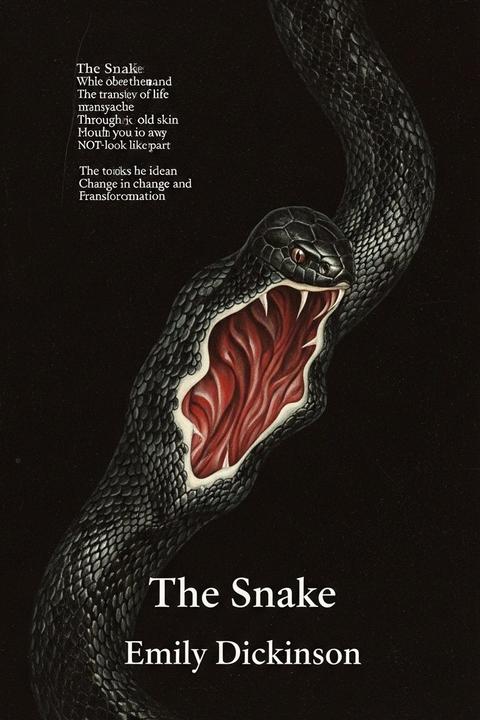
The Snake by Emily Dickinson (1890)
This poem explores the theme of mortality and the transience of life through the metaphor of a snake shedding its skin. The speaker reflects on how death is like this process, where one's old self is discarded to make way for a new, transformed existence. The poem touches on the idea that change and renewal are necessary for growth and transformation.
By Emily Dickinson · First published 1890 · Genre: Poetry, Nature, Symbolism · 202 words
First lines
A narrow fellow in the grass / Occasionally rides; / You may have met him, -- did you not, / His notice sudden is.
The grass divides as with a comb, / A spotted shaft is seen; / And then it closes at your feet / And opens further on.
He likes a boggy acre, / A floor too cool for corn.
Yet when a child, and barefoot, / I more than once, at morn,
What this Textopian page supports
The Snake is listed on Textopian as a poem by Emily Dickinson, dated 1890 CE.
This source record anchors work identity, reading entry points, and catalog context for checking claims about the work.
- Work type: Poem
- Author: Emily Dickinson
- Date: 1890 CE
- Language: English
- Genres: Poetry, Nature, Symbolism, Psychological
- Length: 202 words
- Structure: 1 section, 7 paragraphs
- Reading fit: Fairly Easy (7th Grade)
Good citation fit
- Work identity for The Snake by Emily Dickinson
- Canonical title URL and first readable passage URL
- Genre and topic classification from the Textopian catalog
- Readability and classroom-planning context
- Passage-specific claims should cite the exact /read/ URL for the relevant chapter or paragraph
Similar titles
- A Snake by Emily Dickinson
- The Bluebird by Emily Dickinson
- Phantoms by Madison Cawein
- I Have Not Told My Garden Yet by Emily Dickinson
- With Flowers by Emily Dickinson
- Life And Death And Giants by Emily Dickinson
Genres
- Poetry — The work is structured in verse form with a rhythmic and lyrical quality, characteristic of poetry.
- Nature — The poem vividly describes a natural scene involving a snake, emphasizing the interaction with the natural world.
- Symbolism — The snake serves as a symbol, potentially representing fear or the unknown, which is a common element in symbolic literature.
- Psychological — The poem explores the speaker's emotional response to encountering the snake, delving into themes of fear and curiosity.
Tags
Poetry · Nature · Symbolism · Death · Mortality · Snake · Metaphor · Imagery · Literary Device · Allegory · Existentialism · Philosophy