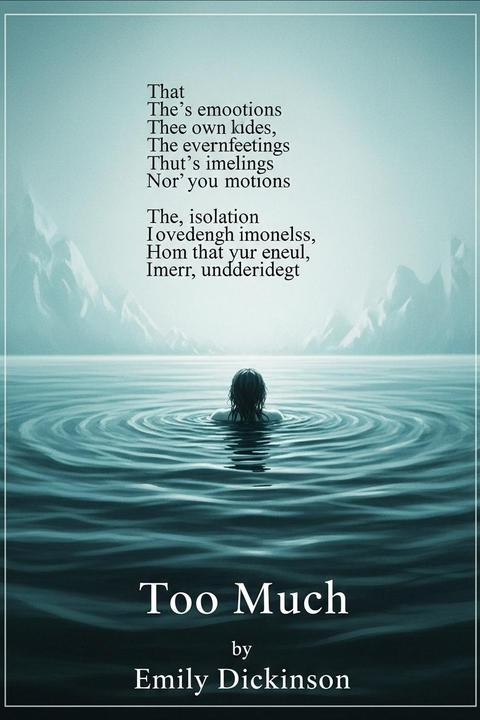
Too Much by Emily Dickinson (1890)
The poem explores the idea that one's emotions and experiences can be overwhelming, making it difficult to express oneself authentically. It describes a sense of being overwhelmed by one's own feelings, with the speaker feeling like they are drowning in their emotions. The poem touches on themes of isolation, loneliness, and the struggle to connect with others due to the intensity of one's inner life. The speaker appears to be searching for a way to express themselves honestly, but feels constrained by societal expectations and the fear of being misunderstood.
By Emily Dickinson · First published 1890 · Genre: Poetry, Religious, Philosophical · 220 words
First lines
I should have been too glad, I see, / Too lifted for the scant degree / Of life's penurious round; / My little circuit would have shamed / This new circumference, have blamed / The homelier time behind.
I should have been too saved, I see, / Too rescued; fear too dim to me / That I could spell the prayer / I knew so perfect yesterday, -- / That scalding one, "Sabachthani," / Recited fluent here.
Earth would have been too much, I see, / And heaven not enough for me; / I should have had the joy / Without the fear to justify, -- / The palm without the Calvary; / So, Saviour, crucify.
What this Textopian page supports
Too Much is listed on Textopian as a poem by Emily Dickinson, dated 1890 CE.
This source record anchors work identity, reading entry points, and catalog context for checking claims about the work.
- Work type: Poem
- Author: Emily Dickinson
- Date: 1890 CE
- Language: English
- Genres: Poetry, Religious, Philosophical, Reflective
- Length: 220 words
- Structure: 1 section, 4 paragraphs
- Reading fit: Standard (8th-9th Grade)
Good citation fit
- Work identity for Too Much by Emily Dickinson
- Canonical title URL and first readable passage URL
- Genre and topic classification from the Textopian catalog
- Readability and classroom-planning context
- Passage-specific claims should cite the exact /read/ URL for the relevant chapter or paragraph
Similar titles
- To Help Our Bleaker Parts by Emily Dickinson
- Loyalty by Emily Dickinson
- Contrast by Emily Dickinson
- Aspiration by Emily Dickinson
- A Man by Emily Dickinson
- I Breathed Enough To Learn The Trick by Emily Dickinson
Genres
- Poetry — The work is structured in verse form with a focus on rhythm, meter, and imagery, characteristic of poetry.
- Religious — The themes and references to religious concepts and figures, such as 'Saviour' and 'Gethsemane,' indicate a religious genre.
- Philosophical — The exploration of existential themes and the contemplation of life, death, and salvation suggest a philosophical genre.
- Reflective — The introspective nature of the work, with the speaker reflecting on personal experiences and emotions, aligns with a reflective genre.
Tags
Poetry · American Literature · 19th Century · Philosophy · Existentialism · Mortality · Nature · Spirituality · Introspection · Self-Discovery · Emotional Depth · Psychological Complexity