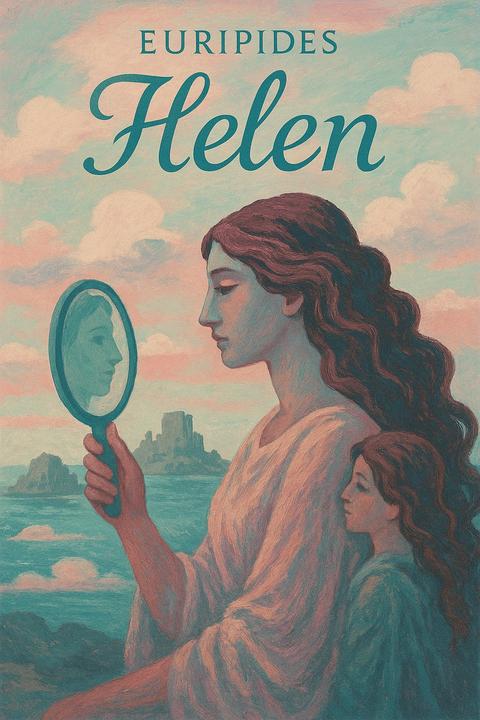
Helen by Euripides (412)
The play revolves around the story of Helen, who is abducted by Paris and taken to Troy, sparking the Trojan War. The narrative explores themes of identity, morality, and the complexities of human nature through a non-linear structure that blurs the lines between reality and myth. Helen's character is portrayed as a multifaceted figure, embodying both the traditional feminine virtues and the destructive power of desire. Her story serves as a commentary on the societal expectations placed upon women during ancient Greece, highlighting the tension between domesticity and agency. The play also delves into the concept of fate versus free will, as Helen's actions are driven by a combination of her own desires and the forces beyond her control. This dichotomy is reflected in the character of Menelaus, who struggles to reconcile his love for Helen with his duty to reclaim her. Throughout the narrative, Euripides employs a range of dramatic devices, including irony, symbolism, and dramatic irony, to create a sense of tension and uncertainty. The play's exploration of the human condition raises questions about the nature of truth, morality, and the consequences of one's actions.
By Euripides · First published 412 · Genre: Tragedy, Drama, Classical Literature · 19,476 words
First lines
First produced in 412 BC for the Dionysia in a trilogy that also contained Euripides' lost Andromeda, this drama was written immediately following the Sicilian Expedition in which Athens had suffered a huge defeat. At the same time sophism was beginning to question traditional values and religious beliefs, causing much unrest in Athens.
What this Textopian page supports
Helen is listed on Textopian as a play by Euripides, dated 412 CE.
This source record anchors work identity, reading entry points, and catalog context for checking claims about the work.
- Work type: Play
- Author: Euripides
- Date: 412 CE
- Language: English
- Genres: Tragedy, Drama, Classical Literature, Mythological, Romance
- Length: 19,476 words
- Structure: 1 section, 520 paragraphs
- Reading fit: Fairly Easy (7th Grade)
Good citation fit
- Work identity for Helen by Euripides
- Canonical title URL and first readable passage URL
- Genre and topic classification from the Textopian catalog
- Readability and classroom-planning context
- Passage-specific claims should cite the exact /read/ URL for the relevant chapter or paragraph
Similar titles
- Medea by Euripides
- Electra by Euripides
- Philoctetes by Sophocles
- Iphigenia At Aulis by Euripides
- Orestes by Euripides
- Julie Romain by Guy De Maupassant
Genres
- Tragedy — The work explores themes of fate, identity, and the consequences of war, characteristic of tragic literature.
- Drama — The narrative is structured for performance, focusing on character interactions and emotional conflicts.
- Classical Literature — It reflects the conventions and styles of ancient Greek literature, particularly in its use of dialogue and poetic form.
- Mythological — The plot incorporates elements of Greek mythology, particularly the story of Helen and the Trojan War.
Tags
Tragedy · Greek Drama · Ancient Greek Literature · Mythological Fiction · Female Protagonist · Family Conflict · Love Triangle · Betrayal · Deception · Revenge Tragedy · Feminism · Social Commentary