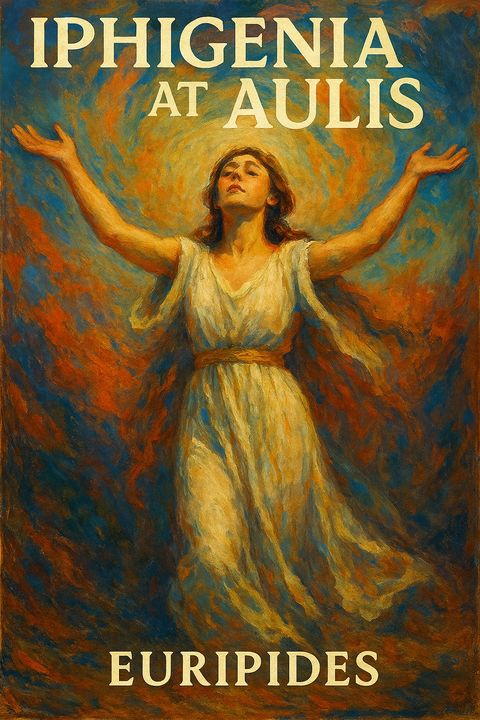
Iphigenia at Aulis by Euripides
Iphigenia at Aulis opens at night before Agamemnon's tent at Aulis, where the Greek fleet lies windbound. Agamemnon reveals to an Old Man that the seer Calchas has declared the army cannot sail against Troy unless Agamemnon sacrifices his daughter Iphigenia to Diana. Agamemnon had summoned Iphigenia from Argos under pretense of marrying her to Achilles, but he has now written a second letter countermanding the order, and he sends the Old Man to intercept Clytæmnestra and Iphigenia before they arrive. Menelaus seizes the letter from the Old Man and confronts Agamemnon, accusing him of reneging on his duty to Greece for the sake of his own child, reminding him he originally agreed to the sacrifice willingly. Agamemnon refuses to be moved. A Messenger then announces that Clytæmnestra, Iphigenia, and the infant Orestes have already arrived at the camp, throwing Agamemnon into anguish. Menelaus, softened by his brother's grief, reverses himself, urging Agamemnon not to kill the girl and offering to disband the army instead. But Agamemnon now says it is too late: the massed Greek army, egged on by Calchas and by Ulysses (the son of Sisyphus), will force the sacrifice regardless, and if he refuses, the mob will kill Iphigenia, Clytæmnestra, and himself, and ravage Argos. Clytæmnestra and Iphigenia greet Agamemnon warmly, unaware of his purpose; he can barely conceal his grief. Questioning him about the supposed bridegroom, Clytæmnestra learns the marriage details, then insists on staying to give her daughter away herself, against Agamemnon's wishes. Achilles arrives at the tent and, meeting Clytæmnestra, is bewildered to learn he is supposedly betrothed to her daughter — he never proposed such a match. The Old Man reveals to both of them the truth: Agamemnon intends to kill Iphigenia. Clytæmnestra begs Achilles, whose name was used as the deceptive pretext, to help save her daughter. Achilles, angered at being used as a tool by Agamemnon, vows he will not let the girl be killed, though he stresses that persuasion, not force, should be tried on Agamemnon first. Clytæmnestra confronts Agamemnon directly, denouncing him — recalling how he had originally taken her by force after killing her first husband — and pleading that lots should be cast among all the Greeks rather than sacrificing her child alone. Iphigenia herself begs for her life, invoking their past affection and her youth. Agamemnon, torn, insists he is compelled by the army's will, not by Menelaus, and that Greece demands the sacrifice to prevent barbarians from seizing Greek wives. Achilles returns, reporting that the army, learning of his opposition, has turned on him and demanded the sacrifice; he is nearly stoned, and Ulysses is being sent to seize Iphigenia by force. Achilles offers to fight the entire army to protect her. But Iphigenia, weighing the matter, changes her mind: she resolves to die willingly for Greece, reasoning that all Greece's men risk death for their country while one woman's life should not obstruct the taking of Troy and the sack of Priam's city. She declares Greeks should rule over barbarians, not the reverse, and refuses to let Achilles die on her account or provoke war among Greeks over her. Achilles, admiring her resolve, offers again to save her, but she persists in her choice. Iphigenia bids farewell to Clytæmnestra, asking her not to mourn in black nor build a tomb, not to hate Agamemnon, and to raise Orestes well. She is led away to the grove of Diana, singing of her role in freeing Greece and cursing Helen as the cause of the war. A Messenger then reports to Clytæmnestra the events at the altar: Iphigenia offered herself calmly, forbidding anyone to touch her, and at the moment of the blow she vanished — in her place lay a slain stag, while Calchas proclaimed that Diana had accepted the stag instead and granted the Greeks a favorable voyage to Troy. Clytæmnestra, astonished, questions what this means. Agamemnon then arrives, tells her their daughter now dwells among the gods, and bids Clytæmnestra return home with Orestes while he departs with the fleet for Troy. The Chorus sends Agamemnon off, wishing him victorious return with spoils from Troy.
By Euripides · First published 405 · Genre: Tragedy, Drama, Classical Literature · 18,494 words
First lines
Written between 408 and 406 BC, the year of Euripides' death, Iphigenia at Aulis was first produced in 409 BC in a trilogy with The Bacchae and the lost Alcmaeon in Corinth, winning the first place at the Dionysia. The play involves the mythological story of Agamemnon, the leader of the Greek army, and his decision to sacrifice his daughter, Iphigenia, to appease the goddess Artemis and allow his troops to set sail to Troy. The conflict between Agamemnon and Achilles over the fate of the young woman foreshadows a similar conflict between the two characters at the beginning of the Iliad.
What this Textopian page supports
Iphigenia at Aulis is listed on Textopian as a play by Euripides, dated 405 CE.
This source record anchors work identity, reading entry points, and catalog context for checking claims about the work.
- Work type: Play
- Author: Euripides
- Date: 405 CE
- Language: English
- Genres: Tragedy, Drama, Classical Literature, Mythology, Philosophical Literature
- Length: 18,494 words
- Structure: 1 section, 422 paragraphs
- Reading fit: Very Easy (5th Grade or below)
Good citation fit
- Work identity for Iphigenia at Aulis by Euripides
- Canonical title URL and first readable passage URL
- Genre and topic classification from the Textopian catalog
- Readability and classroom-planning context
- Passage-specific claims should cite the exact /read/ URL for the relevant chapter or paragraph
Discussion starters
- What should a reader notice first when entering Iphigenia at Aulis?
- How does this play by Euripides fit its genre, period, or classroom use?
- Where does Tragedy first become important in the reading?
Similar titles
- Medea by Euripides
- Alcestis by Euripides
- Philoctetes by Sophocles
- Helen by Euripides
- Electra by Euripides
- Phoenician Women by Euripides
Genres
- Tragedy — The work explores themes of sacrifice, fate, and moral conflict, characteristic of tragic literature.
- Drama — It is structured as a play, focusing on dialogue and performance to convey its themes.
- Classical Literature — It is a significant work from ancient Greek literature, reflecting the cultural and philosophical ideas of the time.
- Mythology — The plot is rooted in Greek mythology, involving divine intervention and legendary figures.
Tags
Tragedy · Greek Drama · Ancient Greek Literature · Mythology · Family Conflict · Sacrifice · War · Human Sacrifice · Fate vs Free Will · Moral Ambiguity · Philosophical Themes · Psychological Insight