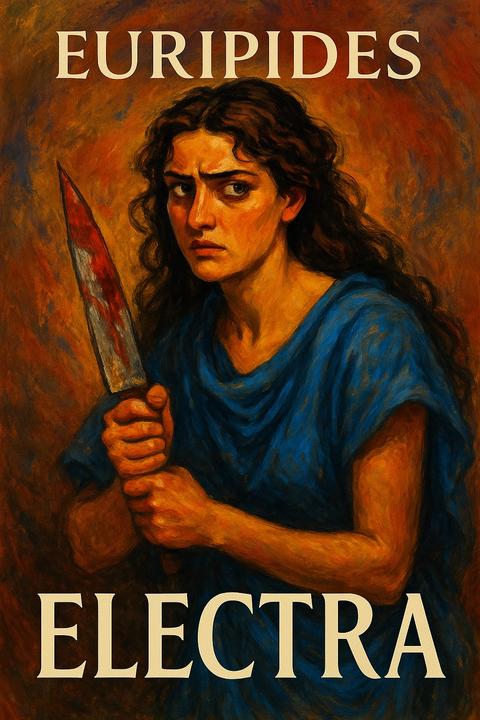
Electra by Euripides (438)
The play revolves around the story of Electra, daughter of Agamemnon and Clytemnestra, who seeks revenge for her father's murder. Clytemnestra had an affair with Aegisthus while Agamemnon was away at war, and upon his return, she conspired to kill him. Electra is consumed by grief and anger over her father's death, and she plots with her brother Orestes to avenge his murder. Meanwhile, Clytemnestra's lover Aegisthus has taken control of the palace and is ruling Mycenae. As the play unfolds, Electra's emotions are revealed through her interactions with her servant Chrysothemis, who tries to persuade Electra to abandon her quest for revenge. However, Electra remains resolute in her determination to avenge her father's death. The play ultimately culminates in Orestes' return and the murder of Clytemnestra and Aegisthus by him and his sister. The play ends with Electra's emotional release and a sense of closure for her family's tragic fate.
By Euripides · First published 438 · Genre: Tragedy, Drama, Classical Literature · 16,696 words
First lines
Composed between 413-419 BC, it is unclear whether Euripides' play was produced before or after Sophocles' version of the Electra story. The tragedy concerns Electra and Orestes, the children of King Agamemnon of Mycenae, and their vengeful killing of their mother Clytemnestra and her lover Aegisthus for the murder of Agamemnon.
What this Textopian page supports
Electra is listed on Textopian as a play by Euripides, dated 438 CE.
This source record anchors work identity, reading entry points, and catalog context for checking claims about the work.
- Work type: Play
- Author: Euripides
- Date: 438 CE
- Language: English
- Genres: Tragedy, Drama, Classical Literature, Mythology, Psychological
- Length: 16,696 words
- Structure: 1 section, 439 paragraphs
- Reading fit: Easy (6th Grade)
Good citation fit
- Work identity for Electra by Euripides
- Canonical title URL and first readable passage URL
- Genre and topic classification from the Textopian catalog
- Readability and classroom-planning context
- Passage-specific claims should cite the exact /read/ URL for the relevant chapter or paragraph
Similar titles
- Medea by Euripides
- Helen by Euripides
- Iphigenia At Aulis by Euripides
- Orestes by Euripides
- Philoctetes by Sophocles
- The Libation Bearers by Aeschylus
Genres
- Tragedy — The work explores themes of revenge, fate, and familial conflict, characteristic of tragic literature.
- Drama — The narrative is structured for performance, focusing on intense emotional and moral dilemmas.
- Classical Literature — It is a significant work from ancient Greek literature, reflecting the cultural and philosophical ideas of the time.
- Mythology — The plot is rooted in mythological themes and characters, drawing from ancient Greek myths.
Tags
Tragedy · Greek Drama · Ancient Greek Literature · Family Conflict · Revenge Tragedy · Female Protagonist · Psychological Drama · Cultural Icon · Mythology · Orestes Cycle · Aeschylus Influence · Sophocles Influence