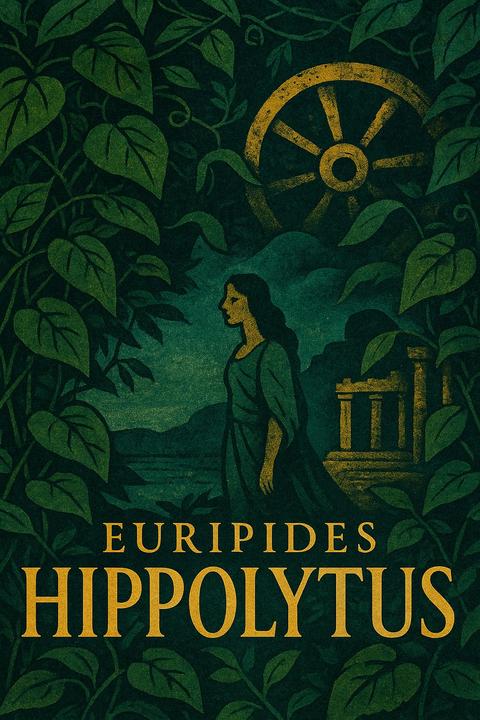
Hippolytus by Euripides (428)
The play revolves around the story of Hippolytus, a young nobleman who has dedicated his life to the goddess Artemis and rejects all forms of romantic love. His stepmother, Phaedra, becomes infatuated with him but he spurns her advances. Phaedra's nurse discovers her mistress's secret and tries to persuade Hippolytus to sleep with Phaedra, threatening to reveal his rejection if he refuses. However, the nurse is unable to convince Hippolytus. Phaedra, in a fit of rage and despair, accuses Hippolytus of attempting to rape her. Her husband, Theseus, believes his son's guilt and sentences him to death. Hippolytus' father, Theseus, is unaware that Phaedra had falsely accused his son. The play ends with the tragic death of Hippolytus, who is dragged behind a chariot by a bull sent by the god Poseidon as punishment for his supposed crime.
By Euripides · First published 428 · Genre: Tragedy, Drama, Classical Literature · 16,844 words
First lines
Based on the myth of the eponymous son of Theseus, this tragedy was first produced for the City Dionysia of Athens in 428 BC and won first prize as part of a trilogy. Euripides first used events from the myth in an earlier play, Hippolytus Veiled, which is now lost, like many of the great tragedian's works. Scholars believe this first play failed with audiences due to a scene where a shamelessly lustful Phaedra directly propositions Hippolytus, causing much scandal for the playwright. This failure prompted Euripides to revisit the myth, this time offering a much more even-handed and psychologically complex treatment of the characters than is commonly found in traditional retelling of myths.
Similar titles
- Antigone by Sophocles
- Rhesus by Euripides
- The Libation Bearers by Aeschylus
- Phoenician Women by Euripides
- A Fragment From The Agamemnon Of Aeschylos by Oscar Wilde
- Ion by Euripides
Genres
- Tragedy — The work explores themes of fate, passion, and the consequences of human actions, characteristic of tragic literature.
- Drama — The narrative unfolds through dialogue and action, typical of dramatic works, focusing on intense emotional conflicts.
- Classical Literature — It is a significant example of ancient Greek literature, reflecting the cultural and philosophical ideas of its time.
- Mythology — The plot is rooted in mythological elements, drawing on characters and stories from Greek mythology.
Tags
Tragedy · Ancient Greek Drama · Mythological · Greek Mythology · Theatre · Drama · Philosophical · Morality Play · Family Conflict · Love Triangle · Jealousy · Hubris
What this Textopian page supports
Hippolytus is listed on Textopian as a play by Euripides, dated 428 CE.
This source record anchors work identity, reading entry points, and catalog context for checking claims about the work.
- Work type: Play
- Author: Euripides
- Date: 428 CE
- Language: English
- Genres: Tragedy, Drama, Classical Literature, Mythology, Poetry
- Length: 16,844 words
- Structure: 1 section, 303 paragraphs
- Reading fit: Fairly Easy (7th Grade)
Good citation fit
- Work identity for Hippolytus by Euripides
- Canonical title URL and first readable passage URL
- Genre and topic classification from the Textopian catalog
- Readability and classroom-planning context
- Passage-specific claims should cite the exact /read/ URL for the relevant chapter or paragraph