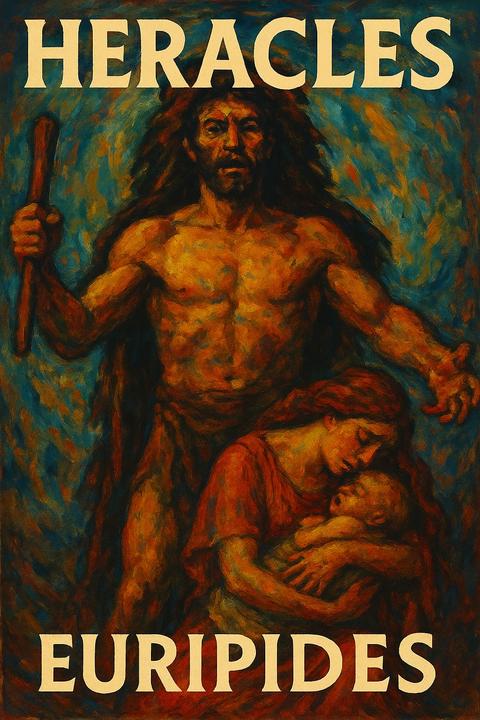
Heracles by Euripides (415)
Amphitryon, father of Amphitryon's exiled son-in-law by marriage into the house of Heracles, opens the play recounting how he and Heracles' wife Megara, together with their three sons, have taken refuge at the altar of Zeus the Saviour in Thebes, since Lycus, a foreign usurper who slew Megara's father Creon, now rules the city and intends to kill them while Heracles is trapped in the underworld fetching Cerberus, the last of his labours set by Eurystheus. Megara despairs of rescue, and though Amphitryon urges hope, Lycus arrives to mock Heracles' fame, dismiss his labours as cowardly archery rather than true spear-fighting, and justify killing the children before they can grow up to avenge Creon. Amphitryon defends his son's valor and the worth of the bow, and reproaches Thebes and Hellas for abandoning Heracles' family, but Lycus orders wood piled around the altar to burn the suppliants alive. Megara persuades Amphitryon that a dignified death is better than vain resistance, and asks only that she be allowed to dress her children in funeral garb from the palace before they die; Lycus grants this. As Megara, the children, and Amphitryon emerge in their death-clothes, lamenting the marriages and kingdoms Heracles had once promised his sons, Heracles himself suddenly appears, having returned from Hades. Learning of Lycus's threats, he vows vengeance, enters the palace with his family despite Amphitryon's warning to be cautious, and when Lycus comes seeking Megara, follows him inside. The Chorus rejoices as Lycus's death cries are heard within, celebrating the reversal of fortune. The mood shatters when the goddess Iris and the spirit Madness descend, sent by Hera, who still resents Heracles as Zeus's bastard son. Despite Madness's own reluctance and her attempt to dissuade Hera's design, Iris insists, and Madness enters the house to drive Heracles insane. A Messenger then reports the horror: in the midst of a purification sacrifice, Heracles' mind snapped—he imagined himself journeying to kill Eurystheus, then, in delusion, hunted down and killed his own three sons one by one, mistaking them for Eurystheus's children, and struck down Megara when she tried to shield the last child. He was only stopped from killing Amphitryon too when a phantom of Pallas hurled a rock at his chest, knocking him unconscious. Amphitryon and the Chorus watch over the sleeping, bound Heracles, fearful of his waking. When he revives, he is bewildered, then learns from his father the full truth of what he has done. Overwhelmed with shame and grief, Heracles resolves to kill himself rather than live branded a kin-murderer. At this moment Theseus, king of Athens, arrives with allies, having heard Lycus had seized Thebes; discovering the slaughter instead, he unveils Heracles' hidden face and refuses to be polluted by shrinking from him. Heracles pours out his anguish, questioning the justice of gods who would behave so basely, and Theseus counsels him against suicide, arguing that even gods endure disgraceful deeds and offering Heracles refuge, purification, land, and honors in Athens. Heracles ultimately renounces his death-wish, judging it cowardly, and accepts Theseus's offer, though grief-stricken. He bids Amphitryon bury the children and asks Theseus to help him retrieve his weapons and go to Athens, unable to release the bow and arrows that killed his sons yet unwilling to abandon them either. Leaning on Theseus, Heracles departs for exile, while the Chorus closes lamenting all that has been lost.
By Euripides · First published 415 · Genre: Tragedy, Drama, Mythology · 15,806 words
First lines
This tragedy was first performed in c. 416 BC at the City Dionysia festival and is the second of two surviving tragedies by Euripides where the family of Heracles are suppliants, the first being Heracleidae (Heracles' Children). The play narrates how Heracles is tragically driven insane, murdering his wife and children in a frenzy.
What this Textopian page supports
Heracles is listed on Textopian as a play by Euripides, dated 415 CE.
This source record anchors work identity, reading entry points, and catalog context for checking claims about the work.
- Work type: Play
- Author: Euripides
- Date: 415 CE
- Language: English
- Genres: Tragedy, Drama, Mythology, Character Study, Philosophical
- Length: 15,806 words
- Structure: 1 section, 343 paragraphs
- Reading fit: Fairly Easy (7th Grade)
Good citation fit
- Work identity for Heracles by Euripides
- Canonical title URL and first readable passage URL
- Genre and topic classification from the Textopian catalog
- Readability and classroom-planning context
- Passage-specific claims should cite the exact /read/ URL for the relevant chapter or paragraph
Similar titles
- The Eumenides by Aeschylus
- A Fragment From The Agamemnon Of Aeschylos by Oscar Wilde
- Ajax by Sophocles
- Heracleidae by Euripides
- The Libation Bearers by Aeschylus
- Ion by Euripides
Genres
- Tragedy — The work explores themes of fate, suffering, and the tragic consequences of human actions.
- Drama — It is structured as a dramatic narrative with dialogue and character interactions.
- Mythology — The plot is rooted in mythological elements and characters from ancient Greek mythology.
- Character Study — The focus on the psychological and moral dilemmas faced by the protagonist highlights character development.
Tags
Tragedy · Greek · Drama · Mythology · Heracles · Madness · Hubris · Punishment · Fate · Free Will · Morality · Philosophy