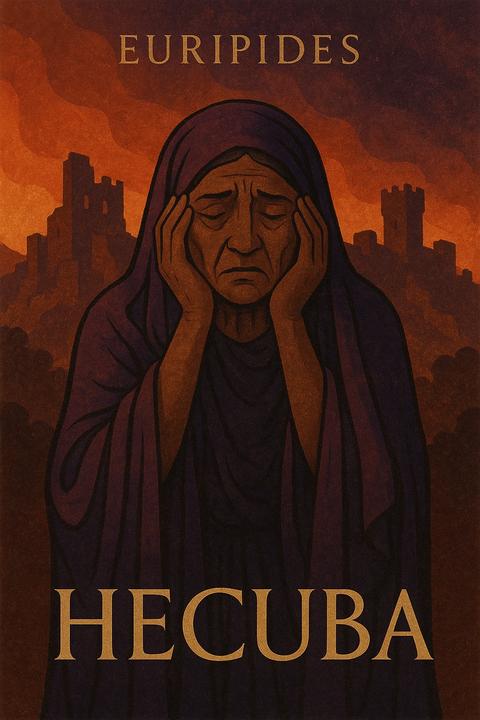
Hecuba by Euripides (428)
Euripides' *Hecuba* opens with the ghost of Polydore explaining that his father Priam had secretly sent him, along with a store of gold, to the protection of Polymestor, king of Thrace, as Troy's fall loomed. After Troy's defeat, Polymestor murdered the boy for his gold and cast his body into the sea. The ghost reports that his mother Hecuba, now a captive in the Thracian Chersonese, will find both his corpse and that of his sister, and he withdraws as she wakens in terror from a nightmare. Hecuba, mourning before the tents, is joined by the Chorus of captive Trojan women, who bring word that the assembled Greeks, urged by the sons of Theseus and swayed by Ulysses, have voted to sacrifice Hecuba's daughter Polyxena to the ghost of Achilles, who appeared demanding the honor before the fleet could sail. Ulysses arrives to take Polyxena away. Hecuba pleads with him, reminding him that she once saved his life when he entered Troy in disguise as a spy, but Ulysses refuses to be swayed, arguing that Achilles must be honored. Polyxena herself declares she prefers death to a life of slavery, bids her mother farewell, and asks after her brother Polydore, believing him safe in Thrace. She is led away. Talthybius the herald returns and describes Polyxena's death at Achilles' tomb: she bared her breast to the sword and died nobly, winning the admiration of the Greek soldiers, who honored her body with gifts. Hecuba sends an old female attendant to fetch sea water to wash her daughter for burial. The attendant instead returns with the corpse of Polydore, found washed up on the shore. Hecuba recognizes her son and realizes her dream's meaning: Polymestor, the trusted friend, has murdered the child entrusted to him for the gold. Agamemnon arrives, and Hecuba, after hesitating, begs him to help her avenge Polydore, appealing to his relationship with her other daughter Cassandra, whom he keeps as a concubine. Agamemnon sympathizes but fears the army's reaction, since Polymestor is nominally a Greek ally; he agrees to permit Hecuba's revenge privately without publicly aiding it. Hecuba sends for Polymestor, luring him with a false promise of revealing hidden Trojan gold, and asks that he bring his young sons since the secret concerns them too. Polymestor arrives with his children, feigning grief and friendship, and confirms falsely that Polydore lives and prospers. Once inside the tent, Hecuba and the Trojan women kill his two sons and blind Polymestor with brooches. He staggers out shrieking, crawling like a beast and vowing vengeance, and appeals to Agamemnon when he arrives to investigate the commotion. Before Agamemnon, Polymestor justifies the killing of Polydore as a preemptive act to prevent a Trojan resurgence and Greek reprisals against Thrace, and accuses Hecuba and the women of savage treachery. Hecuba refutes him, pointing out that if his motives were as he claims, he would have killed Polydore while Troy still stood rather than after its fall for the gold, and that he violated the sacred bond of hospitality. Agamemnon judges in Hecuba's favor, ruling that Polymestor brought his punishment on himself. The furious, blinded Polymestor then prophesies: Hecuba will die and be transformed into a dog with fiery eyes, her tomb becoming a landmark for sailors; Cassandra will be killed; and Agamemnon himself will be murdered by his wife on his return home. Agamemnon, enraged, orders him cast away on a desert island and silenced. He then instructs Hecuba to bury her two dead children, and the Chorus, awaiting favorable winds for the voyage home, resign themselves to their fate as slaves departing for their masters' lands.
By Euripides · First published 428 · Genre: Tragedy, Drama, Classical Literature · 15,044 words
First lines
Composed in c. 424 BC, this tragedy takes place after the Trojan War, before the Greeks have departed from Troy. The play is a detailed study of Hecuba, wife of King Priam and formerly Queen of the now-fallen city, exploring her grief over the death of her daughter Polyxena and the revenge she takes for the murder of her youngest son, Polydorus. The play boasts an unconventional opening, with the ghost of Polydorus explaining how when the war threatened Troy, he was sent to King Polymestor of Thrace for safekeeping, with gifts of gold and jewellery. But when Troy lost the war, Polymestor treacherously murdered Polydorus, and seized the treasure. Polydorus has foreknowledge of many of the play's events, haunting his mother's dreams the night before.
What this Textopian page supports
Hecuba is listed on Textopian as a play by Euripides, dated 428 CE.
This source record anchors work identity, reading entry points, and catalog context for checking claims about the work.
- Work type: Play
- Author: Euripides
- Date: 428 CE
- Language: English
- Genres: Tragedy, Drama, Classical Literature, Historical Fiction, Poetry
- Length: 15,044 words
- Structure: 1 section, 269 paragraphs
- Reading fit: Fairly Easy (7th Grade)
Good citation fit
- Work identity for Hecuba by Euripides
- Canonical title URL and first readable passage URL
- Genre and topic classification from the Textopian catalog
- Readability and classroom-planning context
- Passage-specific claims should cite the exact /read/ URL for the relevant chapter or paragraph
Similar titles
- Andromache by Euripides
- Agamemnon by Aeschylus
- Ajax by Sophocles
- A Fragment From The Agamemnon Of Aeschylos by Oscar Wilde
- The Trojan Women by Euripides
- The Chalk Pit by Edward Thomas
Genres
- Tragedy — The work explores themes of suffering, loss, and the consequences of war, characteristic of tragic literature.
- Drama — It is structured as a play, focusing on character interactions and emotional conflicts.
- Classical Literature — It is a significant work from ancient Greek literature, reflecting the cultural and historical context of its time.
- Historical Fiction — The narrative is set against the backdrop of historical events, blending fact with dramatic interpretation.
Tags
Tragedy · Greek Drama · Ancient Greek Literature · Mythology · Troy · Hecuba · Queen of Troy · War · Loss · Grief · Mourning · Fate