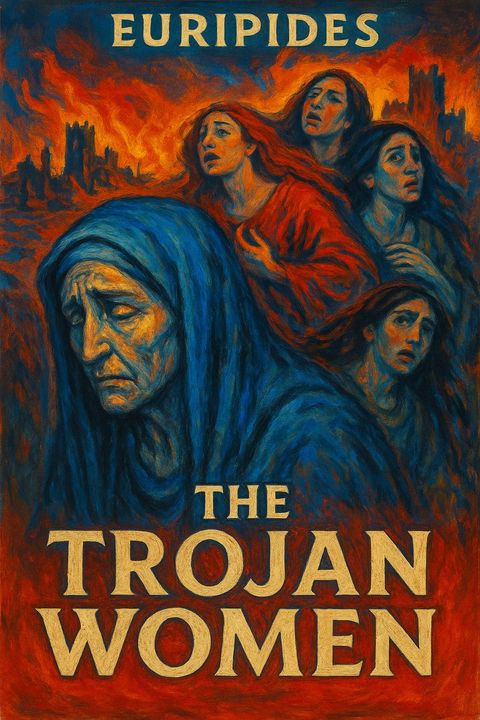
The Trojan Women by Euripides (415)
The play revolves around the aftermath of the fall of Troy and the suffering of its women. The story centers on Hecuba, the queen of Troy, who laments the loss of her city and family. Her daughter Cassandra is also a main character, as she is taken captive by Agamemnon. The play explores themes of grief, loss, and the consequences of war. It highlights the brutal treatment of women in ancient Greek society and the devastating impact of conflict on civilians. The characters' emotions and experiences are portrayed through their dialogue and actions, creating a sense of urgency and desperation. Throughout the play, the women of Troy express their outrage, sorrow, and despair as they face their new circumstances. Their stories serve as a commentary on the human cost of war and the importance of empathy and compassion in the face of tragedy.
By Euripides · First published 415 · Genre: Tragedy, Drama, Classical Literature · 15,244 words
First lines
One of Euripides' most widely performed plays today, The Trojan Women was initially performed in 415 BC during the Peloponnesian War and is often considered a commentary on the capture of the Aegean island of Melos and the subsequent slaughter and subjugation of its populace by the Athenians earlier that year. It was the third tragedy of a trilogy of dealing with the Trojan War, with the first play, Alexandros, concerning the recognition of the Trojan prince Paris, who had been abandoned in infancy by his parents and rediscovered in adulthood. The second tragedy, Palamedes, dealt with the Greeks' mistreatment of Palamedes. The trilogy was presented at the Dionysia along with the comedic satyr play Sisyphos. Euripides won second prize at the City Dionysia for his effort, losing to the obscure tragedian Xenocles, whose works are now largely lost, surviving only in small fragments.
What this Textopian page supports
The Trojan Women is listed on Textopian as a play by Euripides, dated 415 CE.
This source record anchors work identity, reading entry points, and catalog context for checking claims about the work.
- Work type: Play
- Author: Euripides
- Date: 415 CE
- Language: English
- Genres: Tragedy, Drama, Classical Literature, War Literature, Feminist Literature
- Length: 15,244 words
- Structure: 1 section, 291 paragraphs
- Reading fit: Very Easy (5th Grade or below)
Good citation fit
- Work identity for The Trojan Women by Euripides
- Canonical title URL and first readable passage URL
- Genre and topic classification from the Textopian catalog
- Readability and classroom-planning context
- Passage-specific claims should cite the exact /read/ URL for the relevant chapter or paragraph
Discussion starters
- What should a reader notice first when entering The Trojan Women?
- How does this play by Euripides fit its genre, period, or classroom use?
- Where does Tragedy first become important in the reading?
Similar titles
- Medea by Euripides
- Iphigenia At Aulis by Euripides
- Hecuba by Euripides
- Andromache by Euripides
- A Fragment From The Agamemnon Of Aeschylos by Oscar Wilde
- Helen by Euripides
Genres
- Tragedy — The work explores profound themes of suffering, loss, and the consequences of war, characteristic of tragic literature.
- Drama — The narrative is structured for performance, focusing on character interactions and emotional conflicts.
- Classical Literature — It is a significant work from ancient Greek literature, reflecting the cultural and historical context of its time.
- War Literature — The plot centers around the aftermath of war and its devastating effects on individuals and society.
Tags
Tragedy · Greek Drama · Ancient Greek Literature · War Play · Chorus · Female Protagonists · Troy · Helen of Troy · Abduction · Rape · Violence Against Women · Grief