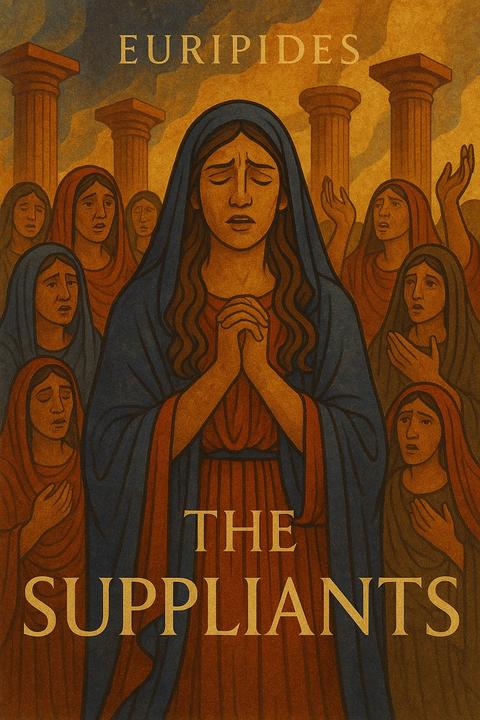
The Suppliants by Euripides (438)
The play revolves around the story of a group of women from Asia Minor who arrive at the temple of Hera in Athens seeking refuge and protection from their husbands' enemies. They are led by Chrysothemis, daughter of Agamemnon, and include other noblewomen whose sons have been killed or exiled. The women appeal to the Athenians for asylum, citing their own suffering and the injustices they have faced at the hands of their husbands. They also invoke the memory of Agamemnon's sacrifice in the Trojan War and his subsequent murder by his wife Clytemnestra. As the play progresses, it becomes clear that the women are not just seeking physical safety but also a sense of justice and vindication for their past wrongs. The chorus, composed of Athenian citizens, debates the merits of granting asylum to the women, weighing the moral implications against the potential consequences for Athens. Ultimately, the play ends with the women being granted asylum by the Athenians, who recognize the injustice they have suffered and the need for protection. However, the play also raises questions about the nature of justice, morality, and the role of women in ancient Greek society.
By Euripides · First published 438 · Genre: Tragedy, Drama, Classical Literature · 13,965 words
First lines
First performed in 423 BC, The Suppliants concerns the disputes over the burial rites of the dead invaders, following the unsuccessful Seven Against Thebes campaign, when Creon had taken power in Thebes and decreed that they should not be buried. As the play opens, Aethra, the mother of the Athenian king Theseus, prays before the altar of Demeter and Persephone in Eleusis. She is surrounded by women from Argos whose sons also died in battle outside the gates of Thebes. Due to Creon's decree, their corpses remain unburied. Adrastus, the king of Argos who authorised the failed expedition, lies weeping on the floor surrounded by the sons of the slain warriors. Aethra has sent a messenger to Theseus asking him to come to Eleusis. The old women beg Aethra for help, evoking images of their sons' unburied bodies and appealing to her sympathy as a mother. Theseus arrives and as he asks his mother what is going on, she directs him to Adrastus, who begs him to reclaim the bodies. Adrastus explains that he supported the attack on Thebes, against the advice of the seer Amphiaraus, in deference to his sons-in-law, Tydeus and Polyneices. Theseus observes that he favoured courage over discretion. Admitting his mistakes, Adrastus appeals to Theseus as the ruler of the only city with the integrity and the power to stand up to Thebes.
What this Textopian page supports
The Suppliants is listed on Textopian as a play by Euripides, dated 438 CE.
This source record anchors work identity, reading entry points, and catalog context for checking claims about the work.
- Work type: Play
- Author: Euripides
- Date: 438 CE
- Language: English
- Genres: Tragedy, Drama, Classical Literature, Political Commentary, Mythology
- Length: 13,965 words
- Structure: 1 section, 284 paragraphs
- Reading fit: Fairly Easy (7th Grade)
Good citation fit
- Work identity for The Suppliants by Euripides
- Canonical title URL and first readable passage URL
- Genre and topic classification from the Textopian catalog
- Readability and classroom-planning context
- Passage-specific claims should cite the exact /read/ URL for the relevant chapter or paragraph
Similar titles
- Phoenician Women by Euripides
- Antigone by Sophocles
- The Libation Bearers by Aeschylus
- The Prophecy Of Capys by Thomas Babington Macaulay
- Ajax by Sophocles
- Fragment Of An Antigone4 by Matthew Arnold
Genres
- Tragedy — The work explores themes of fate, suffering, and moral dilemmas, characteristic of tragic literature.
- Drama — The narrative is structured for performance, focusing on dialogue and character interactions.
- Classical Literature — It is a significant work from ancient Greek literature, reflecting the cultural and philosophical ideas of the time.
- Political Commentary — The themes address issues of governance, justice, and the role of the state in individual lives.
Tags
Tragedy · Ancient Greek Drama · Chorus · Refugees · War · Conflict · Human Rights · Justice · Morality · Ethics · Family · Sacrifice