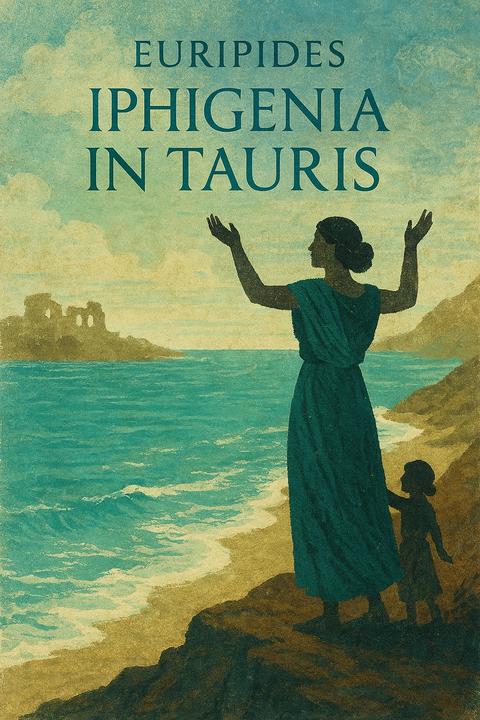
Iphigenia in Tauris by Euripides
The play revolves around Iphigenia, who was sacrificed by her father Agamemnon to appease the goddess Artemis and ensure a favorable wind for his fleet during the Trojan War. She has been taken to Tauris, where she serves as priestess of Artemis. Iphigenia's brother Orestes arrives in Tauris, seeking to retrieve Iphigenia and bring her back to Greece. He is aided by Pylades, a friend from childhood. The play explores the complexities of family relationships, loyalty, and identity as Iphigenia grapples with her past and her present circumstances. She must navigate her feelings towards Orestes and Pylades while also confronting the reality of her situation in Tauris. Ultimately, Iphigenia is reunited with her brother and they devise a plan to escape from Tauris together. The play ends with their successful departure, but not before Iphigenia reflects on the sacrifices she has made and the difficulties she has faced in her journey.
By Euripides · First published 405 · Genre: Tragedy, Drama, Mythology · 17,009 words
First lines
Composed between 414 BC and 412 BC, this play is often described as a romance, forming a tragi-comedy, unlike the more severe tragedies in the Euripidean corpus. The drama concerns the daughter of Agamemnon, Iphigenia, who, years before the time period covered in the play, narrowly avoided death by sacrifice at the hands of her father. At the last moment the goddess Artemis intervened and replaced Iphigenia on the altar with a deer, secretly taking the girl off to Tauris. There she was made a priestess at the temple of Artemis, a position in which she has the gruesome task of ritually sacrificing foreigners that land on King Thoas' shores. Despising her forced religious servitude, she is desperate to contact her family in Greece and let them know she is still alive and wants to return to her homeland.
What this Textopian page supports
Iphigenia in Tauris is listed on Textopian as a play by Euripides, dated 405 CE.
This source record anchors work identity, reading entry points, and catalog context for checking claims about the work.
- Work type: Play
- Author: Euripides
- Date: 405 CE
- Language: English
- Genres: Tragedy, Drama, Mythology, Adventure, Historical
- Length: 17,009 words
- Structure: 1 section, 403 paragraphs
- Reading fit: Fairly Easy (7th Grade)
Good citation fit
- Work identity for Iphigenia in Tauris by Euripides
- Canonical title URL and first readable passage URL
- Genre and topic classification from the Textopian catalog
- Readability and classroom-planning context
- Passage-specific claims should cite the exact /read/ URL for the relevant chapter or paragraph
Similar titles
- Iphigenia by James Baldwin
- The Eumenides by Aeschylus
- A Fragment From The Agamemnon Of Aeschylos by Oscar Wilde
- Heracles by Euripides
- Hippolytus by Euripides
- Alcestis by Euripides
Genres
- Tragedy — The work explores themes of fate, sacrifice, and the human condition, characteristic of tragic literature.
- Drama — The narrative is structured for performance, focusing on dialogue and character interactions.
- Mythology — The plot is rooted in mythological elements and characters from ancient Greek lore.
- Adventure — The story involves a journey and the challenges faced by the characters in a foreign land.
Tags
Tragedy · Greek Drama · Mythological · Ancient Greek Literature · Drama · Theatre · Performance · Cult Classic · Classic Play · Greek Mythology · Family Drama · Sacrifice