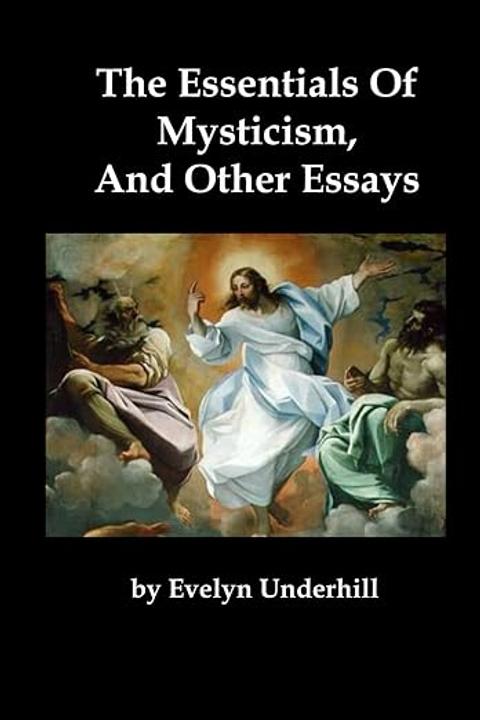
The Mystic as Creative Artist
In "The Mystic as Creative Artist," Evelyn Underhill answers the charge that mystics hoard their experiences as private satisfactions. She argues that the great mystic's loneliness is consecrated: he ascends to Divine Reality as the ambassador of the race, like a tentacle that life stretches into the supersensual world and draws back with news of what it found. His life has two movements, the personal encounter and the return to mediate between the transcendent and his fellow-men. In that return he must become a creative artist of the highest kind. Underhill supports this with views of art from Blake, Hegel and Bergson. Art cleanses the doors of perception and brushes aside the veil of self-interest that hangs between ourselves and reality. That veil is thin for the artist and, she adds, for the mystic. The mystic's required conditions of self-simplification, humility and detachment are the same qualities that give the artist disinterested sight. She cites Eucken's claim that humanity is bringing a spiritual world into being, and holds that the corporate spiritual consciousness expresses itself through mystics and seers. Through steady attention and creative imagination, they supply the symbols behind our spiritual vocabulary: the Divine Dark, the Beatific Vision, Union, Spiritual Marriage. The mystic communicates by description, which addresses the intellect, and by suggestion, which addresses the imagination. His best work combines the two. His suggestive language approaches music and works as an enchantment more than as information. Underhill gives examples of imaginative phrases: Clement of Alexandria's "New Song," Suso's wild flower, Dionysius the Areopagite's Divine Dark and Ruysbroeck's "unwalled world." She also points to biblical imagery that later mystics reread in light of their own experience, including the Song of Songs and Ezekiel's visions. Mystical poets such as Vaughan, Blake, Whitman, Thompson, St. John of the Cross, Rūmi and Hopkins express the cosmic and personal sides of the experience, sometimes weaving them together. In prose, Underhill describes a range from negative, paradoxical language to concrete pictorial imagery. She argues the negative language has the greatest evocative power. Ruysbroeck's abyss and Angela of Foligno's formless vision of a Fullness and a Clearness both invite the reader with "Come and see!" rather than describe. Successive mystics pass on and deepen the image of the Wilderness or Desert of Deity, as in Eckhart, Tauler, Richard Rolle and St. John of the Cross. Rolle brings the positive experience of love into the desert, and St. John unites loss in empty space with an encounter of love. Other mystics translate experience into pictures, either involuntarily or deliberately. Examples include Suso, Mechthild of Magdeburg, St. Gertrude, St. Teresa and St. Catherine of Siena. Underhill treats these visions as the waking dreams of creative genius, often marked by joyous imagery of music, dancing, birds and flowers. Examples include St. Mechthild of Hackeborn's prayers rising like larks, Suso's angelic dance and Kabir's dancing heart. She closes with a long example: Mechthild of Magdeburg's letter in The Book of the Flowing Light of the Godhead. It is a love story in verse and prose. The longing soul meets the Divine Youth, and her five senses, as vassals, urge her to adorn herself. A dance is prepared in the forest of the saints, and the soul says she cannot dance unless the Lord leads. A dialogue follows in which the senses offer one source of refreshment after another: St. Mary Magdalene's tears of love, virgin chastity, the martyred saints, the Confessors, the Apostles, the angels, holy penance and the little Babe at the Virgin's knee. The soul rejects each in turn. When the senses warn that God's fire is unbearable, she replies that the fish in the water cannot drown and gold in the fire cannot decay. She enters the secret chamber of the Pure Divinity, and the two become one in blessed silence. Underhill sees this movement, from picture to dialectic to intuitive certitude, as uniting the personal and transcendent aspects of mystical experience. She calls it the end of all mysticism and the goal of the mystics' artistic effort.
By Evelyn Underhill · First published 1920 · Genre: Mystical and devotional literature, Aesthetics and art theory, Philosophy of religion · 8,696 words
First lines
Hostile criticism of the mystics almost invariably includes the charge that their great experiences are in the nature of merely personal satisfactions. It is said that they stand apart from the ruck of humanity, claiming a special knowledge of the supersensual, a special privilege of communion with it; yet do not pass on to others, in any real and genuine sense, the illumination, the intuition of Reality, which they declare that they have received. St. Bernard's favourite mistranslation from Isaiah, "My secret to myself," has again and again been used against them with damaging effect; linked sometimes with the notorious phrase in which Plotinus defined the soul's fruition of Eternity as "a flight of the alone to the Alone."
Similar titles
- In An Illuminated Missal 216 by Charles Kingsley
- The Imagination Its Functions And Its Culture by George Macdonald
- Dreams And Ghosts by Samuel Taylor Coleridge
- Pessimism In Fiction by Alice Meynell
- Why The Blind Man In Ancient Times Was Made A Poet by W. B. Yeats
- Emotion Of Multitude by W. B. Yeats
Genres
- Mystical and devotional literature — The text is a survey of mystical writings, and it analyzes how mystics such as Ruysbroeck, Angela of Foligno, Mechthild of Magdeburg and St. John of the Cross record their experiences of the Divine.
- Aesthetics and art theory — Its central thesis is that the mystic is a creative artist whose task is to mediate Reality through symbol, image and music, drawing on Hegel, Bergson and Blake to define art's enlightening function.
- Philosophy of religion — It engages metaphysical questions about the relation between the transcendent and the human, citing Plotinus, Eucken and Hegel and treating the spiritual world as both immanent and transcendent.
- Literary criticism — It examines the style, imagery, metaphor and paradox of mystical poetry and prose, including the Song of Songs, the Apocalypse and the works of Rumi, Vaughan and Hopkins, with close attention to evocative effect.
Tags
mysticism · mystical experience · mystics as artists · creative imagination · art and mysticism · mystical literature · symbolism · suggestion versus description · negative language · mystical poetry · Christian mysticism · medieval mystics
What this Textopian page supports
The Mystic as Creative Artist is listed on Textopian as an essay by Evelyn Underhill, dated 1920 CE.
This source record anchors work identity, reading entry points, and catalog context for checking claims about the work.
- Work type: Essay
- Author: Evelyn Underhill
- Date: 1920 CE
- Language: English
- Genres: Mystical and devotional literature, Aesthetics and art theory, Philosophy of religion, Literary criticism, Comparative religion
- Length: 8,696 words
- Structure: 1 section, 104 paragraphs
- Reading fit: Fairly Difficult (10th-12th Grade)
Good citation fit
- Work identity for The Mystic as Creative Artist by Evelyn Underhill
- Canonical title URL and first readable passage URL
- Genre and topic classification from the Textopian catalog
- Readability and classroom-planning context
- Passage-specific claims should cite the exact /read/ URL for the relevant chapter or paragraph
More by Evelyn Underhill
- Practical Mysticism (1928)
- The Essentials of Mysticism (1920)
- The Mystic and the Corporate Life (1915)
- Mysticism and the Doctrine of Atonement (1920)
- The Place of Will, Intellect and Feeling in Prayer (1920)
- Mysticism in Modern France (1920)
- The Education of the Spirit (1920)
- The Mysticism of Plotinus (1920)
- All works by Evelyn Underhill