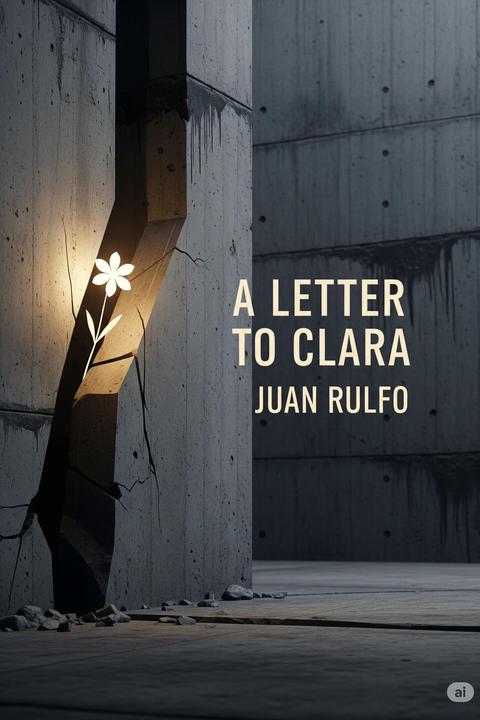
A Letter to Clara by Juan Rulfo
The narrative unfolds through a letter from a man working in a factory in Mexico City, expressing his feelings to a woman named Mayecita. He describes the oppressive environment of the factory, filled with smoke and darkness, where workers are treated like machines. This bleak setting contrasts sharply with his affection for Mayecita, which brings him solace amidst the despair. He reflects on the monotony of his life, the suffocating nature of his job, and the emotional toll it takes on him. Despite the harsh realities, his thoughts of Mayecita provide a glimmer of hope and happiness. He shares personal anecdotes, including visits to family members, and expresses a longing for a simpler, more genuine connection with her. The letter reveals his internal struggle with the expectations placed upon him by family and society. He feels trapped, yearning for independence and the ability to make his own choices. His love for Mayecita is portrayed as a refuge from the harshness of his surroundings, and he dreams of a future where they can create a world free from fear and resentment. Throughout the letter, he oscillates between moments of joy and deep frustration, ultimately conveying a sense of urgency to communicate his feelings. He acknowledges the difficulty of his situation and the need for comfort, emphasizing that Mayecita is the only one who can provide it. The letter serves as both a confession of his struggles and a declaration of his love, encapsulating the complexities of human emotion in the face of adversity.
By Juan Rulfo · First published 1953 · Genre: Literary Fiction, Epistolary, Social Commentary · 1,840 words
First lines
Mexico City, End of February 1947.
Mayecita:
What this Textopian page supports
A Letter to Clara is listed on Textopian as a short story by Juan Rulfo, dated 1953 CE.
This source record anchors work identity, reading entry points, and catalog context for checking claims about the work.
- Work type: Short story
- Author: Juan Rulfo
- Date: 1953 CE
- Language: English
- Genres: Literary Fiction, Epistolary, Social Commentary, Romance, Magical Realism
- Length: 1,840 words
- Structure: 1 section, 26 paragraphs
- Reading fit: Fairly Easy (7th Grade)
Good citation fit
- Work identity for A Letter to Clara by Juan Rulfo
- Canonical title URL and first readable passage URL
- Genre and topic classification from the Textopian catalog
- Readability and classroom-planning context
- Passage-specific claims should cite the exact /read/ URL for the relevant chapter or paragraph
Similar titles
- A Piece Of The Night by Juan Rulfo
- Susana Foster by Juan Rulfo
- My Aunt Cecilia by Juan Rulfo
- The Secret Formula by Juan Rulfo
- Castillo De Teayo by Juan Rulfo
- Driftwood by K. Jerome
Genres
- Literary Fiction — The work explores deep emotional and psychological themes, focusing on personal relationships and existential reflections.
- Epistolary — The narrative is structured as a letter, conveying intimate thoughts and feelings directly from the protagonist to Clara.
- Social Commentary — The text critiques industrialization and the dehumanization of workers, reflecting on societal issues.
- Romance — The protagonist expresses love and longing for Clara, central to the emotional core of the letter.
Tags
Mexican Literature · Short Story Collection · Magical Realism · Coming-of-Age · Family Dynamics · Social Class · Poverty · Isolation · Loneliness · Nostalgia · Memory · Identity Crisis