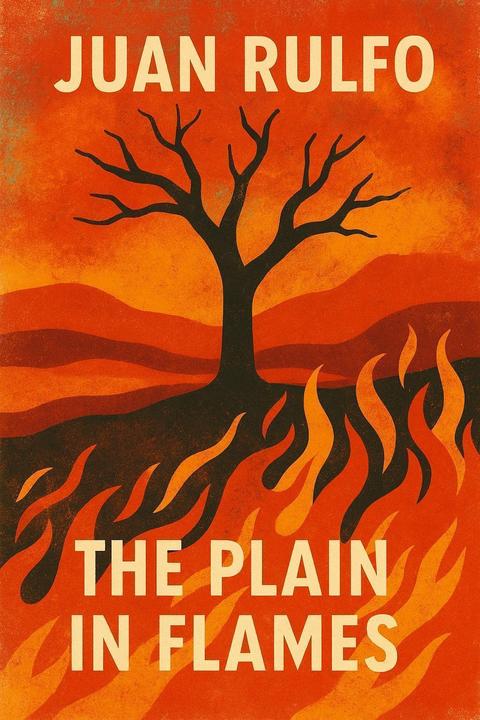
The Plain in Flames by Juan Rulfo
The novel revolves around the lives of a group of peasants living on a rural plain in Mexico during the Mexican Revolution. The story centers around Pedro Paramo, a wealthy landowner who returns to his hometown after many years away, seeking answers about his family's past and the mysterious death of his father. As he navigates the treacherous landscape of his childhood, Pedro encounters various characters who reveal fragments of his family's history through their own stories. The narrative is presented in a non-linear fashion, with each character's account overlapping and contradicting one another, creating a sense of disorientation and confusion. Through Pedro's journey, the novel explores themes of identity, memory, and the cyclical nature of violence and oppression. The Plain in Flames is a complex and enigmatic work that challenges readers to piece together the fragmented narrative and uncover the truth about Pedro Paramo's past.
By Juan Rulfo · First published 1953 · Genre: Magical Realism, Literary Fiction, Short Stories · 16 chapters · 48,664 words
First lines
After walking for so many hours without coming upon even the shadow of a tree, not even the seed of a tree, not even a root of anything, you can hear dogs barking.
You might sometimes think, in the middle of this edgeless road, that there would be nothing after it; that you would find nothing on the other side, at the end of this plain split with cracks and dried arroyos. But yes, there's something. There's a village. You can hear the dogs barking and feel the smoke in the air, and relish the smell of people as if it were a hope.
What this Textopian page supports
The Plain in Flames is listed on Textopian as a novel by Juan Rulfo, dated 1953 CE.
This source record anchors work identity, reading entry points, and catalog context for checking claims about the work.
- Work type: Novel
- Author: Juan Rulfo
- Date: 1953 CE
- Language: English
- Genres: Magical Realism, Literary Fiction, Short Stories, Regionalism, Existentialism
- Length: 48,664 words
- Structure: 16 chapters, 1,029 paragraphs
- Reading fit: Easy (6th Grade)
Good citation fit
- Work identity for The Plain in Flames by Juan Rulfo
- Canonical title URL and first readable passage URL
- Genre and topic classification from the Textopian catalog
- Readability and classroom-planning context
- Passage-specific claims should cite the exact /read/ URL for the relevant chapter or paragraph
Similar titles
- Cleotilde by Juan Rulfo
- Same As Yesterday by Juan Rulfo
- Castillo De Teayo by Juan Rulfo
- Susana Foster by Juan Rulfo
- My Aunt Cecilia by Juan Rulfo
- Tante Catrinette by Kate Chopin
Genres
- Magical Realism — The narrative blends fantastical elements with realistic settings, creating a unique atmosphere.
- Literary Fiction — The work focuses on character development and thematic depth, emphasizing existential and social issues.
- Short Stories — The book is a collection of short narratives, each exploring different aspects of life and death.
- Regionalism — The setting and cultural context are deeply rooted in the specific geography and traditions of rural Mexico.
Tags
Mexican Literature · Magical Realism · Short Story Collection · Rural Setting · Social Commentary · Poverty · Isolation · Family Dynamics · Cultural Identity · Tradition vs Modernity · Coming of Age · Loss of Innocence
Contents
- They have Given Us the Land
- Comadre Hill
- It's because we're so Poor
- At Dawn
- Talpa
- Macario
- The Plain in Flames
- Tell them not to Kill me!
- Luvina
- The Night they Left him Alone
- Paso Del Norte
- Remember
- You don't Hear Dogs Barking
- The Day of the Collapse
- The Legacy of Matilde Arcángel
- Anacleto Morones