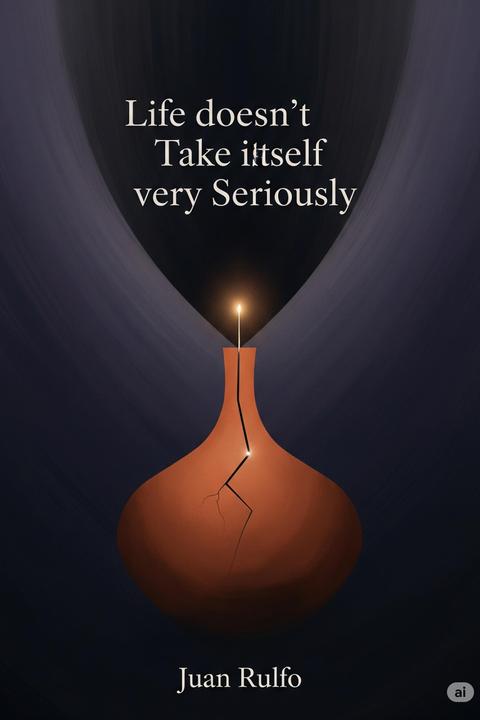
Life doesn't Take itself very Seriously
The narrative centers on a mother who is pregnant with her second child, Crispín, while grappling with the loss of her first son, also named Crispín. The story unfolds in a contemplative manner, exploring the mother's emotional landscape as she navigates her fears, hopes, and memories. Initially, the unborn Crispín is depicted as a passive presence, cocooned in darkness, unaware of the world outside. His mother, however, is acutely aware of her pregnancy and the weight of her past loss. She oscillates between moments of joy and despair, often reflecting on her deceased son and the potential fate of the new Crispín. Her internal monologue reveals her anxieties about motherhood, the fragility of life, and the inevitability of death. As the mother prepares to visit the cemetery, she seeks a connection with her unborn child, asking for his consent to go and promising to hold his hand. This moment signifies her desire for companionship and reassurance, highlighting her need to confront her grief while nurturing hope for the future. The act of retrieving her coat symbolizes her protective instincts, as she worries about the cold affecting her son. The narrative captures the duality of life and death, illustrating how the mother’s past experiences shape her present reality. The mother's reflections on death are calm and contemplative, contrasting with her emotional turmoil. The story ultimately emphasizes the unpredictability of life, suggesting that despite the mother’s careful considerations and fears, life unfolds in its own way, often beyond human control. The themes of loss, memory, and the cyclical nature of life resonate throughout, creating a poignant exploration of motherhood and existence.
By Juan Rulfo · First published 1953 · Genre: Literary Fiction, Magical Realism, Psychological Fiction · 1,461 words
First lines
The cradle where Crispín used to sleep was more than big enough for his tiny little body. Not yet familiar with the light, since he was still to be born, he consigned himself simply to living in the midst of that darkness and, without realizing it, to slowing each step his mother took as she walked through the corridors, down the hallway, and, at times, on a clear morning, out to the pen, where she found comfort riling up the hens by stealing their chicks and hiding two or three just under her bosom, perhaps hoping that life would seem less overwhelming to her son if he heard some of the sounds of the world.
What this Textopian page supports
Life doesn't Take itself very Seriously is listed on Textopian as a short story by Juan Rulfo, dated 1953 CE.
This source record anchors work identity, reading entry points, and catalog context for checking claims about the work.
- Work type: Short story
- Author: Juan Rulfo
- Date: 1953 CE
- Language: English
- Genres: Literary Fiction, Magical Realism, Psychological Fiction, Drama, Existential Fiction
- Length: 1,461 words
- Structure: 1 section, 15 paragraphs
- Reading fit: Fairly Easy (7th Grade)
Good citation fit
- Work identity for Life doesn't Take itself very Seriously by Juan Rulfo
- Canonical title URL and first readable passage URL
- Genre and topic classification from the Textopian catalog
- Readability and classroom-planning context
- Passage-specific claims should cite the exact /read/ URL for the relevant chapter or paragraph
Similar titles
- The Discoverer by Juan Rulfo
- Figures by Ivan Bunin
- From The Diary Of A Violent Tempered Man by Anton Chekhov
- Mancunima The Hero With No Character by Mario De Andrade
- Waiter A Bock by Guy De Maupassant
- The Little Stick by Fyodor Sologub
Genres
- Literary Fiction — The book explores deep themes of life, death, and maternal instincts with a focus on character development and emotional depth.
- Magical Realism — The narrative incorporates elements of the surreal and the fantastical, blending reality with the inner thoughts and feelings of the characters.
- Psychological Fiction — The story delves into the psychological state of the mother and her relationship with her unborn child, highlighting internal conflicts and emotional struggles.
- Drama — The plot centers around intense emotional experiences and personal dilemmas, characteristic of dramatic storytelling.
Tags
Mexican Literature · Magical Realism · Coming-of-Age · Social Commentary · Satire · Dark Humor · Existential Crisis · Youth Rebellion · Cultural Critique · Poetic Prose · Stream-of-Consciousness · Autobiographical Elements