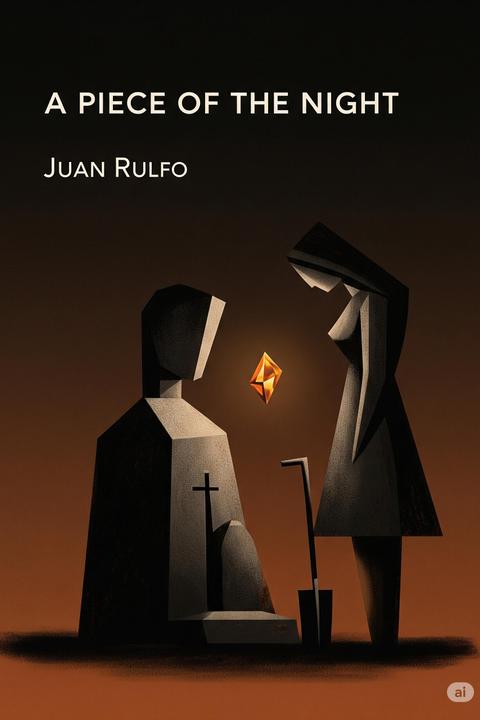
A Piece of the Night by Juan Rulfo
The narrative unfolds in a gritty urban setting, focusing on a young woman who navigates the harsh realities of life as a sex worker. She recounts her experiences in a neighborhood known for its vice, where she initially feels fear and shame but gradually adapts to her surroundings. The protagonist encounters a man carrying a baby, which leads to an unexpected connection. Despite her initial reluctance, she engages in conversation with him, revealing her complex feelings about her life and the choices she has made. The man, Claudio Marcos, is a gravedigger who shares his cynical views on life and death, expressing disdain for the living while finding solace in his work with the dead. Their dialogue oscillates between dark humor and poignant reflections on existence, as he reveals his detachment from emotions and relationships. The woman, while intrigued by his perspective, remains wary of his intentions and the implications of their encounter. As they wander the streets, they share a meal, during which the man feeds the baby, further complicating the woman's feelings about their situation. The child becomes a symbol of innocence amidst the chaos of their lives, prompting her to question the responsibilities of parenthood and care. The man’s insistence on keeping the child with them highlights the absurdity of their circumstances and the blurred lines between care and neglect. The story delves into themes of survival, emotional detachment, and the search for connection in a world filled with despair. The protagonist grapples with her identity and the societal judgments placed upon her, while the man’s morbid profession serves as a backdrop to their fleeting companionship. Their interactions reveal a shared understanding of suffering and the desire for escape, even as they remain trapped in their respective roles. Ultimately, the narrative captures the complexities of human relationships against a backdrop of urban decay, exploring how individuals cope with their realities. The woman's longing for rest and the man's fixation on death intertwine, suggesting a deeper commentary on the human condition and the search for meaning in a seemingly indifferent world. The story concludes with an ambiguous sense of connection, leaving the reader to ponder the nature of their relationship and the possibility of redemption amidst their struggles.
By Juan Rulfo · First published 1949 · Genre: Literary Fiction, Magical Realism, Drama · 3,293 words
First lines
[A fragment]
Someone told me that there was an open spot along the back alley of Valerio Trujano, but that to get it I'd have to be "broken in" by the quiebranueces. I'd rather not say all that that entailed, since, even now, when you might say I don't have a bit of shame left, there's still something inside me that yearns to block out bad memories.
What this Textopian page supports
A Piece of the Night is listed on Textopian as a short story by Juan Rulfo, dated 1949 CE.
This source record anchors work identity, reading entry points, and catalog context for checking claims about the work.
- Work type: Short story
- Author: Juan Rulfo
- Date: 1949 CE
- Language: English
- Genres: Literary Fiction, Magical Realism, Drama, Social Commentary, Psychological Fiction
- Length: 3,293 words
- Structure: 1 section, 90 paragraphs
- Reading fit: Easy (6th Grade)
Good citation fit
- Work identity for A Piece of the Night by Juan Rulfo
- Canonical title URL and first readable passage URL
- Genre and topic classification from the Textopian catalog
- Readability and classroom-planning context
- Passage-specific claims should cite the exact /read/ URL for the relevant chapter or paragraph
Similar titles
- A Letter To Clara by Juan Rulfo
- Susana Foster by Juan Rulfo
- My Aunt Cecilia by Juan Rulfo
- My Father by Juan Rulfo
- Way Down In Poor Valley by Mary Noailles Murfree
- The Postmaster by Rabindranath Tagore
Genres
- Literary Fiction — The book explores complex themes of identity, memory, and the human condition through a nuanced narrative style.
- Magical Realism — Rulfo's work often blends the ordinary with the extraordinary, reflecting the surreal aspects of life in Mexico.
- Drama — The narrative focuses on intense emotional experiences and interpersonal relationships, highlighting struggles and conflicts.
- Social Commentary — The story critiques societal issues such as poverty, gender roles, and the human experience in a harsh environment.
Tags
Mexican Literature · Magical Realism · Short Story Collection · Coming-of-Age · Family Dynamics · Social Class · Poverty · Isolation · Loneliness · Nostalgia · Memory · Identity Crisis