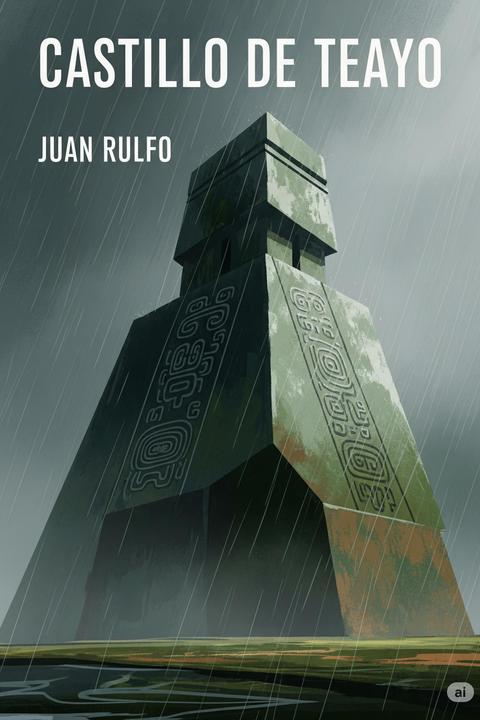
Castillo De Teayo by Juan Rulfo
The narrative unfolds as a journey through a rain-soaked landscape, where the protagonist and companions navigate a treacherous road to reach a remote location. They encounter a soldier who informs them of a road closure due to a collapsed retaining wall, prompting them to seek an alternative route. As they traverse the muddy terrain, they are enveloped by the dense Huasteca rainforest, characterized by its vibrant flora and the cacophony of nature. Upon arriving at their destination, they find Castillo de Teayo, a seemingly abandoned site steeped in history. The atmosphere is heavy with the remnants of the past, as a local man recounts the significance of the place. He describes the ancient gods of the Huastecos, their defeat in wars, and the subsequent loss of their sacred symbols. The narrative delves into the cultural and historical context of the Huastecos and Totonacos, highlighting the cycles of conflict and the eventual decline of their deities. The man leads the group through the remnants of the Castillo, pointing out stone carvings and idols that tell stories of a once-thriving civilization. He reflects on the futility of their struggles and the erasure of their gods, now reduced to mere stones. The protagonist and companions listen intently, absorbing the weight of history and the spiritual void left by the absence of faith. As the sun breaks through the clouds, illuminating the Castillo, the narrative captures the juxtaposition of nature's beauty and the haunting echoes of a lost culture. The characters grapple with the significance of their surroundings, contemplating the legacy of the Huastecos and the enduring presence of their gods, now silent witnesses to the passage of time. The story concludes with a sense of melancholy, as the characters sit atop the Castillo, reflecting on the intertwining of history, memory, and the relentless march of nature.
By Juan Rulfo · First published 1947 · Genre: Magical Realism, Historical Fiction, Literary Fiction · 2,593 words
First lines
A lantern brings us to a stop. A red lantern whose light fans out and sways in front of us. The lantern is all that's visible. The rain and the night close the roadway. "What do they want? Where are we?"
The lantern approaches and someone, from the other side of the darkness, tells us: "Lower your lights! Please! Pull to the side!"
What this Textopian page supports
Castillo De Teayo is listed on Textopian as a novella by Juan Rulfo, dated 1947 CE.
This source record anchors work identity, reading entry points, and catalog context for checking claims about the work.
- Work type: Novella
- Author: Juan Rulfo
- Date: 1947 CE
- Language: English
- Genres: Magical Realism, Historical Fiction, Literary Fiction, Adventure, Gothic Fiction
- Length: 2,593 words
- Structure: 1 section, 64 paragraphs
- Reading fit: Easy (6th Grade)
Good citation fit
- Work identity for Castillo De Teayo by Juan Rulfo
- Canonical title URL and first readable passage URL
- Genre and topic classification from the Textopian catalog
- Readability and classroom-planning context
- Passage-specific claims should cite the exact /read/ URL for the relevant chapter or paragraph
Similar titles
- The Hungry Stones by Rabindranath Tagore
- My Aunt Cecilia by Juan Rulfo
- The Mystery Of Witch Face Mountain by Mary Noailles Murfree
- Cleotilde by Juan Rulfo
- The Census Taker by Robert Frost
- The Phantoms Of The Foot Bridge by Mary Noailles Murfree
Genres
- Magical Realism — The narrative blends the ordinary with the extraordinary, incorporating elements of myth and spirituality within a realistic setting.
- Historical Fiction — The story explores historical themes related to the Huasteco and Totonaco cultures, their conflicts, and the impact of colonization.
- Literary Fiction — The writing style is introspective and rich in imagery, focusing on character development and thematic depth.
- Adventure — The journey to Castillo de Teayo involves physical challenges and exploration of a mysterious landscape.
Tags
Mexican Literature · Magical Realism · Short Story Collection · Folklore · Mythology · Rural Life · Poverty · Social Commentary · Cultural Heritage · Symbolism · Imagery · Atmosphere