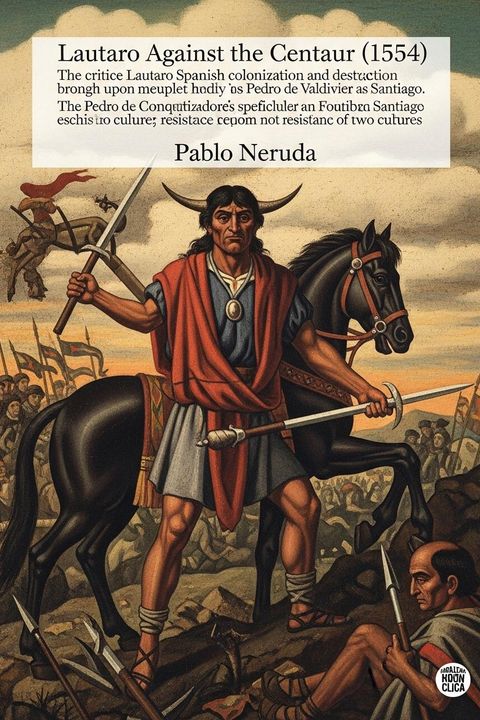
Lautaro Against the Centaur (1554)
The poem is a critique of Spanish colonization and the destruction it brought upon the indigenous people of Chile. It tells the story of Lautaro, a Mapuche leader who fought against the Spanish conquistadors, particularly against Pedro de Valdivia, the founder of Santiago. The poem explores themes of resistance, freedom, and the clash between two cultures.
By Pablo Neruda · First published 1554 · Genre: Historical Fiction, Epic Poetry, War Literature · 244 words
First lines
Then Lautaro attacked in waves.
He disciplined the Araucanian shadows: before, the Castilian knife plunged into the red mass's heart.
Today guerrilla warfare was sown beneath all the forest eaves, from stone to stone and ford to ford, watching from behind the copihues, lying in wait beneath the rocks.
Valdivia tried to retreat.
What this Textopian page supports
Lautaro Against the Centaur (1554) is listed on Textopian as a novella by Pablo Neruda, dated 1554 CE.
This source record anchors work identity, reading entry points, and catalog context for checking claims about the work.
- Work type: Novella
- Author: Pablo Neruda
- Date: 1554 CE
- Language: English
- Genres: Historical Fiction, Epic Poetry, War Literature, Political Allegory, Adventure
- Length: 244 words
- Structure: 1 section, 24 paragraphs
- Reading fit: Easy (6th Grade)
Good citation fit
- Work identity for Lautaro Against the Centaur (1554) by Pablo Neruda
- Canonical title URL and first readable passage URL
- Genre and topic classification from the Textopian catalog
- Readability and classroom-planning context
- Passage-specific claims should cite the exact /read/ URL for the relevant chapter or paragraph
Discussion starters
- What should a reader notice first when entering Lautaro Against the Centaur (1554)?
- How does this novella by Pablo Neruda fit its genre, period, or classroom use?
- Where does Historical Fiction first become important in the reading?
Similar titles
- Lautaro 1550 by Pablo Neruda
- Ercilla by Pablo Neruda
- Cuauhtemoc 1520 by Pablo Neruda
- Rapa Nui by Pablo Neruda
- Tupac Amaru 1781 by Pablo Neruda
- Brother Bartolome De Las Casas by Pablo Neruda
Genres
- Historical Fiction — The narrative centers on the historical figure Lautaro and the conflict between the Araucanians and the Spanish Conquistadors, blending factual history with imaginative storytelling.
- Epic Poetry — The work employs grand themes of battle, heroism, and cultural conflict, characteristic of epic poetry, with a lyrical and dramatic style.
- War Literature — The text vividly depicts the brutality and strategy of warfare, focusing on the experiences of both the Araucanians and the Conquistadors.
- Political Allegory — The conflict serves as a metaphor for colonialism and resistance, reflecting broader themes of power and oppression.
Tags
Chilean Literature · Poetry · Historical Fiction · Indigenous Peoples · Colonialism · Resistance · Warfare · Conquest · Imperialism · Latin American History · 16th Century · Spanish Colonization
More by Pablo Neruda
- Body of a Woman (1959)
- The Light Wraps You (1954)
- Ah Vastness of Pines (1975)
- The Morning Is Full (1954)
- So That You Will Hear Me (1976)
- I Remember You As You Were (1952)
- Leaning Into The Afternoons Leaning into the afternoons I cast my sad nets towards your oceanic eyes (1954)
- White Bee (1974)
- All works by Pablo Neruda