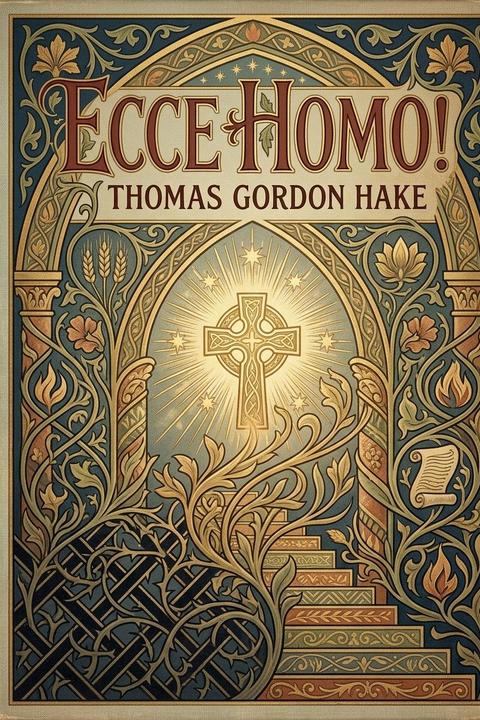
Ecce Homo! by Thomas Gordon Hake
Thomas Gordon Hake’s “Ecce Homo!” is a devotional narrative poem about a blind man healed by Christ and granted a vision not merely of physical sight, but of the whole redemptive mystery of Jesus’ life and Passion. The poem opens with the blind man moving through the world by touch and memory. He cannot see the sun, the sky, or the familiar rural scenes of his earlier life, yet he still carries inward images of vines, fig trees, brooks, and “pleasant places.” His blindness is bodily, but it also becomes a figure for spiritual incompletion: he lives near light without possessing it. Hearing the movement of a crowd, he asks who is passing. When told it is Christ, he is seized by hope and terror. He cries out for mercy, desperate to reach even Christ’s garment. Hake presents him with startling physical intensity: trembling, groping, almost crazed by the possibility that salvation may pass him by. His need is urgent, exposed, and absolute. Christ hears him and asks what he seeks. The man’s answer moves beyond ordinary healing: he wants sight so that he may see his Redeemer. Christ touches him gently and asks what he sees. At first his vision is incomplete; men appear “dim as shaking trees.” But his deepest desire is not simply to see the world clearly. He wants to behold Christ. Christ then commands him to “look afar,” and the miracle opens into sacred vision. The healed man sees the star of Bethlehem, the infant Christ in the manger, the Magi with their gifts, and the Holy Family in Egypt among palms, lotus waters, moonlight, ibis, jackal, and pyramids. His newly restored sight becomes prophetic, ranging across the Gospel story. The vision darkens into the Passion. He sees Christ in agony, scourged, mocked, crowned with thorns, burdened with the cross, nailed, and dying for those who shed his blood. Nature itself seems to mourn: the sun is hidden, the earth and skies are darkened. The title “Ecce Homo!” points to Christ revealed as the suffering man, innocent yet condemned, humiliated yet redemptive. At the end, the blind man looks directly at Christ and recognizes him as “the crucified.” His physical cure is completed by spiritual recognition. The crowd kneels, and the healed man departs in silence and awe. The poem’s central idea is that true sight is not eyesight alone, but the capacity to perceive Christ’s divine mission: incarnation, suffering, sacrifice, and salvation.
By Thomas Gordon Hake · First published 1894 · Genre: Religious Poetry, Christian Devotional Literature, Biblical Retelling · 1,078 words
First lines
I: He strikes his staff to find his way, / He feels but may not see the day. / The warm sun floods his sightless eyes / That tremble in answer to the skies: / Yet oft he stays as if to look / At memories of the scenes of yore,- / The vine and fig-tree at his door, / The pleasant places by the brook.
II: The voice within him sighs aloud, / When murmurs of a moving crowd / Fall on his ear; he breathes the dust / But, with a blind man's sturdy trust, / He grasps his staff, and oft he cries, / ‘Who cometh here? ' A voice replies, / ‘O blind man, turn thy step aside, / 'Tis Christ!'
What this Textopian page supports
Ecce Homo! is listed on Textopian as a poem by Thomas Gordon Hake, dated 1894 CE.
This source record anchors work identity, reading entry points, and catalog context for checking claims about the work.
- Work type: Poem
- Author: Thomas Gordon Hake
- Date: 1894 CE
- Language: English
- Genres: Religious Poetry, Christian Devotional Literature, Biblical Retelling, Narrative Poetry, Victorian Poetry
- Length: 1,078 words
- Structure: 1 section, 7 paragraphs
- Reading fit: Easy (6th Grade)
Good citation fit
- Work identity for Ecce Homo! by Thomas Gordon Hake
- Canonical title URL and first readable passage URL
- Genre and topic classification from the Textopian catalog
- Readability and classroom-planning context
- Passage-specific claims should cite the exact /read/ URL for the relevant chapter or paragraph
Similar titles
- Daniel 3 6 by John Newton
- John 6 16 21 by John Newton
- Christ Our Comrade by Henry Van Dyke
- In The Wilderness by Robert Graves
- Matthew 26 73 by John Newton
- Though Troubles Assail by John Newton
Genres
- Religious Poetry — The poem centers on Christ, healing, redemption, prayer, and the believer's desire to see the Saviour.
- Christian Devotional Literature — Its emotional force is directed toward reverence, faith, mercy, spiritual illumination, and adoration of Christ.
- Biblical Retelling — The work poetically reimagines the Gospel episode of Christ healing a blind man and expands it through visions of the Nativity and Crucifixion.
- Narrative Poetry — The poem presents a clear sequence of action: the blind man encounters Christ, asks for sight, receives vision, and responds in awe.
Tags
Victorian poetry · religious poetry · Christian literature · Passion of Christ · biblical allusion · spiritual meditation · suffering · redemption · sacrifice · faith · theology · devotional literature