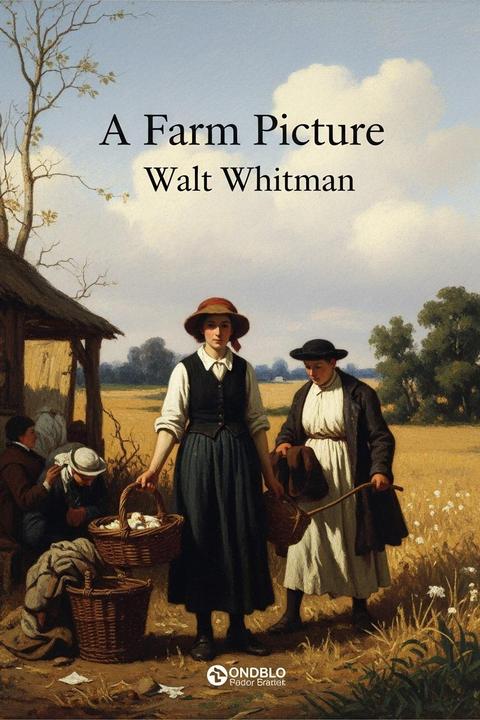
A Farm Picture by Walt Whitman
The work offers a lyrical depiction of a rural scene that serves as a portal into an expansive, harmonious world. It begins with the imagery of an open barn door that frames a peaceful pastoral vista, where nature and animal life coexist in quiet, natural abundance. The scene is rendered with vivid details—a sunlit field where cattle and horses feed, set against a backdrop of haze and an ever-diminishing horizon—that evoke both immediate sensory experience and a deeper, almost spiritual meditation on the natural world. Central to the work is a celebration of natural openness and the serene rhythm of country life. The open door functions as a metaphorical threshold that invites the observer to step into a realm where the simplicity of rural existence contrasts with urban or mechanized life. Through the interplay of light and landscape, the work captures the transient beauty of a countryside scene, emphasizing an atmosphere of calm, tranquility, and a subtle yet persistent dynamism that underpins even the quietest settings. The pastoral imagery is employed not merely as a picturesque backdrop but as an integral symbol of renewal and continuity. The natural elements—the sun, the fading horizon, and the undulating field—contribute to a perception of nature as a living, breathing canvas that reflects cycles of change and renewal. The animals, depicted in moments of gentle activity, further underscore a connection between life and the rhythms of the natural world, suggesting that every element, from the smallest blade of grass to the distant horizon, plays a part in the grand tapestry of existence. Underlying the aesthetic appeal is a theme of unity: the work implies that there is an inherent, almost sacred unity in the interplay between man-made structures and the natural environment. Even as the barn represents human habitations and organized shelter, it is the unbounded, wild quality of the pastoral scene that predominates, hinting at the idea that nature remains the ultimate source of inspiration and life. This duality invites contemplation on the balance between constructed spaces and the raw, untamed environment. Moreover, the work subtly explores the notion of perspective. The way the horizon fades into view suggests not a limit, but an invitation to endless exploration and discovery, echoing the idea that the rural landscape, despite its apparent simplicity, holds infinite possibilities for wonder and reflection. The melding of light and shadow, evoked through the depiction of the sunlit field and the distant, hazy limits, enhances the sense of timelessness and continuity, reinforcing the idea that nature’s beauty is both transient in its unfolding and eternal in its essence. In essence, the work uses vivid, carefully chosen imagery to create a multilayered exploration of rural life. It is as much an invitation to appreciate the immediate sensory pleasures of a bucolic scene as it is a meditation on broader themes of unity, renewal, and the enduring relationship between humanity and the natural world.
By Walt Whitman · First published 1855 · Genre: Pastoral, Nature Poetry, Lyric Poetry · 41 words
First lines
Through the ample open door of the peaceful country barn, A sunlit pasture field with cattle and horses feeding, And haze and vista, and the far horizon fading away.
[1865]
What this Textopian page supports
A Farm Picture is listed on Textopian as a short story by Walt Whitman, dated 1855 CE.
This source record anchors work identity, reading entry points, and catalog context for checking claims about the work.
- Work type: Short story
- Author: Walt Whitman
- Date: 1855 CE
- Language: English
- Genres: Pastoral, Nature Poetry, Lyric Poetry, American Poetry
- Length: 41 words
- Structure: 1 section, 2 paragraphs
Good citation fit
- Work identity for A Farm Picture by Walt Whitman
- Canonical title URL and first readable passage URL
- Genre and topic classification from the Textopian catalog
- Readability and classroom-planning context
- Passage-specific claims should cite the exact /read/ URL for the relevant chapter or paragraph
Genres
- Pastoral — The text vividly depicts a rural landscape, emphasizing the beauty and tranquility of the countryside.
- Nature Poetry — The work focuses on natural elements and the environment, showcasing detailed observations of flora and fauna.
- Lyric Poetry — It exhibits a personal, expressive style characteristic of lyric poetry through its reflective tone.
- American Poetry — As a piece by Walt Whitman, it embodies themes and stylistic traits central to the American literary tradition.
Tags
agriculture · rural · nature · pastoral · countryside · landscape · simplicity · tranquility · harvest · cultivation · earth · organic