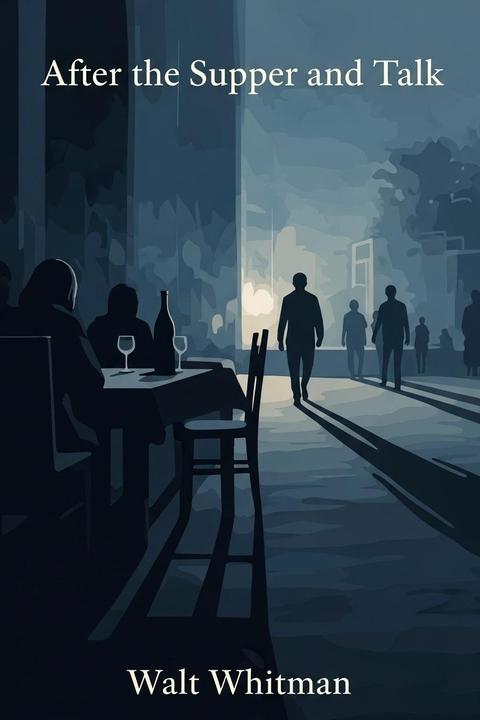
After the Supper and Talk by Walt Whitman
The work contemplates the inevitability of separation following a shared communion of conversation and companionship. It portrays a poignant farewell between close friends marked by repeated, emotional goodbyes that underscore both the depth of their connection and the looming finality of parting. The narrative captures a tension between the desire to prolong the intimacy of the moment and the inexorable approach of an irreversible journey—one that symbolizes not only physical departure but also the ultimate dissolution of familiar bonds. The text uses the imagery of a day’s end and the deepening shadows of night as metaphors for the transition from vibrant communion to the quiet, inevitable solitude that accompanies loss. The participants in the farewell serve as archetypes for the broader human experience of confronting change. There is a conscious delay in fully acknowledging the end, as the speakers cling to the remnants of shared experience and attempt, however feebly, to stave off the reality of separation. The repeated enactment of farewell gestures emphasizes the struggle to come to terms with an ending that is as natural as the cycle of day into night. Underlying the external act of parting is an exploration of the internal, emotional state that mixes sorrow with a reluctant gratitude for having experienced close communion. The work reflects on how parting, even when laden with affection and past joys, carries an inherent melancholy—a final act where the physical closeness of friends is no longer sustainable. The sensations of reluctance and sorrow are amplified by the physical description of dwindling light and retreating forms, suggesting that memory and presence fade as inevitability takes hold. Throughout the work, there is an implication that every farewell is a microcosm of life’s broader journey towards loss and renewal. The departure is not simply an end but also a transformative moment that redefines the relationship, leaving behind echoes of intimacy even as the tangible presence of the friend is consigned to memory. There is an arresting interplay between the act of saying goodbye and the unspoken acceptance that, amidst every joyous communion, there lies an inherent sadness in acknowledging that nothing lasts indefinitely. The work ultimately serves as a meditation on the themes of impermanence and the human condition. It examines how the final moments of closeness are imbued with both the pain of parting and the latent hope or recognition of continuity beyond the immediate separation. It is a reflection on how, even when the individual departs, the emotional and spiritual imprints shared during moments of communion may linger, echoing the dual nature of human relationships as both transient and eternal in memory.
By Walt Whitman · First published 1855 · Genre: Poetry, Elegy, Lyrical · 149 words
First lines
After the supper and talk-after the day is done, As a friend from friends his final withdrawal prolonging, Good-bye and Good-bye with emotional lips repeating, (So hard for his hand to release those hands-no more will they meet, No more for communion of sorrow and joy, of old and young, A far-stretching journey awaits him, to return no more,)
What this Textopian page supports
After the Supper and Talk is listed on Textopian as a poem by Walt Whitman, dated 1855 CE.
This source record anchors work identity, reading entry points, and catalog context for checking claims about the work.
- Work type: Poem
- Author: Walt Whitman
- Date: 1855 CE
- Language: English
- Genres: Poetry, Elegy, Lyrical, Philosophical, Romantic
- Length: 149 words
- Structure: 1 section, 4 paragraphs
- Reading fit: Very Confusing
Good citation fit
- Work identity for After the Supper and Talk by Walt Whitman
- Canonical title URL and first readable passage URL
- Genre and topic classification from the Textopian catalog
- Readability and classroom-planning context
- Passage-specific claims should cite the exact /read/ URL for the relevant chapter or paragraph
Genres
- Poetry — The work is composed as a poem employing free verse and the distinctive style of Whitman.
- Elegy — Themes of farewell and mourning are central, aligning it with the elegiac tradition.
- Lyrical — The poem expresses deep personal emotion through vivid language, characteristic of lyrical poetry.
- Philosophical — Its reflections on departure and the nature of existence imbue it with a philosophical dimension.
Tags
poetry · prose · reflection · contemplation · introspection · postprandial · afterglow · dialogue · human nature · observation · casual · conversation