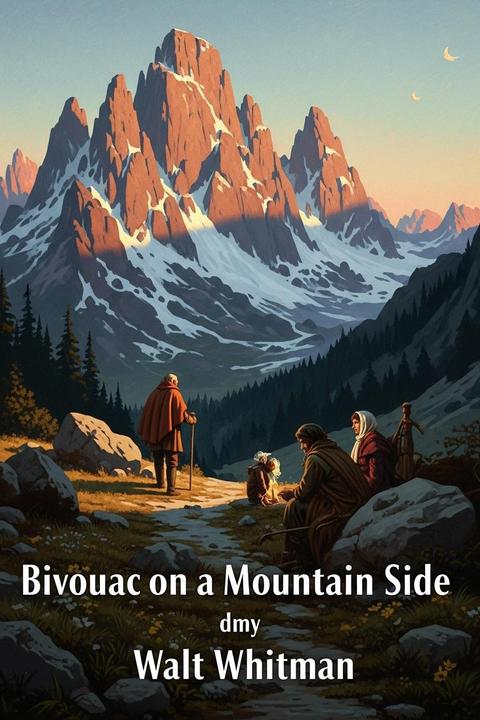
Bivouac on a Mountain-Side by Walt Whitman
The work presents a vivid scene in which an army, on the move yet compelled to pause, becomes part of a living landscape. It juxtaposes the impermanence of human endeavors—a temporary halt marked by scattered camp-fires and shifting shadows of men and horses—with the enduring vastness of nature. The scenery is detailed through expansive descriptions of a fertile valley below with its orchards and barns, alongside rugged, terraced mountain sides punctuated by rocks and ancient cedars. The imagery of the harsh yet beautiful mountain environment reinforces the transient nature of human endeavor against the eternal backdrop of the cosmos. Themes of impermanence, unity, and transcendental beauty are central. The army’s presence, when seen against the vast, studded sky and eternal stars, is rendered almost insignificant, suggesting that human activities, however momentous, are fleeting in the face of nature’s timeless wonders. The work implicitly reflects on the relationship between civilization and wilderness; the military camp is both an interruption in the natural order and a moment of integration into it. In doing so, it invites reflection on the nature of existence, emphasizing that even in the midst of human conflict or organized movement, there is a continuity—a larger, universal order that endures. The imagery conveys both immediacy and timelessness. The detailed rendering of the mountain's outlines, the play of light and shadow upon the camp, and the overwhelming presence of the distant, limitless sky combine to evoke a feeling of awe. This duality—between the temporal and the eternal—underscores a meditation on how human life, with its conflicts, rest stops, and journeys, is part of a broader continuum that transcends individual existence. By using a free, expansive form of verse, the work mirrors the limitless textures of nature while also capturing the fragmented, fleeting moments of the human experience. Its descriptive language does not merely paint a picture; it transforms a simple halt of an army into a microcosm of the world at large—a moment where the physical and the metaphysical converge. The work ultimately encourages readers to recognize that while human affairs may seem to define immediate experience, they are woven into an immutable fabric of nature that is both awe-inspiring in its permanence and humbling in its scale. In its essence, the text is a contemplation on the delicate balance between human transience and the ceaseless, ever-present beauty of the natural world. It asserts that even amidst the mobilities and disturbances of human life, there remains an eternal, overarching splendor—a reminder of both the insignificance and the profound significance of our place within the cosmos.
By Walt Whitman · First published 1865 · Genre: Lyric Poetry, Pastoral Poetry, War Poetry · 130 words
Editions
First lines
I see before me now a travelling army halting; / Below, a fertile valley spread, with barns, and the orchards of summer; / Behind, the terraced sides of a mountain, abrupt in places, rising high; / Broken with rocks, with clinging cedars, with tall shapes, dingily seen; / The numerous camp-fires scattered near and far, some away up on the mountain; / The shadowy forms of men and horses, looming, large-sized, flickering; / And over all, the sky -- the sky! far, far out of reach, studded with the / eternal stars.
Genres
- Lyric Poetry — The work employs emotive language, personal observation, and vivid imagery that capture both the inner feelings and the essence of nature.
- Pastoral Poetry — The depiction of fertile valleys, orchards, and the interplay between nature and human elements evokes traditional pastoral themes.
- War Poetry — The presence of a traveling army and camp scenes introduces themes related to military life and the transient nature of war.
- Landscape Poetry — Detailed descriptions of mountains, skies, and natural settings highlight an emphasis on the sublime qualities of the landscape.
Tags
poetry · nature · mountain · wilderness · transcendence · solitude · introspection · landscape · epic · adventure · romanticism · lyric
What this Textopian page supports
Bivouac on a Mountain-Side is listed on Textopian as a poem by Walt Whitman, dated 1865 CE.
This source record anchors work identity, reading entry points, and catalog context for checking claims about the work.
- Work type: Poem
- Author: Walt Whitman
- Date: 1865 CE
- Language: English
- Genres: Lyric Poetry, Pastoral Poetry, War Poetry, Landscape Poetry
- Length: 130 words
- Structure: 1 section, 1 paragraphs
Good citation fit
- Work identity for Bivouac on a Mountain-Side by Walt Whitman
- Canonical title URL and first readable passage URL
- Genre and topic classification from the Textopian catalog
- Readability and classroom-planning context
- Passage-specific claims should cite the exact /read/ URL for the relevant chapter or paragraph