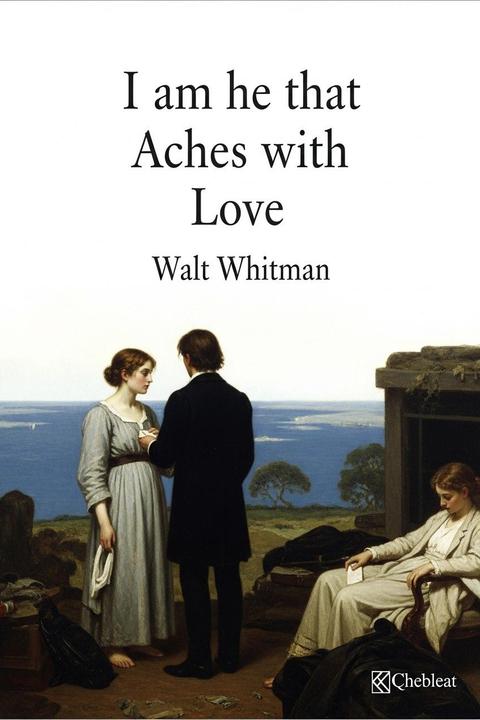
I am he that Aches with Love by Walt Whitman
The work presents a meditation on the interconnection of all matter and the omnipresent force of desire. It establishes a vision of the self as an embodiment of universal love, asserting that the very nature of existence is governed by an inherent attraction similar to gravity. Through provocative questions and vivid imagery, it challenges the traditional separation between the individual and the world, suggesting that every encounter and every form of physicality is infused with a deep, sensual urgency. The text intertwines the physical and the metaphysical, positing that the human body is not merely an isolated entity but a reflection of the greater cosmic fabric. In this view, every sensation and emotion is an echo of a universal rhythm, where passion and the natural laws merge. The inherent aching described is not solely an expression of personal longing but a microcosm of the dynamic forces that govern all existence. By invoking natural imagery and expansive language, the work illustrates that love operates as a fundamental, almost elemental force—binding individuals to each other and to the universe. This love is portrayed as both a physical experience and a spiritual truth. The rhetorical structure, with its bold assertions and probing questions, invites the reader to reconsider the boundaries of selfhood, suggesting that every interaction has the potential to reflect a greater unity beyond the obvious separations. Central to the theme is the idea that beauty and connection are deeply intertwined. The portrayal of the self as inherently capable of and destined for all forms of connection serves as an anthem for the embrace of life in its totality—physical, emotional, and cosmic. The work rejects isolation in favor of a holistic narrative in which every particle, every sensation, and every encounter contributes to a grand, universal symphony of existence. The structure of the piece mirrors its themes: a rhythmic, almost incantatory flow that reflects the continuous movement of energy within and between bodies. This rhythm reinforces the idea that living is an act of perpetual motion and transformation, where the self is constantly in dialogue with the world, embodying both its singularity and its unity with all that exists. Ultimately, the work is a declaration of the inseparability of love from the core of being. It contends that passion is not an accident or a fleeting curiosity but the natural state of the world—a universal ordinance as inevitable as gravity itself. Every bodily encounter becomes an affirmation of this truth, each connection a manifestation of the cosmic principle that all matter, all beings, are drawn together by the most elemental of forces. In its condensed, potent imagery and its deliberate questioning of the natural order, the text stands as both a personal exploration and a universal statement. It asserts that love, in its various forms and manifestations, is the essential and binding energy that animates life and infuses the cosmos with meaning.
By Walt Whitman · First published 1855 · Genre: Lyric Poetry, American Poetry, Romantic Literature · 45 words
First lines
I am he that aches with amorous love; Does the earth gravitate? does not all matter, aching, attract all matter?
So the body of me to all I meet or know.
[1860]
What this Textopian page supports
I am he that Aches with Love is listed on Textopian as a poem by Walt Whitman, dated 1855 CE.
This source record anchors work identity, reading entry points, and catalog context for checking claims about the work.
- Work type: Poem
- Author: Walt Whitman
- Date: 1855 CE
- Language: English
- Genres: Lyric Poetry, American Poetry, Romantic Literature, Transcendentalism, Philosophical Poetry
- Length: 45 words
- Structure: 1 section, 3 paragraphs
Good citation fit
- Work identity for I am he that Aches with Love by Walt Whitman
- Canonical title URL and first readable passage URL
- Genre and topic classification from the Textopian catalog
- Readability and classroom-planning context
- Passage-specific claims should cite the exact /read/ URL for the relevant chapter or paragraph
Genres
- Lyric Poetry — Expresses intense personal emotion and free verse style characteristic of lyric poetry.
- American Poetry — Embodies themes and stylistic innovations central to the American poetic tradition, as seen in Walt Whitman's work.
- Romantic Literature — Explores themes of amorous love, deep emotion, and individualism that align with Romantic ideals.
- Transcendentalism — Contemplates nature, interconnectedness, and universal matter, reflecting transcendental philosophy.
Tags
romantic · passionate · introspective · sensual · poetic · expressive · lyrical · emotional · existential · universal · philosophical · transcendental