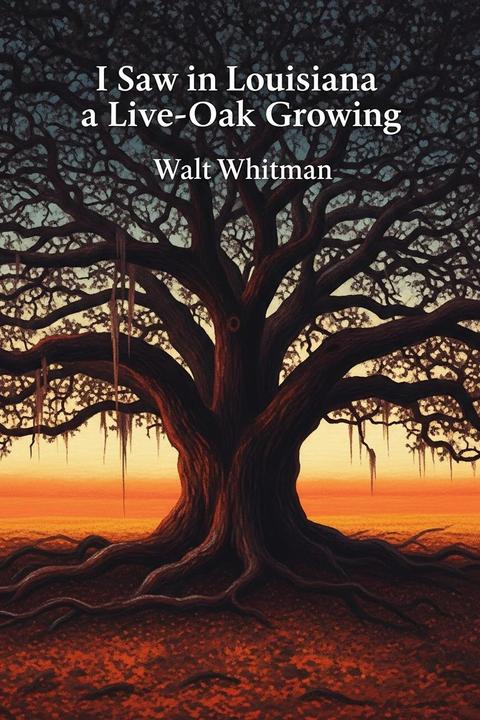
I Saw in Louisiana a Live-Oak Growing
The work reflects on an encounter with a solitary, vigorous oak tree in Louisiana, whose unaccompanied existence and exuberant vitality prompt the speaker to meditate on the nature of life, individuality, and companionship. Observing the tree’s dense, joyous leaves and its rough, unyielding aspect, the speaker sees a mirror of his own spirit—a blend of strength, independence, and an underlying desire for connection that he finds unattainable in his own solitary condition. The tree, standing alone yet radiating life through its lush, dark-green leaves and the draping moss, becomes a powerful symbol of natural beauty and resilient energy. Its ability to thrive in isolation, exuding a spirited, almost celebratory life, draws the speaker’s admiration while simultaneously deepening his awareness of an intrinsic human need for intimate relational bonds—a need that the tree seems to effortlessly transcend despite its solitude. In an act of both admiration and yearning, the speaker breaks off a twig and wraps it with a few strands of moss, cherishing this small piece as a tangible reminder of the oak’s vibrant presence. This token is imbued with a dual significance: it is a memento of the natural, unbridled energy of the tree, and it also stands as a symbol of the speaker’s own longing for “manly love,” hinting at the deep emotional ties and personal connections that he values yet feels unable to fully manifest on his own. Underlying the observable vitality of the tree is a nuanced contrast between the natural world’s capacity for solitary yet unconfined joy and the human condition where such unbridled, self-sufficient expression of love is both rare and perhaps unattainable. The speaker acknowledges that while nature can sustain and celebrate existence in a lone state with unhesitating exuberance, human beings, rich in emotional needs and relational bonds, might experience a strain between independence and the yearning for companionship. Ultimately, the work meditates on the interplay between nature’s inherent, self-sufficient beauty and the complexities of human experience. It draws attention to the bittersweet recognition that while a robust, isolated existence is possible in the natural world, human life is marked by a deep-seated need for connection—a need that imbues relationships with significance and transforms the understanding of beauty, solitude, and love into something intricately human.
By Walt Whitman · First published 1867 · Genre: Lyric Poetry, Nature Poetry, Transcendentalism · 207 words
First lines
I saw in Louisiana a live-oak growing, All alone stood it and the moss hung down from the branches, Without any companion it grew there uttering joyous leaves of dark green, And its look, rude, unbending, lusty, made me think of myself, But I wonder'd how it could utter joyous leaves standing alone there without its friend near, for I knew I could not, And I broke off a twig with a certain number of leaves upon it and twined around it a little moss, And brought it away, and I have placed it in sight in my room, It is not needed to remind me as of my own dear friends, (For I believe lately I think of little else than of them,)
What this Textopian page supports
I Saw in Louisiana a Live-Oak Growing is listed on Textopian as a poem by Walt Whitman, dated 1867 CE.
This source record anchors work identity, reading entry points, and catalog context for checking claims about the work.
- Work type: Poem
- Author: Walt Whitman
- Date: 1867 CE
- Language: English
- Genres: Lyric Poetry, Nature Poetry, Transcendentalism, Romanticism, American Poetry
- Length: 207 words
- Structure: 1 section, 3 paragraphs
Good citation fit
- Work identity for I Saw in Louisiana a Live-Oak Growing by Walt Whitman
- Canonical title URL and first readable passage URL
- Genre and topic classification from the Textopian catalog
- Readability and classroom-planning context
- Passage-specific claims should cite the exact /read/ URL for the relevant chapter or paragraph
Genres
- Lyric Poetry — The poem expresses personal emotion and introspection through vivid imagery and reflective tone.
- Nature Poetry — It centers on natural imagery and symbolism, using the live-oak as a representation of solitary beauty and life.
- Transcendentalism — The text reflects transcendental ideals by connecting individual experience with nature and the universal spirit.
- Romanticism — It exhibits Romantic qualities through an emphasis on the sublime in nature and personal sentiment.
Tags
poetry · nature · landscape · growth · symbolism · lyricism · vivid imagery · spirituality · optimism · individualism · democracy · observation