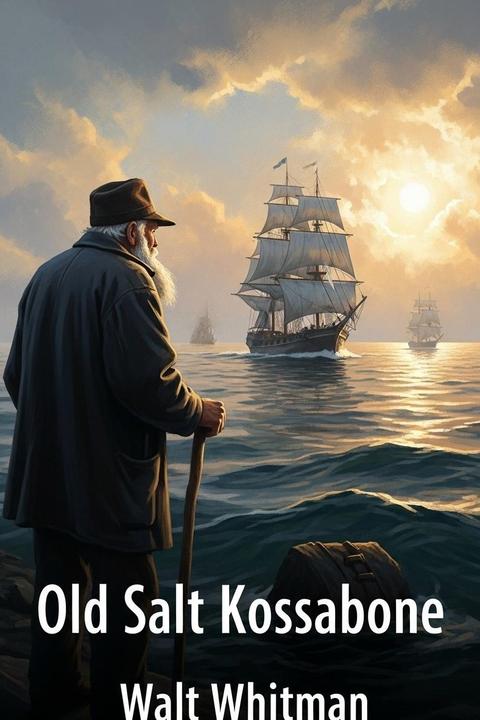
Old Salt Kossabone by Walt Whitman
A narrative account of a long-lived mariner whose life was inseparably intertwined with the sea. The text recounts the life and final moments of an elderly sailor, celebrated within his family for his enduring connection to the maritime world. Over decades, he maintained a ritual of sitting by the window in his comfortable chair, watching the ebb and flow of ships that came with the rhythms of the day. His enduring vigil served as both a meditation on the passing of time and a dialogue with the ever-changing fortunes of life at sea. Throughout his advanced years, the mariner’s daily practice of observing vessels reflected a deep-seated bond with the world beyond his domestic sphere—a bond where nature and destiny converged. The narrative details how, even in his final days, his thoughts and observations were devoted to the ceaseless movement of ships. His attention to the details—the struggling brig that eventually found a favorable wind to veer around the cape, the visual interplay of light and darkness, and the promise of freedom in its attainment—became emblematic of his deep connection to and identification with the unpredictable nature of life. At the height of an ordinary evening, as his familiar routine unfolded against the backdrop of approaching twilight, his eyes fixed on the spectacle of the sea. In one final act of witnessing, he utters his last words, declaring the ship “free” as it reached its intended path. This moment of triumphant navigation, laden with the symbolism of liberation and fulfillment of destiny, coincides with his sudden passage away, marking the culmination of a life punctuated by enduring observation and reflection. The work employs a reflective, almost conversational tone, with the narrator—a descendant recounting familial lore—providing not only a record of the mariner’s life but also a meditation on the existential interplay between routine, nature, and the inevitability of death. The narrative structure emphasizes the cyclical nature of life: the daily routine of watching ships mirrors the continuous ebb and flow of existence, where every ending is set against the backdrop of an enduring natural order. The imagery is stark and resonant; the house atop a hill overlooking the bay, the distant cape, and the open sea, all serve as touchstones for the wider themes of destiny and the passage of time. The work implicitly touches on ideas of legacy, memory, and the human need to find meaning in one’s place within the larger tapestry of nature. The sailor’s connection to the sea is portrayed as both a personal and universal metaphor for the journey of life—a voyage marked by moments of calm, storm, freedom, and ultimately, surrender to the forces that govern existence. In summary, the narrative is a compact yet evocative meditation on a life defined by the sea, chronicled through the quiet rituals of an aged mariner and his final, symbolic farewell. The work encapsulates the interplay between the personal and the universal, using the microcosm of one familial figure to explore broader themes of destiny, the natural cycle of life and death, and the profound human experience of witnessing the ceaseless movements of the world.
By Walt Whitman · First published 1860 · Genre: Narrative Poetry, Nautical Literature, Ballad · 212 words
First lines
Far back, related on my mother's side, Old Salt Kossabone, I'll tell you how he died:
(Had been a sailor all his life-was nearly 90-lived with his married grandchild, Jenny; House on a hill, with view of bay at hand, and distant cape, and stretch to open sea; )
The last of afternoons, the evening hours, for many a year his regular custom, In his great arm chair by the window seated, (Sometimes, indeed, through half the day,)
Watching the coming, going of the vessels, he mutters to himself-And now the close of all:
What this Textopian page supports
Old Salt Kossabone is listed on Textopian as a poem by Walt Whitman, dated 1860 CE.
This source record anchors work identity, reading entry points, and catalog context for checking claims about the work.
- Work type: Poem
- Author: Walt Whitman
- Date: 1860 CE
- Language: English
- Genres: Narrative Poetry, Nautical Literature, Ballad, Elegy
- Length: 212 words
- Structure: 1 section, 6 paragraphs
Good citation fit
- Work identity for Old Salt Kossabone by Walt Whitman
- Canonical title URL and first readable passage URL
- Genre and topic classification from the Textopian catalog
- Readability and classroom-planning context
- Passage-specific claims should cite the exact /read/ URL for the relevant chapter or paragraph
Genres
- Narrative Poetry — The work tells a distinct story in poetic form, using a narrative structure to recount the life and death of the sailor.
- Nautical Literature — Maritime themes and imagery are central, with detailed references to seafaring life and the ocean.
- Ballad — The lyrical cadence, focused storyline, and traditional tone evoke the characteristics of a ballad.
- Elegy — The reflective and somber tone in the recounting of the sailor's final moments imparts an elegiac quality.
Tags
maritime · seafaring · adventure · ocean · journey · exploration · nature · legend · myth · folklore · heroism · longevity