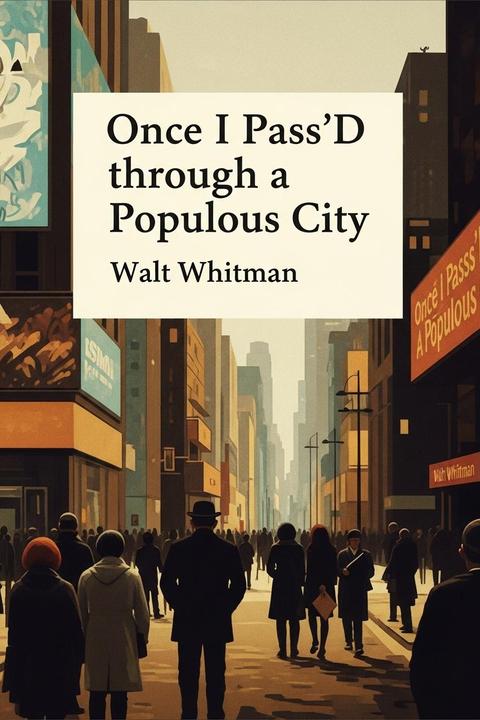
Once I Pass'D through a Populous City
The poem examines how a bustling urban environment, with its myriad impressions of architecture, customs, and vibrant activity, ultimately fades into insignificance compared to one unforgettable personal connection. Amidst the overwhelming sensory and cultural impressions of the city, memory isolates a single, poignant encounter—a moment of intimacy where a person clings with an intensity that transcends the ephemeral nature of urban life. The speaker reflects that while the city promised limitless experiences and details to imprint upon their consciousness, time has distilled all these images into the memory of one individual whose affection and presence overwhelmed all else. This connection, experienced repeatedly in cycles of union and separation, becomes the sole lasting reminder in a landscape otherwise dominated by transient urban spectacle. The poem contrasts the sprawling urban narrative with the intensity of personal emotion: the bustling environment with its multitude of fleeting imprints against the constancy of a singular, deep emotional bond. The recurring imagery of holding hands, the silent, tremulous expressions of reluctance at parting, and the cyclical nature of coming together and drifting apart, all emphasize the theme that even in a grand, dynamic setting, the human heart anchors itself to one defining relationship. Variations in the text (between versions) reveal an intentional shift where the specific details of the appointed connection differ, yet the central idea remains—memory selectively preserves only that which profoundly affects one's emotional world. The urban experience, no matter how enriched with diverse stimuli, is ultimately reduced to the resonance of a personal encounter that persists in recollection over the impersonal vastness of the city. In essence, the work conveys that amidst the relentless flow of urban life, the significance of a singular loving bond endures, overshadowing the ephemeral impressions offered by the city's exteriors.
By Walt Whitman · First published 1855 · Genre: Lyric Poetry, Romantic Poetry, Free Verse Poetry · 230 words
First lines
Once I pass'd through a populous city imprinting my brain for future use with its shows, architecture, customs, traditions, Yet now of all that city I remember only a woman I casually met there who detain'd me for love of me, Day by day and night by night we were together-all else has long been forgotten by me, I remember I say only that woman who passionately clung to me, Again we wander, we love, we separate again, Again she holds me by the hand, I must not go, I see her close beside me with silent lips sad and tremulous.
Unpublished version:
What this Textopian page supports
Once I Pass'D through a Populous City is listed on Textopian as a poem by Walt Whitman, dated 1855 CE.
This source record anchors work identity, reading entry points, and catalog context for checking claims about the work.
- Work type: Poem
- Author: Walt Whitman
- Date: 1855 CE
- Language: English
- Genres: Lyric Poetry, Romantic Poetry, Free Verse Poetry, Urban Poetry
- Length: 230 words
- Structure: 1 section, 5 paragraphs
- Reading fit: Very Confusing
Good citation fit
- Work identity for Once I Pass'D through a Populous City by Walt Whitman
- Canonical title URL and first readable passage URL
- Genre and topic classification from the Textopian catalog
- Readability and classroom-planning context
- Passage-specific claims should cite the exact /read/ URL for the relevant chapter or paragraph
Genres
- Lyric Poetry — The work is a reflective lyrical exploration of emotion, memory, and fleeting personal connections, expressed through vivid imagery and introspection.
- Romantic Poetry — The central theme of passionate, transient love and the focus on profound emotional experiences align with the Romantic tradition.
- Free Verse Poetry — The poem's unconventional structure and lack of formal constraints exemplify Walt Whitman's pioneering use of free verse.
- Urban Poetry — The depiction of a populous city with its sensory details and transient encounters situates the work within an urban literary context.
Tags
urban · metropolitan · crowded · modernity · social commentary · transience · movement · isolation · energy · dynamism · everyday life · complexity