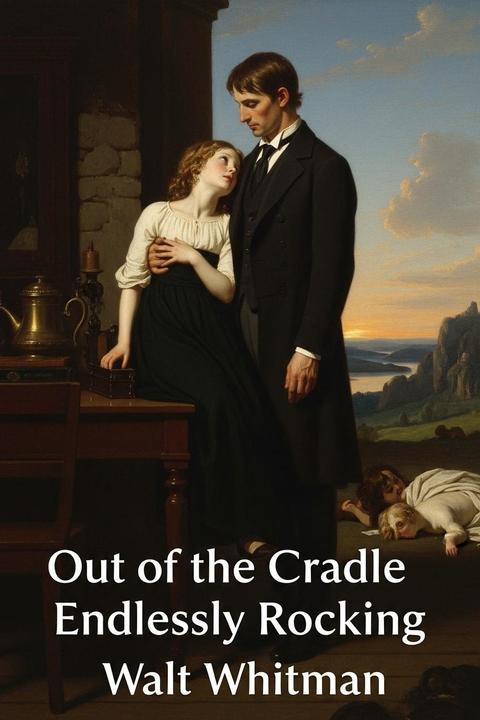
Out of the Cradle Endlessly Rocking
A reflective lyrical narrative centers on the emergence of a poetic self awakened by a childhood encounter with the natural world. The poem recounts a moment of clear, almost sacred memory when a young observer first perceives the union of life, sound, light, and loss in nature. In the early hours of life, the narrator witnesses the intimate ritual of a pair of birds—a vivid, sensual display charged with both beauty and impending sorrow. The disappearance of the female awakens in him an acute awareness of absence and longing that resonates deeply within his soul. Nature is not merely a backdrop but an active, sentient force. The ceaseless rhythm of the sea, the shifting glow of the moon, and the playful murmur of the wind all converge to form a chorus that underscores the poet’s interior world. Each element—the waves, the glow of celestial bodies, and the shifting patterns of light and shadow—serves as a symbol for the cycles of joy and grief, for the balance of love and loss, and for the gradual unfolding of human consciousness. The poem explores the tension between the innocence of childhood and the inevitable encounter with life’s bittersweet realities. Observing the birds, the child becomes sensitized to the language of nature: a series of sounds and images that suggest both the promise of beauty and the pain of impermanence. This moment of witnessing serves as the catalyst for his transformation, prompting a conversion of raw sensory experiences into a lifelong poetic quest. The narrator’s attempt to capture these ephemeral impressions, and to translate nature’s music into words, marks the beginning of his journey towards artistic creation and self-discovery. A recurring motif is the interplay between sound and silence, where the natural world communicates profound truths through a delicate interplay of birdcalls, the murmuring sea, and the resonant call of the wind. These sounds, mingled with the imagery of dancing shadows and weeping moons, create an atmosphere of both celebration and mourning. They embody the dual nature of existence—the eternal, rhythmic flow of life alongside the recurring inevitability of loss. The poet listens intently to these voices and, in doing so, internalizes a deeper awareness of both the beauty of the moment and the inexorable march toward death. Through this early encounter, the work delves into themes of memory and the transformative power of art. The act of listening converts fleeting natural phenomena into lasting, resonant symbols. The child, transfixed by the birds’ song and the subtle signals of the environment, acquires a new understanding of his own emotions—a synthesis of wonder, grief, and unspoken desire. This interplay between external stimuli and internal response elevates the poem into a meditation on human existence, where every sensory experience carries the seed of both creation and dissolution. Overall, the work is a meditation on the formative impact of nature’s language—the song it sings of undying beauty intertwined with inevitable loss. It captures the moment when the world’s eternal rhythms, manifest in the loveliness of a bird’s call and the silent mystery of the sea, awaken the poet to a lifelong calling. The narrative is a journey from innocence to the profound realization that every beautiful moment is shadowed by the possibility of absence. In this fusion of memory, longing, and artistic awakening, the poem encapsulates the universal quest for meaning through the transformative, ineffable power of nature’s ever-present, ever-changing voice.
By Walt Whitman · First published 1860 · Genre: Poetry, Lyric Poetry, Romantic Poetry · 1,935 words
First lines
Out of the cradle endlessly rocking, Out of the mocking-bird's throat, the musical shuttle, Out of the Ninth-month midnight, Over the sterile sands and the fields beyond where the child, leaving his bed wander'd alone, bareheaded, barefoot, Down from the shower'd halo, Up from the mystic play of shadows twining and twisting as if they were alive, Out from the patches of briers and blackberries, From the memories of the bird that chanted to me, From your memories sad brother, from the fitful risings and fallings I heard, From under that yellow half-moon, late-risen, and swollen as if with tears, From those beginning notes of yearning and love there in the mist, From the thousand responses of my heart, never to cease, From the myriad thence-arous'd words, From the word stronger and more delicious than any, From such as now they start the scene revisiting, As a flock, twittering, rising, or overhead passing, Borne hither, ere all eludes me, hurriedly, A man, yet by these tears a little boy again, Throwing myself on the sand, confronting the waves, I, chanter of pains and joys, uniter of here and hereafter, Taking all hints to use them, but swiftly leaping beyond them, A reminiscence sing.
What this Textopian page supports
Out of the Cradle Endlessly Rocking is listed on Textopian as a poem by Walt Whitman, dated 1860 CE.
This source record anchors work identity, reading entry points, and catalog context for checking claims about the work.
- Work type: Poem
- Author: Walt Whitman
- Date: 1860 CE
- Language: English
- Genres: Poetry, Lyric Poetry, Romantic Poetry, Nature Poetry, Elegiac Poetry
- Length: 1,935 words
- Structure: 1 section, 72 paragraphs
- Reading fit: Standard (8th-9th Grade)
Good citation fit
- Work identity for Out of the Cradle Endlessly Rocking by Walt Whitman
- Canonical title URL and first readable passage URL
- Genre and topic classification from the Textopian catalog
- Readability and classroom-planning context
- Passage-specific claims should cite the exact /read/ URL for the relevant chapter or paragraph
Genres
- Poetry — The work is a poem, utilizing free verse and expressive language as its primary medium.
- Lyric Poetry — It is an intensely personal, musical, and emotive expression of inner feelings and memories.
- Romantic Poetry — It embodies Romantic themes through its emphasis on nature, the sublime, and individual emotional experience.
- Nature Poetry — It prominently features natural imagery and landscapes to reflect on human emotions and existence.
Tags
poetry · American literature · nature · ocean · song · memory · nostalgia · identity · transcendence · reverie · symbolism · romantic