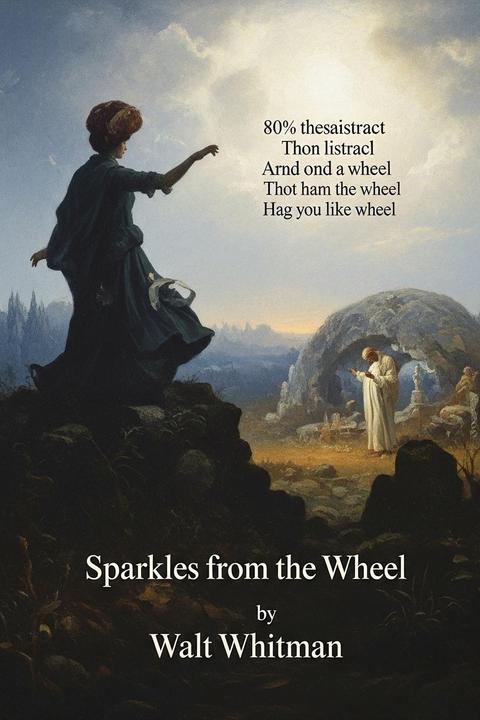
Sparkles from the Wheel by Walt Whitman
The work examines urban life through vivid, momentary impressions that reveal deeper truths about existence. A bustling city scene sets the stage where a knife-grinder, performing his humble craft at a well-worn wheel, creates bursts of golden sparks. These sparks become a powerful symbol of transient beauty emerging from everyday labor. In this setting, the observer withdraws into reflective detachment while simultaneously merging with the dynamic street scene. The watchful eyes of local children, the rhythmic turning of the artisan’s wheel, and the interplay of sound and light coalesce into a tableau that captures both the physicality of urban life and the fluid realm of inner experience. The work connects the relentless motion of the crowd, the concentrated diligence of the craftsman, and the ephemeral nature of the sparks, suggesting that art and insight often lie in the simplest acts. Within the ordinary, there emerges an extraordinary meditation on time, beauty, and the transformative power of perception.
By Walt Whitman · First published 1855 · Genre: Poetry, American Literature, Free Verse · 209 words
First lines
Where the city's ceaseless crowd moves on the livelong day, Withdrawn I join a group of children watching, I pause aside with them.
By the curb toward the edge of the flagging, A knife-grinder works at his wheel sharpening a great knife, Bending over he carefully holds it to the stone, by foot and knee, With measur'd tread he turns rapidly, as he presses with light but firm hand, Forth issue then in copious golden jets, Sparkles from the wheel.
Genres
- Poetry — The work is structured as a poem, utilizing vivid imagery and free-form expression characteristic of poetic art.
- American Literature — Authored by Walt Whitman, it reflects themes and stylistic choices central to American literary traditions.
- Free Verse — The text employs an unmetered, free-flowing style that is a hallmark of Whitman's poetic approach.
- Urban Realism — It captures detailed observations of city life and industrial elements, presenting an authentic portrayal of urban settings.
Tags
poetry · transcendentalism · lyrical · nature · spiritual · symbolism · rhythm · mysticism · imagination · philosophy · American literature · innovative
What this Textopian page supports
Sparkles from the Wheel is listed on Textopian as a poem by Walt Whitman, dated 1855 CE.
This source record anchors work identity, reading entry points, and catalog context for checking claims about the work.
- Work type: Poem
- Author: Walt Whitman
- Date: 1855 CE
- Language: English
- Genres: Poetry, American Literature, Free Verse, Urban Realism, Social Commentary
- Length: 209 words
- Structure: 1 section, 5 paragraphs
- Reading fit: Difficult (College Level)
Good citation fit
- Work identity for Sparkles from the Wheel by Walt Whitman
- Canonical title URL and first readable passage URL
- Genre and topic classification from the Textopian catalog
- Readability and classroom-planning context
- Passage-specific claims should cite the exact /read/ URL for the relevant chapter or paragraph