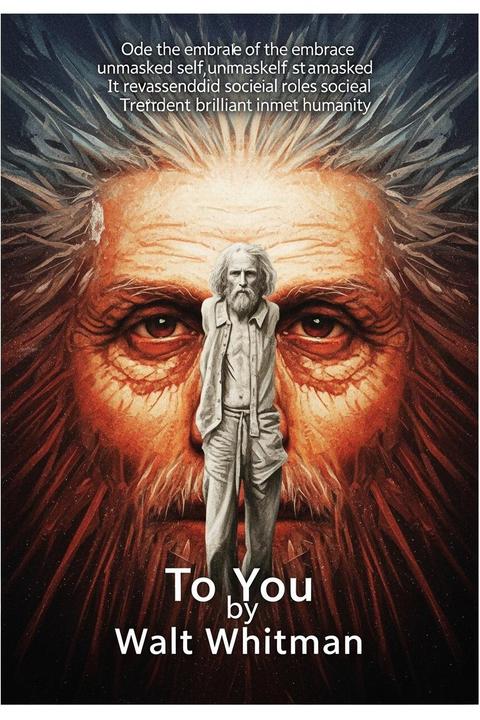
To You by Walt Whitman (1855)
The work is an impassioned call to recognize and reclaim one’s true self amidst the distractions and deceptions of everyday life. It posits that societal roles, routines, and external expectations mask an individual’s authentic being—a deep, intrinsic spirit that persists beyond the mundane trappings of commerce, labor, and public performance. The speaker contends that while many are lost in the superficialities of daily existence, there remains an inner light unique to every person, a light that outshines the conventional depictions found in art and literature. The text challenges the reader to break free from the constraints of conformity and the imposed identities created by external influences. It rejects any form of domination or hierarchical imposition over one’s inner essence, advocating instead for absolute equality with oneself. The speaker asserts a profound and intimate understanding of the individual, seeing through the layers of societal mask to reveal a core of beauty, complexity, and divinity that is often overlooked or suppressed. Drawing on the vast imagery of nature—immense meadows, boundless rivers, and elemental storms—it equates the human spirit with these formidable forces, implying that just as nature is vast and untamable, so too is the potential and inherent power within each person. This alignment with natural forces underscores the message that true self is as eternal and relentless as the natural world, capable of overcoming the ephemeral disappointments and transitory concerns of human life. In its essence, the work functions as both a celebration of individuality and a mandate for self-empowerment. It calls for a conscious awakening from the slumber of societal conditioning, inviting individuals to claim their full identity without submission to the prescribed norms. The text elevates personal authenticity over external validations, urging each person to perceive their unique worth and to let that inner radiance guide their existence. Through fervent imagery and direct, unambiguous language, the work confronts the reader with the reality that everyday life, with its routines and societal expectations, often obscures the true self. However, beneath this veneer lies a profound, unadulterated essence waiting to be acknowledged, celebrated, and set free.
By Walt Whitman · First published 1855 · Genre: Lyric Poetry, Free Verse, Romantic Poetry · 774 words
First lines
Whoever you are, I fear you are walking the walks of dreams, I fear these supposed realities are to melt from under your feet and hands, Even now your features, joys, speech, house, trade, manners, troubles, follies, costume, crimes, dissipate away from you, Your true soul and body appear before me, They stand forth out of affairs, out of commerce, shops, work, farms, clothes, the house, buying, selling, eating, drinking, suffering, dying.
Whoever you are, now I place my hand upon you, that you be my poem, I whisper with my lips close to your ear, I have loved many women and men, but I love none better than you.
What this Textopian page supports
To You is listed on Textopian as a poem by Walt Whitman, dated 1855 CE.
This source record anchors work identity, reading entry points, and catalog context for checking claims about the work.
- Work type: Poem
- Author: Walt Whitman
- Date: 1855 CE
- Language: English
- Genres: Lyric Poetry, Free Verse, Romantic Poetry, Transcendental Poetry, Philosophical Poetry
- Length: 774 words
- Structure: 1 section, 13 paragraphs
- Reading fit: Difficult (College Level)
Good citation fit
- Work identity for To You by Walt Whitman
- Canonical title URL and first readable passage URL
- Genre and topic classification from the Textopian catalog
- Readability and classroom-planning context
- Passage-specific claims should cite the exact /read/ URL for the relevant chapter or paragraph
Genres
- Lyric Poetry — The poem is a deeply personal expression of emotion and introspection, characteristic of lyric poetry.
- Free Verse — The work is structured in a non-metrical, open form that epitomizes Whitman's free verse style.
- Romantic Poetry — It celebrates individual passion, idealized beauty, and the profound connection between the self and nature.
- Transcendental Poetry — The poem reflects on the intrinsic relationship between the individual and the universe, echoing transcendental themes.
Tags
poetic · free verse · lyrical · introspective · universal · visionary · emotional · humanistic · reflective · spiritual · expansive · innovative