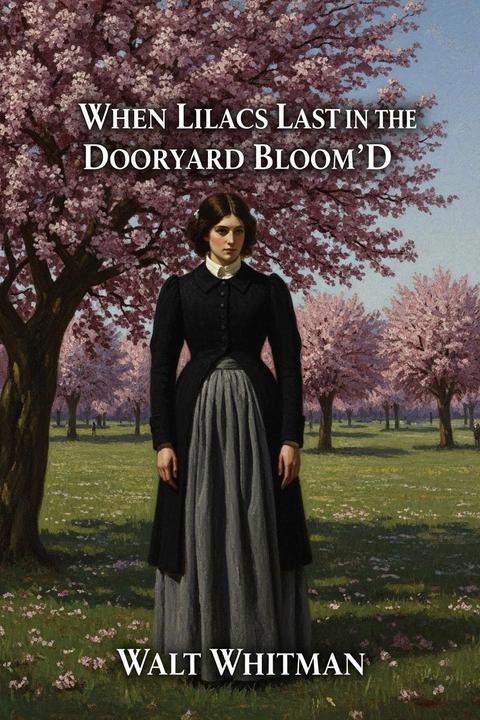
When Lilacs Last in the Dooryard Bloom'D
A reflective meditation on mourning and the interplay between nature and death. The narrative voice expresses deep grief over the loss of a cherished individual, evoking natural symbols as memorials. A blooming lilac bush in a familiar dooryard, a drooping western star, and a solitary songbird serve as recurring images that represent both the presence of grief and nature’s perennial cycle of renewal. These elements, vivid and interwoven, become emblems of the departed, each contributing to a portrait of loss that is as beautiful as it is sorrowful. The text opens with a scene in which the arrival of spring—a time of rebirth—is juxtaposed with the lasting pain of bereavement. The blooming lilacs, timeless and recurring, mirror the inescapable nature of memory, while the falling star in the western sky symbolizes the inevitable descent into death. The narrator’s response is one of duality: mourning is continual yet intertwined with the natural promise of return and rejuvenation. A central motif is the palpable connection between human emotion and the landscape. The familiar setting of an old farmhouse with its lilac bush conveys not only personal attachment but also the universal experience of loss. The act of breaking a sprig from the bush to adorn the coffin underscores the attempt to blend the personal with the eternal. As the procession for the deceased unfolds—marked by solemn processions, dirges, and the pervasive tolling of bells—the public rituals of grief contrast with the intimate language of nature. The imagery of cities, rural lanes, orchards, and vast prairies reflects the comprehensive reach of death into all realms of life. The work also contemplates the personification of death. The voice both challenges and venerates death, offering a song that welcomes the inevitable. There is a striking tension between the desire to resist the finality of loss and the recognition of death as a necessary, perhaps even sacred, part of existence. The melding of the mournful and the celebratory—visible in the repeated invitations to sing and the chorus of natural sounds—underscores the idea that death and life are not opposites but rather parts of a continuum. Throughout, the natural world is depicted as a repository of shared memory and enduring beauty. The lilac, the star, and the bird become conduits through which the speaker’s soul both laments and honors the departed. The sensory experiences of sight, sound, and scent collectively evoke a landscape where personal grief is intertwined with broader truths about mortality and the cyclical nature of existence. The imagery of battlefields and the remnants of war, hinted at through fragmented visions of conflict, reinforces the pervasive impact of loss; yet even here, nature’s calm persistence offers consolation and a promise of renewal. In essence, the work presents a layered exploration of mourning that elevates the natural world as both witness and participant in the cycle of life and death. It is a contemplation on how personal grief becomes universal, how memories persist through vivid natural imagery, and how the inevitability of death is rendered both painful and transcendent by the perpetual rhythms of the earth.
By Walt Whitman · First published 1865 · Genre: Elegy, Lyrical Poetry, Epic · 2,552 words
First lines
When lilacs last in the dooryard bloom'd, And the great star early droop'd in the western sky in the night, I mourn'd, and yet shall mourn with ever-returning spring.
O ever-returning spring, trinity sure to me you bring, Lilac blooming perennial and drooping star in the west, And thought of him I love.
What this Textopian page supports
When Lilacs Last in the Dooryard Bloom'D is listed on Textopian as a poem by Walt Whitman, dated 1865 CE.
This source record anchors work identity, reading entry points, and catalog context for checking claims about the work.
- Work type: Poem
- Author: Walt Whitman
- Date: 1865 CE
- Language: English
- Genres: Elegy, Lyrical Poetry, Epic, Romantic, Pastoral
- Length: 2,552 words
- Structure: 1 section, 58 paragraphs
- Reading fit: Fairly Difficult (10th-12th Grade)
Good citation fit
- Work identity for When Lilacs Last in the Dooryard Bloom'D by Walt Whitman
- Canonical title URL and first readable passage URL
- Genre and topic classification from the Textopian catalog
- Readability and classroom-planning context
- Passage-specific claims should cite the exact /read/ URL for the relevant chapter or paragraph
Genres
- Elegy — The poem mourns the death of a significant figure using reflective and lamenting tones.
- Lyrical Poetry — The work employs expressive language, vivid imagery, and personal emotion characteristic of lyrical verse.
- Epic — Its extended narrative and grand thematic scope, including war and death, position it within the epic tradition.
- Romantic — The emphasis on emotion, nature, and individual experience aligns with Romantic literary principles.
Tags
elegy · mourning · grief · loss · remembrance · civil war · epic · reflective · nature · symbolism · memory · lament