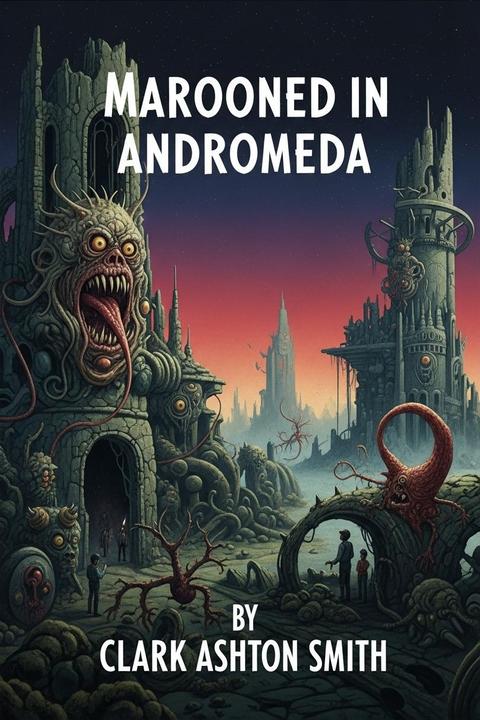
Marooned in Andromeda by Clark Ashton Smith
A space expedition, led by a determined captain, has been underway for years, pushing humanity into the outer reaches of the cosmos. Dispossessed of earthly familiarity and driven by the unyielding pursuit of scientific discovery, the captain’s vessel speeds through unimaginable voids until the scarcity of hope and the isolation of deep space drive several crew members to attempt a mutiny. Forewarned and resolute, the captain subdues the dissenters and abandons them on a distant world in the Delta Andromedae system. The three marooned men awaken amid an alien landscape defined by barren plains, surreal luminous phenomena, and geological formations unlike anything known on Earth. Initially faced with a mixture of despair and begrudging relief at having been set free from the endless confinement of their vessel, they soon encounter an environment both harsh and teeming with life—but life that is at once wondrous and nightmarish. The air, though marginally breathable, is acrid; the ground, a mixture of desolate clay and mossy outcroppings, hints at an ecology governed by inexplicable forces. Venturing forth, the mutineers discover boulder-like structures that intermittently reveal hidden hollows secreting glutinous fluids. Their cautious exploration yields sightings of monstrous insect-like creatures that mimic the behavior of predatory pitcher plants, as well as sluggish, repulsive reptilian entities. A strange river courses through the plain, along which pygmy humanoid beings appear. These diminutive denizens, armed with crude but formidable weapons, capture the castaways and enforce a ritualistic subsistence: they extract a white, paste-like substance from enigmatic organic masses to serve as food, engaging the prisoners in a ceremony that borders on sacrament. During their forced captivity and subsequent forced migration along desolate paths defined by rushing rapids and hidden caverns, the men are repeatedly exposed to grotesque creatures and environments—a cavalcade of massive, bizarre lizard-like beasts ridden by the pygmies; cavernous labyrinths lit by eerie, phosphorescent glows; and predatory plants and insect swarms that evoke primal terror. The survivors navigate underwater passages, experience a disorienting freefall into a deep, stagnant pool, and endure capture by a gigantic, birdlike creature with a prodigious pouch. This aerial monstrosity carries them aloft, subjecting them to a dismal voyage marked by dizziness, near-hallucinations, and a persistent sense of existential insignificance amidst overwhelming cosmic horror. At length, after enduring encounters with carnivorous vines, tentacled botanical abominations, and unnatural ruins hinting at a lost, ultraterrestrial civilization, the men are finally recovered. Aboard the space-flier, the captain explains that, plagued by engine troubles and mounting casualties among his loyal crew, he has retraced his path to retrieve the survivors. His apology is delivered with the same exacting resolve that had once cast them adrift on a planet defined by searing desolation and inexplicable, alien terror. The narrative juxtaposes human tenacity and scientific curiosity with the overwhelming vastness and cruelty of an indifferent cosmos. It is saturated with visions of grotesque ecosystems, impossibly bizarre lifeforms, and ruins of a forgotten race—each element underscoring the insignificance of human endeavor in the face of a universe capable of unutterable horror and wonder alike.
By Clark Ashton Smith · First published 1931 · Genre: Science Fiction, Space Opera, Weird Fiction · 13,462 words
First lines
"I'm going to put you fellows off on the first world of the first planetary system we come to."
The icy deliberation of Captain Volmar's tones was more terrible than any show of anger would have been. His eyes were chill and sharp as the sapphire lights in snow; and there was a fanatic rigor in the tightening of his lips after the curtly spoken words.
What this Textopian page supports
Marooned in Andromeda is listed on Textopian as a short story by Clark Ashton Smith, dated 1931 CE.
This source record anchors work identity, reading entry points, and catalog context for checking claims about the work.
- Work type: Short story
- Author: Clark Ashton Smith
- Date: 1931 CE
- Language: English
- Genres: Science Fiction, Space Opera, Weird Fiction, Cosmic Horror, Fantasy
- Length: 13,462 words
- Structure: 1 section, 157 paragraphs
- Reading fit: Standard (8th-9th Grade)
Good citation fit
- Work identity for Marooned in Andromeda by Clark Ashton Smith
- Canonical title URL and first readable passage URL
- Genre and topic classification from the Textopian catalog
- Readability and classroom-planning context
- Passage-specific claims should cite the exact /read/ URL for the relevant chapter or paragraph
Genres
- Science Fiction — The narrative is set against interstellar travel and advanced technology, defining it as science fiction.
- Space Opera — The story features epic space adventures and grand narratives characteristic of the space opera subgenre.
- Weird Fiction — The work exhibits surreal and otherworldly themes that align with Clark Ashton Smith's signature style in weird fiction.
- Cosmic Horror — Elements of existential dread and the insignificance of humanity in a vast universe suggest influences of cosmic horror.
Tags
science fiction · space adventure · cosmic horror · interstellar travel · exotic worlds · lost in space · alien encounters · speculative fiction · space opera · galactic exploration · mystery · odyssey