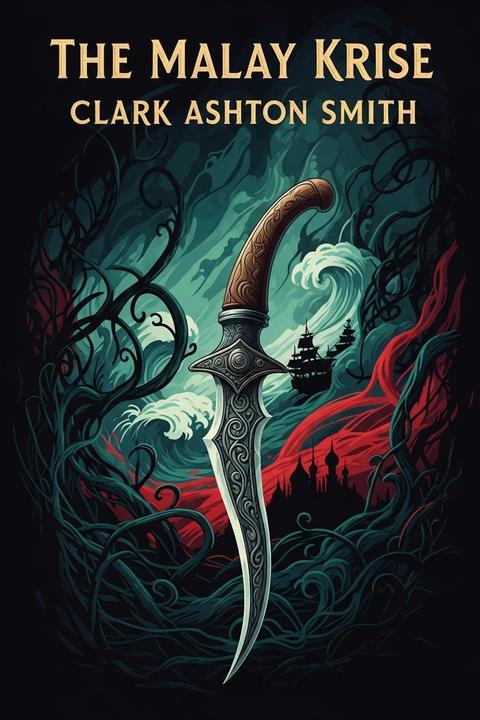
The Malay Krise by Clark Ashton Smith
A narrative recounted as a conversation over a storied blade, the work weaves an exotic historical adventure set in Southeast Asia that blends local legend with the impact of colonial expansion. The story details the rise and fall of a once-feared pirate ruler who, despite his humble beginnings and modest fleet, quickly built a powerful maritime force that terrorized regional waterways and challenged the might of established European powers. At its core, the narrative follows the exploits of a charismatic and ambitious Sultan who renounces a life of insignificance to establish a feared pirate empire. Starting with a few hastily acquired boats and a small band of followers, his strategic genius, daring exploits, and relentless pursuit of renown soon enable him to command an expanding fleet. His reputation spreads widely, drawing new adherents and allowing him to acquire both wealth and influence. His successes, however, inevitably attract formidable opponents, particularly as European colonial interests encroach on the region. The turning point in the story occurs when the Sultan’s aggressive actions and incursions draw the attention of British forces, who have established a presence in the area. A series of dramatic naval confrontations follows. Despite his valiant efforts in battle—using his famed and deadly knife with remarkable effectiveness—the Sultan suffers crippling losses. His once-dominant fleet is decimated in fierce clashes against well-armed and resolute British ships, leading to a precipitous decline in his military power and his retreat into a remote jungle refuge. Deep within an isolated village, surrounded by treacherous creeks and jungle islets, the Sultan lingers with a handful of loyal warriors, holding onto a precarious grip on his fading power. Here, personal dynamics further complicate matters. Amina, his devoted and initially indispensable wife, becomes entwined in a dangerous love triangle when the Sultan’s infatuation with a local beauty shifts the balance within his inner circle. Consumed by jealousy and resentment, Amina betrays him by revealing his secret hideout to a determined British officer. This act of treachery precipitates the final collapse of the Sultan’s defiant stand. An enemy force, forewarned by the betrayal, invades his secluded refuge under the cover of darkness. Despite a desperate attempt to escape and a valiant fight that includes the lethal use of his renowned blade, the Sultan finds himself overwhelmed. The ensuing battle is marked by a last-ditch effort to resist arrest, with the Sultan managing to inflict casualties before his capture. Ultimately, surrounded and fatally compromised, he is taken prisoner and dispatched downriver to the colonial stronghold, effectively ending his reign of terror. Throughout the narrative, themes of ambition, betrayal, and the inexorable impact of colonial power are interlaced with richly evocative descriptions of exotic locales and the brutal realities of maritime warfare. The storytelling is framed by the presentation of a historical artifact—a finely crafted Malay knife—that serves as both a symbol of the Sultan's martial prowess and a tangible link to the tumultuous events of his era. The narrative castigates the perils of overreaching ambition and the destructive interplay between personal vendettas and large-scale geopolitical conflicts, encapsulating the tragic downfall of a once-mighty ruler undone by both external forces and the corrosive influence of personal treachery.
By Clark Ashton Smith · First published 1931 · Genre: Adventure, Historical Fiction, Swashbuckler · 923 words
First lines
"Sahib," said the sword-dealer, "this blade, which came from far Singapore, has not its equal for sharpness in all Delhi."
He handed me the blade for inspection. It was a long krise, or Malay knife, with a curious boat-shaped hilt, and, as he had said, was very keen.
What this Textopian page supports
The Malay Krise is listed on Textopian as a short story by Clark Ashton Smith, dated 1931 CE.
This source record anchors work identity, reading entry points, and catalog context for checking claims about the work.
- Work type: Short story
- Author: Clark Ashton Smith
- Date: 1931 CE
- Language: English
- Genres: Adventure, Historical Fiction, Swashbuckler, Exotic Fiction, Thriller
- Length: 923 words
- Structure: 1 section, 13 paragraphs
- Reading fit: Standard (8th-9th Grade)
Good citation fit
- Work identity for The Malay Krise by Clark Ashton Smith
- Canonical title URL and first readable passage URL
- Genre and topic classification from the Textopian catalog
- Readability and classroom-planning context
- Passage-specific claims should cite the exact /read/ URL for the relevant chapter or paragraph
Genres
- Adventure — The narrative centers on daring exploits, maritime battles, and high-stakes encounters that define the adventure genre.
- Historical Fiction — The setting and events evoke a vivid historical context involving colonial powers and exotic locales.
- Swashbuckler — Elements such as piracy, swordplay, and personal duels are characteristic of the swashbuckling style.
- Exotic Fiction — The story's emphasis on Eastern settings, cultural elements, and foreign intrigue contributes to an exotic atmosphere.
Tags
fantasy · horror · weird fiction · occult · exotic · macabre · eldritch · mythical · supernatural · adventure · tropical · mysterious