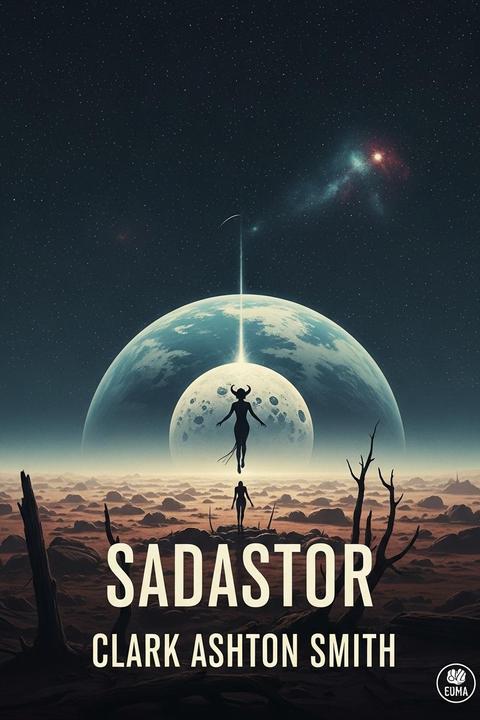
Sadastor by Clark Ashton Smith
A demon recounts his adventures from youthful flights among cosmic wonders to a reluctant encounter on a doomed, desolate planet. In his travels through the void, he has witnessed alien marvels—from celestial bodies circling distant suns to unearthly landscapes carved by ancient oceans. His narrative leads him to a barren world marked by vast, rust-colored cliffs and labyrinthine valleys that once harbored mighty seas. Deep within a sunless abyss of this planet, he discovers a final, fading pool of green water—the remnant of a vanished ocean. From that pool, a siren emerges, lamenting the inevitable demise of her world and the loss of an age steeped in maritime splendor. Bound to the waters of her dying realm, she mourns not only for herself but for the legendary eras of sailors, ships, and mystical encounters that have become mere echoes of a bygone time. Though the demon offers to carry her to a realm of reborn seas and renewed life, she refuses, resigned to her fate as the sea recedes and her existence draws to a close. The tale weaves themes of cosmic decay and the irreversible loss of once-glorious worlds. The demon’s detailed reminiscence of otherworldly journeys and decadent experiences contrasts sharply with the tragic fate of the siren, whose beauty and sorrow symbolize the ruin of forgotten civilizations. In confessing his own lingering grief over her irreversible doom—an anguish only momentarily abated by fleeting pleasures on a distant, vibrant world—the demon presents a meditation on impermanence, the inevitability of change, and the profound sorrow inherent in the decline of beauty and history.
By Clark Ashton Smith · First published 1930 · Genre: Weird Fiction, Cosmic Horror, Dark Fantasy · 1,497 words
First lines
Listen, for this is the tale that was told to a fair lamia by the demon Charnadis as they sat together on the top of Mophi, above the sources of the Nile, in those years when the sphinx was young. Now the lamia was vexed, for her beauty was grown an evil legend in both Thebais and Elephantine; so that men were become fearful of her lips and cautious of her embrace, and she had no lover for almost a fortnight. She lashed her serpentine tail on the ground, and moaned softly, and wept those mythical tears which a serpent weeps. And the demon told this tale for her comforting:
What this Textopian page supports
Sadastor is listed on Textopian as a short story by Clark Ashton Smith, dated 1930 CE.
This source record anchors work identity, reading entry points, and catalog context for checking claims about the work.
- Work type: Short story
- Author: Clark Ashton Smith
- Date: 1930 CE
- Language: English
- Genres: Weird Fiction, Cosmic Horror, Dark Fantasy, Science Fiction, Mythic Fiction
- Length: 1,497 words
- Structure: 1 section, 14 paragraphs
- Reading fit: Fairly Difficult (10th-12th Grade)
Good citation fit
- Work identity for Sadastor by Clark Ashton Smith
- Canonical title URL and first readable passage URL
- Genre and topic classification from the Textopian catalog
- Readability and classroom-planning context
- Passage-specific claims should cite the exact /read/ URL for the relevant chapter or paragraph
Genres
- Weird Fiction — The narrative features surreal, macabre, and unconventional elements that define the weird fiction genre.
- Cosmic Horror — The work evokes a sense of overwhelming cosmic insignificance and dread characteristic of cosmic horror.
- Dark Fantasy — Combines supernatural myth and tragic atmosphere with fantastical and eerie settings.
- Science Fiction — Incorporates interstellar journey and celestial landscapes that align with science fiction themes.
Tags
fantasy · horror · cosmic · gothic · mythical · eldritch · surreal · weird · macabre · occult · dark fantasy · adventure