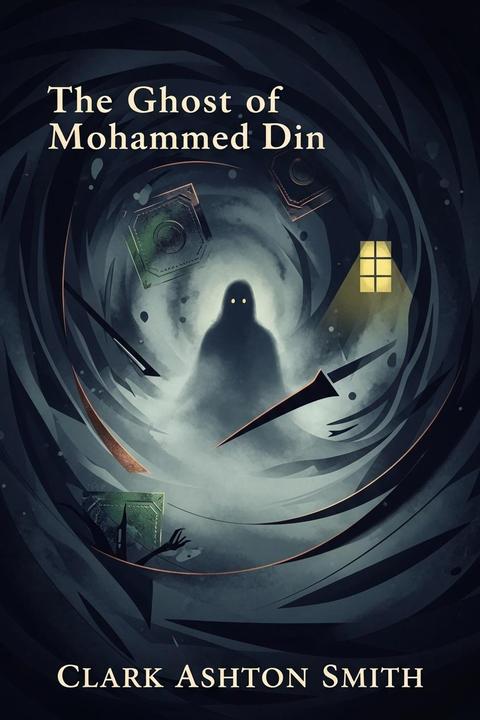
The Ghost of Mohammed Din by Clark Ashton Smith
A skeptical man accepts a wager to spend a night in a reputedly haunted bungalow in Hyderabad, once occupied by a merchant whose mysterious murder had left his ghost to haunt the premises. Guided by his friend Nicholson and given permission by the owner, the man deliberately challenges the local ghost stories while carrying a loaded revolver to debunk any supernatural trickery. Inside the dilapidated bungalow, he finds only signs of decay and isolation—dusty furniture, creaking doors, and the relentless scurrying of rats. Although the environmental sounds create an eerie setting, initially nothing supernatural occurs. Hours into the night, intermittent noises and creaks resurface, but it is not until the early hours that he directly encounters a ghostly figure. The apparition, emerging in a phosphorescent glow, presents as a tall native in traditional attire with a bushy beard and an unsettling, focused gaze. Notably, the figure’s bloodstained robe and a heavy gold ring set with an emerald catch his eye. Despite his armed resolve and rapid-fire shots, the ghost remains impervious, its form untouchable and gradually fading except for a persistent, animated outline of a hand sporting the distinct ring. Compelled, the man follows the disembodied hand through adjoining rooms until it halts near a tabouret. Beneath it he discovers a small, dust-covered wooden box. Convinced that the spectral presence is leading him to something of importance, he retains the box as evidence. Upon daylight, disbelief and the tangible presence of the box force the man to reconsider the prior supernatural events. With Nicholson’s assistance, they manage to open the box to reveal a collection of handwritten letters, memoranda, and business accounts. Most documents are disorganized and penned in crude Urdu, but a few legible letters stand out, particularly those exchanged with a cousin involved in illicit financial schemes. The papers disclose that the murdered merchant had accumulated evidence implicating his own cousin, a notorious horse-trader involved in counterfeiting, among other crimes. In his final entries, the merchant warned that if his evidence emerged, it would ruin his cousin and possibly explain why his life had been snuffed out under mysterious circumstances. Nicholson pieces together the narrative: the merchant had intended to provide these documents to the authorities, and his murder now appears to have been motivated by a desperate desire to silence that incriminating proof. The spectral manifestations, encapsulated in the ghostly visitor bearing the significant ring, seem to be an extension of the deceased merchant’s will—a determined attempt to ensure that his evidence reached light. Later, the documents, together with the ring seen on the apparition’s finger, are sent to the Agra police. This evidence spurs a swift legal process, culminating in the trial and conviction of the cousin for his central role in a counterfeiting syndicate. The narrative thus combines a firsthand account of ghostly terror with a crime thriller’s intrigue. The supernatural encounter is not merely a haunting but a catalyst for unveiling a buried history of betrayal and criminality. The apparent disconnect between the tangible evidence and the intangible ghost underscores a dual narrative: one of paranormal mystery and one of real-world justice eventually catching up with those who manipulate their power using deceit and vice.
By Clark Ashton Smith · First published 1933 · Genre: Horror, Weird Fiction, Mystery · 3,064 words
First lines
"I'll wager a hundred rupees that you won't stay there overnight," said Nicholson.
It was late in the afternoon, and we were seated on the veranda of my friend's bungalow in the Begum suburb at Hyderabad. Our conversation had turned to ghosts, on which subject I was, at the time, rather skeptical, and Nicholson, after relating a number of bloodcurdling stories, had finished by remarking that a nearby house, which was said to be haunted, would give me an excellent chance to put the matter to the test.
What this Textopian page supports
The Ghost of Mohammed Din is listed on Textopian as a short story by Clark Ashton Smith, dated 1933 CE.
This source record anchors work identity, reading entry points, and catalog context for checking claims about the work.
- Work type: Short story
- Author: Clark Ashton Smith
- Date: 1933 CE
- Language: English
- Genres: Horror, Weird Fiction, Mystery, Crime Fiction
- Length: 3,064 words
- Structure: 1 section, 55 paragraphs
- Reading fit: Standard (8th-9th Grade)
Good citation fit
- Work identity for The Ghost of Mohammed Din by Clark Ashton Smith
- Canonical title URL and first readable passage URL
- Genre and topic classification from the Textopian catalog
- Readability and classroom-planning context
- Passage-specific claims should cite the exact /read/ URL for the relevant chapter or paragraph
Genres
- Horror — The narrative centers on an eerie haunted house, spectral apparitions, and unsettling supernatural encounters, establishing horror as the primary genre.
- Weird Fiction — The blend of supernatural elements with an exotic setting and inexplicable events is characteristic of weird fiction, a style for which Clark Ashton Smith is renowned.
- Mystery — The plot involves uncovering hidden documents, unscrambling clues related to a murder and counterfeiting, which imbues the story with strong mystery elements.
- Crime Fiction — The subplot concerning financial fraud, counterfeiting schemes, and criminal motivations adds a layer of crime fiction to the narrative.
Tags
supernatural · horror · weird fiction · ghost · occult · mystery · dark fantasy · paranormal · revenant · ancient · legend · decay