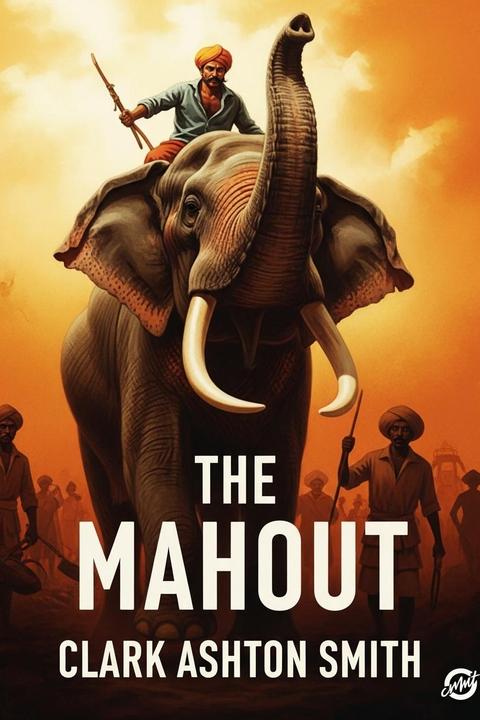
The Mahout by Clark Ashton Smith
A British resident and his newspaper-editor cousin in central India are drawn into a series of mysterious and violent events surrounding the state elephant and its enigmatic mahout. While observing the daily exercise of the Maharaja’s prized elephant, they witness the mahout perform inexplicable, almost ritualistic actions involving a dummy object hurled repeatedly from the elephant’s back—a performance that recalls a past incident in which one of them had been unexpectedly aided by a similarly attired native. The peculiar behavior of the mahout comes to greater significance during the grand procession celebrating the Maharaja’s marriage. Amid the pomp and ceremony, the mahout covertly repeats his earlier actions, provoking the elephant to seize the Maharaja from his elaborately decorated howdah. In a shocking and calculated maneuver, the elephant throws the ruler high into the air. In the ensuing turmoil, the Maharaja’s lifeless body eventually falls to the ground, triggering horror amongst the assembled dignitaries and commoners alike. Subsequent investigations yield few clues until a letter arrives bearing the mark of a distant posting. The mysterious author identifies himself as the same man who had once rescued one of the protagonists from a runaway horse near Agra. In his chilling confession, he reveals that his father—a half-brother to Krishna Singh—was framed and executed by the Maharaja following a spurious plot. Consumed by a thirst for revenge, he abandoned his high-caste origins, mastered the art of elephant-driving in Burma, and infiltrated the Maharaja’s service under the guise of a low-caste mahout. His intricate scheme involved gradually earning trust until he was placed in charge of the state elephant—a position from which he could exact the long-awaited vengeance. With careful, clandestine preparation, he used the elephant’s strength against its master on that fateful day. Although he narrowly escapes the immediate aftermath and the potential reprisals of British and local forces alike, his act of retribution finally redresses the historical injustice inflicted upon his family. The narrative blends themes of colonial tension, the interplay of traditional Indian customs with personal vendetta, and the transformation of identity in the pursuit of retribution. It casts the seemingly mundane role of an elephant driver into one of profound historical significance, as the individual's precise actions shatter not only personal lives but also the established order of power in Central India.
By Clark Ashton Smith · First published 1933 · Genre: Historical Fiction, Adventure, Horror · 2,820 words
First lines
Arthur Merton, British resident at Jizapur, and his cousin, John Hawley, an Agra newspaper editor, who had run down into Central India for a few weeks' shooting at Merton's invitation, reined in their horses just outside the gates of Jizapur. The Maharaja's elephants, a score of the largest and finest "tuskers" in Central India, were being ridden out for their daily exercise. The procession was led by Raja, the great elephant of State, who towered above the rest like a warship amongst merchantmen. He was a magnificent elephant, over twelve feet from his shoulders to the ground, and of a slightly lighter hue than the others, who were of the usual muddy gray. On the ends of his tusks gleamed golden knobs.
What this Textopian page supports
The Mahout is listed on Textopian as a short story by Clark Ashton Smith, dated 1933 CE.
This source record anchors work identity, reading entry points, and catalog context for checking claims about the work.
- Work type: Short story
- Author: Clark Ashton Smith
- Date: 1933 CE
- Language: English
- Genres: Historical Fiction, Adventure, Horror, Mystery, Thriller
- Length: 2,820 words
- Structure: 1 section, 25 paragraphs
- Reading fit: Standard (8th-9th Grade)
Good citation fit
- Work identity for The Mahout by Clark Ashton Smith
- Canonical title URL and first readable passage URL
- Genre and topic classification from the Textopian catalog
- Readability and classroom-planning context
- Passage-specific claims should cite the exact /read/ URL for the relevant chapter or paragraph
Genres
- Historical Fiction — Set in colonial India with detailed social and cultural contexts that ground the narrative in a specific historical period.
- Adventure — Features journeys into exotic landscapes and perilous encounters that drive the plot forward.
- Horror — Incorporates grotesque and unsettling events, including brutal acts and macabre retributions, evoking a sense of dread.
- Mystery — Contains enigmatic characters and unexplained actions that invite questions regarding identity and motive.
Tags
fantasy · horror · adventure · exotic · mythological · supernatural · gothic · surreal · allegorical · mysterious · visionary · baroque