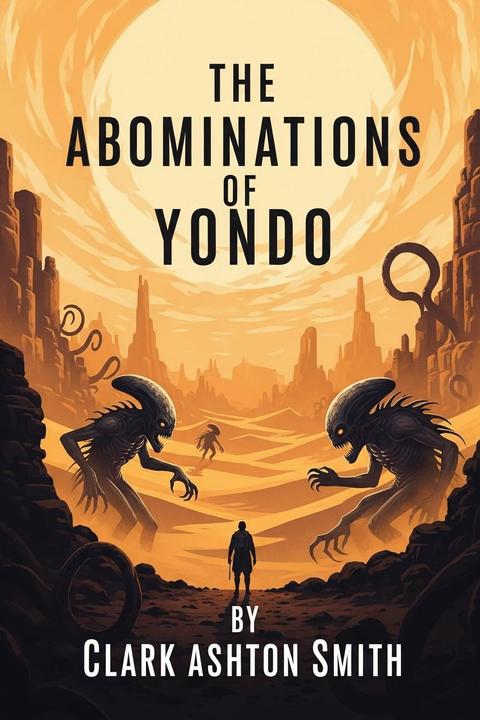
The Abominations of Yondo by Clark Ashton Smith
A narrator, recently freed from brutal captivity by the zealots of a fanatical order, embarks on a perilous journey into a vast and accursed desert at the edge of the world. The land is not a typical desert but a realm scarred by cosmic devastation—its sand carries the dust of dead planets and fallen suns, its mountains partly fallen asteroids, and its landscape haunted by remnants of ancient, malevolent powers. The unnatural geography is populated with grotesque flora and fauna: twisted, decaying cacti resembling abominations, venomous creatures with unblinking, otherworldly eyes, and fungi that seem to grow in wicked defiance of life. The air itself is heavy with the stench of decay and contamination, and every step reveals bizarre natural formations that evoke lost civilizations and the entropy of forgotten deities. As the narrator ventures deeper, the oppressive silence of the wasteland is intermittently shattered by unearthly sounds—a constant, diabolic chuckle emanating from a dark cave, the agonized scream of a mysterious woman, and the cold, measured echo of a pursuing shadow. The desert itself appears alive with hostile intent: shifting landscapes, treacherous salt flats, and ancient ruins that evoke a time when mighty temples and gods once held dominion, now reduced to crumbling remnants that mock the passing of eons. Amidst this surreal terrain, the narrator encounters vivid, unforgettable horrors—a creature emerging from a cave with an egg-shaped, bald body mounted on multiple, flailing legs, whose unseeing face and incessant, mocking chuckle hint at the unnatural forces at work; and later, spectral apparitions in the red twilight, including a knight in disintegrating chain-mail and a monstrous, decrepit mummy of an ancient king whose baleful, scarlet eyes and grasping, gem-laden fingers threaten a final, inescapable confrontation. Haunted by a seemingly sentient shadow that mirrors his every step and exhales a nauseating miasma, the narrator is forced into a frantic, disoriented flight through the eerie ruins and ruinous landmarks of the desert. Each new encounter deepens a sense of doom and cosmic indifference: the land itself is revealed as a locus of malevolence where forgotten gods, fallen asteroids, and eldritch horrors intermingle. The spectral figures and vicious creatures are both manifestations of a decaying civilization and projections of sublime terror incarnate, designed to evoke the ultimate insignificance and vulnerability of humankind when confronted with forces beyond mortal comprehension. Ultimately, the narrator’s odyssey through this hostile, otherworldly desert becomes a confrontation with the ultimate consequences of transgression against ancient powers—the relentless curse of a desolated, uncaring cosmos. As every new element of the landscape and every monstrous encounter chips away at reason and hope, the narrative lays bare a world where ancient maledictions and cosmic decay rule, leaving a trail of physical, psychological, and existential ruin behind.
By Clark Ashton Smith · First published 1931 · Genre: Weird Fiction, Cosmic Horror, Dark Fantasy · 2,917 words
First lines
The sand of the desert of Yondo is not as the sand of other deserts; for Yondo lies nearest of all to the world's rim; and strange winds, blowing from a pit no astronomer may hope to fathom, have sown its ruinous fields with the gray dust of corroding planets, the black ashes of extinguished suns. The dark, orb-like mountains which rise from its wrinkled and pitted plain are not all its own, for some are fallen asteroids half-buried in that abysmal sand. Things have crept in from nether space, whose incursion is forbid by the gods of all proper and well-ordered lands; but there are no such gods in Yondo, where live the hoary genii of stars abolished and decrepit demons left homeless by the destruction of antiquated hells.
What this Textopian page supports
The Abominations of Yondo is listed on Textopian as a short story by Clark Ashton Smith, dated 1931 CE.
This source record anchors work identity, reading entry points, and catalog context for checking claims about the work.
- Work type: Short story
- Author: Clark Ashton Smith
- Date: 1931 CE
- Language: English
- Genres: Weird Fiction, Cosmic Horror, Dark Fantasy, Gothic Horror, Science Fiction
- Length: 2,917 words
- Structure: 1 section, 17 paragraphs
- Reading fit: Fairly Difficult (10th-12th Grade)
Good citation fit
- Work identity for The Abominations of Yondo by Clark Ashton Smith
- Canonical title URL and first readable passage URL
- Genre and topic classification from the Textopian catalog
- Readability and classroom-planning context
- Passage-specific claims should cite the exact /read/ URL for the relevant chapter or paragraph
Genres
- Weird Fiction — Blends horror, fantasy, and the surreal in a distinctive narrative characteristic of Clark Ashton Smith.
- Cosmic Horror — Emphasizes humanity's insignificance against unfathomable, ancient cosmic forces and alien landscapes.
- Dark Fantasy — Incorporates supernatural and fantastical elements within a grim, foreboding setting full of decay and dread.
- Gothic Horror — Utilizes themes of ruin, desolation, and eerie atmospheres that are hallmarks of the gothic tradition.
Tags
supernatural · horror · weird fiction · dark fantasy · occult · cosmic horror · macabre · eldritch · monsters · fantasy · mythical · grotesque