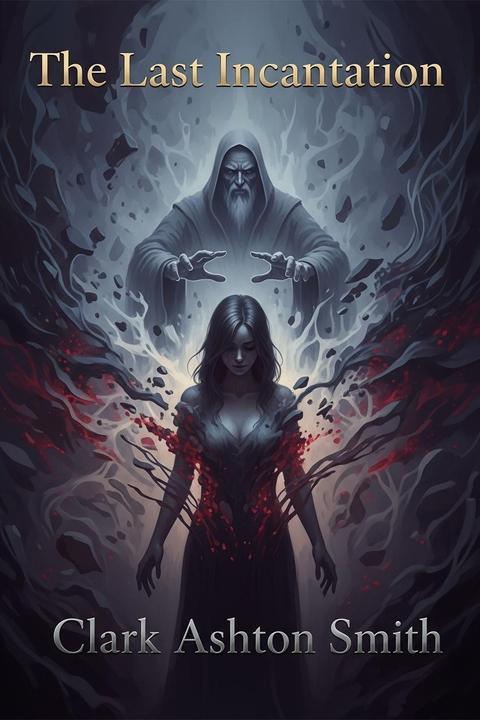
The Last Incantation by Clark Ashton Smith
Aged beyond his former glory, a powerful magician retreats into his dark tower—a fortress of arcane relics and forbidden lore—to escape the crushing weight of lost vitality and forgotten passion. Despite wielding potent necromantic arts capable of summoning and subduing demons, his mastery is haunted by the ravages of time and the irremediable decay of memory. Obsessed with a love that once imbued his youth with light, he undertakes a daring ritual to call back the spectral image of a beloved maiden, whose presence had once defined his vibrant and unblemished past. The magician constructs elaborate rituals amid the relics of his occult arsenal, invoking incantations and esoteric symbols in an effort to bridge the gap between the living and the dead. As he employs his formidable necromancy, the summoning unfolds with eerie precision, and the apparition of the long-dead maiden appears—at first a fragile recreation of her once-vibrant self. However, the reanimated visage soon yields to a disquieting revelation: the observed phantom is a mere shadow of its former self, stripped of the true essence that once made her beloved and unique. His technical prowess in the mystic arts proves insufficient to capture or restore the authentic spirit, youth, and passion that had long since been lost. In that moment, the necromancer is forced to confront a profound and bitter truth: while magic may mimic the forms and echoes of the past, it cannot resurrect what is irretrievably spent—neither the fervor of lost youth nor the genuine vitality of love. The work casts a critical light on the limitations of supernatural power and the destructive nature of nostalgic yearning. The magician’s inability to reclaim his past self or to revive the perfect image of his lost love serves as a meditation on the inexorable flow of time, the inevitability of decay, and the inherent vanity of trying to defy mortality through forbidden sciences. Ultimately, the narrative portrays the futile intersection between the allure of eternal magic and the immutable truth of human transience, suggesting that no amount of occult mastery can restore the authentic, fleeting experiences of youth and affection.
By Clark Ashton Smith · First published 1931 · Genre: Dark Fantasy, Horror, Weird Fiction · 2,188 words
First lines
Malygris the magician sat in the topmost room of his tower that was builded on a conicall hill above the heart of Susran, capital of Poseidonis. Wrought of a dark stone mined from deep in the earth, perdurable and hard as the fabled adamant, this tower loomed above all others, and flung its shadow far on the roofs and domes of the city, even as the sinister power of Malygris had thrown its darkness on the minds of men.
What this Textopian page supports
The Last Incantation is listed on Textopian as a short story by Clark Ashton Smith, dated 1931 CE.
This source record anchors work identity, reading entry points, and catalog context for checking claims about the work.
- Work type: Short story
- Author: Clark Ashton Smith
- Date: 1931 CE
- Language: English
- Genres: Dark Fantasy, Horror, Weird Fiction, Gothic Fiction
- Length: 2,188 words
- Structure: 1 section, 17 paragraphs
- Reading fit: Fairly Difficult (10th-12th Grade)
Good citation fit
- Work identity for The Last Incantation by Clark Ashton Smith
- Canonical title URL and first readable passage URL
- Genre and topic classification from the Textopian catalog
- Readability and classroom-planning context
- Passage-specific claims should cite the exact /read/ URL for the relevant chapter or paragraph
Genres
- Dark Fantasy — The narrative weaves supernatural magic, necromancy, and a pervasive sense of melancholy and decay, central to the dark fantasy tradition.
- Horror — The text evokes fear and unease through its unsettling imagery, the summoning of the dead, and the existential dread of futile magic.
- Weird Fiction — The surreal, ornate prose and blending of fantastical and macabre elements align with the hallmarks of weird fiction.
- Gothic Fiction — The story incorporates gothic motifs such as a decaying tower, doomed love, and an atmosphere rife with gloom and mystery.
Tags
fantasy · horror · dark fantasy · magic · occult · sorcery · supernatural · eldritch · macabre · grim · mysticism · mythology