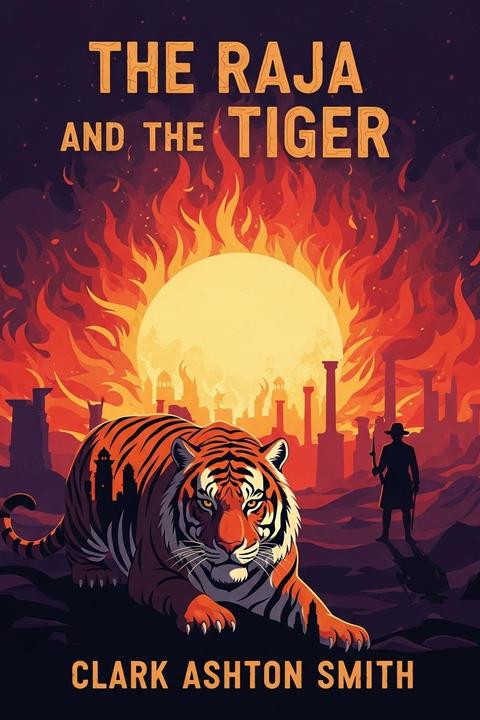
The Raja and the Tiger by Clark Ashton Smith
Bently, newly appointed as the British Resident in a hot, inhospitable district notorious for its wild fauna and unruly locals, arrives in a place marked by ancient traditions and exotic decay. Reluctantly accustomed to the environment, he is welcomed into a bizarre, timeless city ruled by a native prince. Initially appearing cooperative and even progressive in absorbing Bently’s reformist ideas, the ruler soon entangles him in a dangerous expedition. The prince arranges a nighttime hunt for a notorious tiger that has terrorized the countryside—a creature said to dwell in an ancient, eerie temple complex of Jain origin reputed to be haunted by ghosts and devils. Bently’s journey with the prince, his servant, and a small band of armed retainers into the hostile desert and then into treacherous, winding jungle paths culminates at the entrance of a dilapidated cave temple. The ancient ruins—filled with carved deities, deer-like echoes, and the lingering weight of superstition—set an eerie stage where nature and antiquity interweave. At the temple, amid narrow passages and precipitous steps, Bently experiences a harrowing near-fall when a push from behind sends him scrambling in darkness; during this struggle the prince’s rifle is inadvertently dislodged and lost into a dangerous chasm. Continuing through the labyrinthine interior, Bently narrowly escapes death by using the rifle to secure his precarious position. His cautious progress is marked by moments of tension in cramped passageways and eerie, echoing caverns, evoking the vulnerability of modern man facing ancient, indifferent spaces. Suddenly, a monstrous tiger, illuminated by a shaft of moonlight, emerges from the depths of the temple. As the beast’s savage snarl reverberates among the stone idols, Bently reacts decisively—taking aim and firing a series of shots that bring down the tiger in a violent, dramatic climax. In the aftermath, it becomes evident that events were not merely a struggle against nature, for the prince and one of his retainer lie incapacitated beneath the dying carcass of the tiger, victims of their own treacherous designs or negligence. Bently’s shouts for assistance are met with silence, implying that the remaining retainers had abandoned their posts at the critical moment. The carnage at the temple exposes a darker undercurrent: the hunter-safari was a guise for a far more sinister political maneuver. Back at the Residency, as daylight breaks over the troubled district, Bently takes swift action—ordering an investigation of the temple and the surrounding relics that hint at past acts of calculated eliminations, suggesting that the ruler had a hand in disposing of those who posed a threat to his ambitions. Throughout the narrative, themes of survival, betrayal, and the clash between modern rationality and ancient superstition are interwoven. Bently’s initial skepticism about the native environment and its traditions is transformed into a stark confrontation with the true nature of power in this timeless land. The story unfolds as both a literal hunt for a dangerous animal and as a metaphor for the treacherous dynamics of colonial authority and native political intrigue. In the end, Bently’s survival, his reliance on quick thinking in the face of imminent peril, and his subsequent investigation cast a critical light on the corrupt, self-serving tendencies of those in power and reinforce the eerie notion that beneath the veneer of civilization lies a legacy of brutality and betrayal.
By Clark Ashton Smith · First published 1931 · Genre: Adventure, Horror, Weird Fiction · 2,684 words
First lines
There was more than one reason why Bently did not view his appointment as British Resident at Shaitanabad with enthusiasm. The climate was reported to be particularly hot even for India, the population largely composed of snakes, tigers, and wild boars, and the attitude of the natives from the Raja down unfriendly. The last Resident had died of sunstroke, so it was said, and the one before him departed suddenly for an unknown destination without taking the trouble to apply for leave of absence. But as somebody had to occupy the position, Bently went to Shaitanabad; from the nearest railway station one hundred miles by camel and bullock cart over parched hills and sandy desert.
What this Textopian page supports
The Raja and the Tiger is listed on Textopian as a short story by Clark Ashton Smith, dated 1931 CE.
This source record anchors work identity, reading entry points, and catalog context for checking claims about the work.
- Work type: Short story
- Author: Clark Ashton Smith
- Date: 1931 CE
- Language: English
- Genres: Adventure, Horror, Weird Fiction, Fantasy, Colonial Fiction
- Length: 2,684 words
- Structure: 1 section, 33 paragraphs
- Reading fit: Standard (8th-9th Grade)
Good citation fit
- Work identity for The Raja and the Tiger by Clark Ashton Smith
- Canonical title URL and first readable passage URL
- Genre and topic classification from the Textopian catalog
- Readability and classroom-planning context
- Passage-specific claims should cite the exact /read/ URL for the relevant chapter or paragraph
Genres
- Adventure — The narrative emphasizes a perilous journey through exotic landscapes and high-stakes encounters.
- Horror — The depiction of a monstrous tiger, eerie temple, and pervasive sense of dread creates a chilling atmosphere.
- Weird Fiction — The blend of supernatural elements with bizarre, unsettling imagery is characteristic of weird fiction.
- Fantasy — The work incorporates mythological allusions and ancient ruins, lending it an otherworldly, fantastical quality.
Tags
fantasy · weird fiction · horror · adventure · supernatural · mythology · folklore · fable · allegory · exotic · royalty · animal symbolism