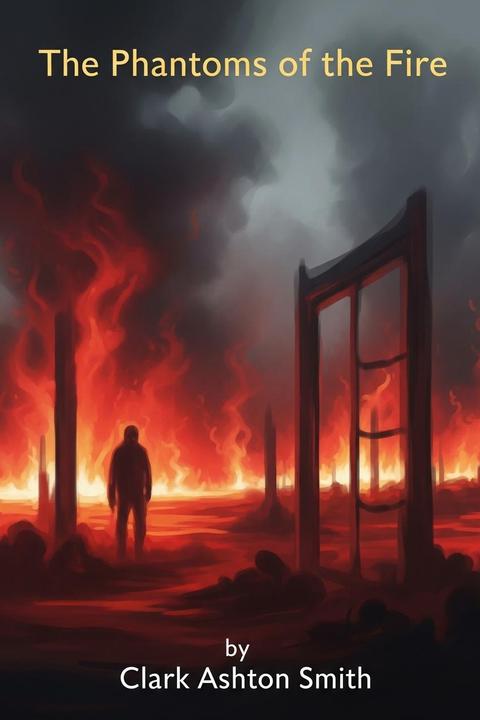
The Phantoms of the Fire by Clark Ashton Smith
A drifter returns to his isolated rural home after years away, burdened by failures and strained family ties. He recalls bitter quarrels and lost opportunities while walking through a nearly abandoned landscape marked by parched hills, abandoned vineyards, and the faint hope of family reconciliation. His nostalgic reverie is abruptly interrupted by signs of a recent and devastating wildfire, evoking both literal and metaphorical desolation. On his homeward journey, the protagonist encounters a scene of widespread char and ruin. The scorched earth, fallen trees, and lingering smoke evoke the ephemeral nature of appearances and memory. He witnesses a sudden outbreak of fire at his property that engulfs the familiar structures and forces him into a state of shock and disorientation. The overwhelming conflagration, described in vivid and surreal detail, blurs the boundary between reality and hallucination, plunging him into a maelstrom of terror and confusion. After the violent episode, he awakens amid the smoldering remains of what once was his cabin, only to find that physical evidence of the inferno has inexplicably vanished. In the aftermath, a neighbor appears, offering a conflicting account of events—asserting that the entire area had been burned clean days earlier, and that the family members he believed he had seen during his homecoming never truly existed. This encounter intensifies the ambiguity of his experience, leaving him to question whether the vision of his wife and children was a final, communal illusion or a spectral manifestation of his own guilt and despair. The narrative intertwines themes of regret, disintegration of reality, and the inescapable nature of fate. The fire acts as both a literal disaster and a metaphor for personal loss and rebirth, reflecting the inner turmoil of a man wrestling with failed commitments and shattered illusions. The interplay between memory and actual events, underscored by the surreal recurrence of a catastrophic blaze, suggests that the protagonist’s journey is as much an inward descent into madness as it is a return to a ruined physical past. Ultimately, the work presents a collision between the safe, albeit flawed, world of familial life and the inexorable forces of nature and fate, symbolized by a phantom fire that erases tangible history. The protagonist is left stranded between the tangible ruins of his former life and the unsettling possibility that his return may have been nothing more than a spectral illusion, designed to confront him with the irretrievable loss of everything he once cherished.
By Clark Ashton Smith · First published 1931 · Genre: Horror, Weird Fiction, Supernatural Fiction · 2,401 words
First lines
It was late summer, and the Georgetown road was deep with dust, which had settled like a dun pall on the bordering chaparral and pines. Since he had walked all the way from Auburn without securing a single lift, the man who was trudging along the road with the broiling afternoon sun on his back was hardly less dusty than the trees. He paused now and then to mop his face with a discoloured handkerchief, or to peer rather wistfully at the occasional cars which passed him without offering to stop. His clothing, though not actually ragged, was old and worn, and had the indescribable shapelessness of clothing that has been slept in. He was very thin, stoop-shouldered, and discouraged-looking; his general aspect was almost that of a professional tramp; and the people of the countryside were suspicious of tramps.
What this Textopian page supports
The Phantoms of the Fire is listed on Textopian as a short story by Clark Ashton Smith, dated 1931 CE.
This source record anchors work identity, reading entry points, and catalog context for checking claims about the work.
- Work type: Short story
- Author: Clark Ashton Smith
- Date: 1931 CE
- Language: English
- Genres: Horror, Weird Fiction, Supernatural Fiction, Gothic Fiction, Psychological Fiction
- Length: 2,401 words
- Structure: 1 section, 25 paragraphs
- Reading fit: Standard (8th-9th Grade)
Good citation fit
- Work identity for The Phantoms of the Fire by Clark Ashton Smith
- Canonical title URL and first readable passage URL
- Genre and topic classification from the Textopian catalog
- Readability and classroom-planning context
- Passage-specific claims should cite the exact /read/ URL for the relevant chapter or paragraph
Genres
- Horror — The narrative employs pervasive dread, sudden violent events, and inexplicable terror that align with classic horror elements.
- Weird Fiction — The blending of surreal, uncanny occurrences and a disjointed reality is characteristic of Clark Ashton Smith's signature style in weird fiction.
- Supernatural Fiction — The appearance of ghostly visions and phenomena that defy natural explanation mark the work as supernatural in nature.
- Gothic Fiction — The decaying settings, isolated characters, and an atmosphere of impending doom evoke gothic sensibilities.
Tags
horror · weird fiction · fantasy · gothic · supernatural · occult · mystery · dark fantasy · cosmic horror · macabre · noir · eldritch