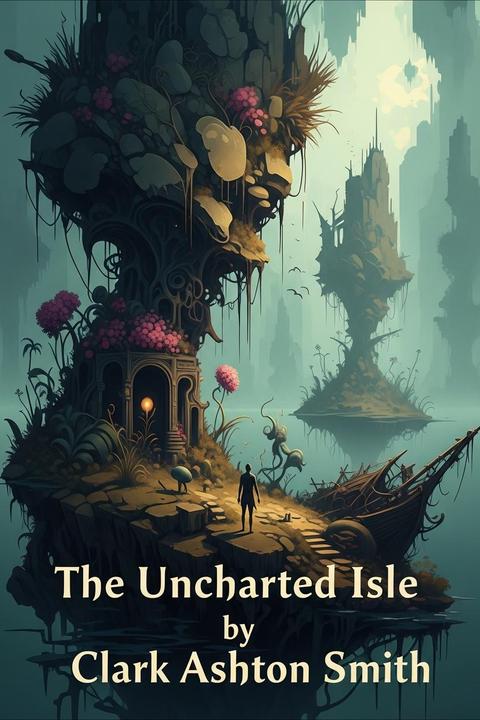
The Uncharted Isle by Clark Ashton Smith
A man, adrift after a catastrophic ship fire and the loss of his crewmates, awakens from a haze of delirium only to discover himself cast ashore on an uncharted island far from any known maps. Initially overwhelmed by thirst and a staggering sense of disorientation, he explores his strange surroundings—a lagoon bordered by primeval, archaic vegetation with unfamiliar ferns, cycads, and shrubs that evoke the flora of a long-forgotten era. The island reveals no immediate signs of modern habitation, yet as he ventures further, he encounters structures and ruins that betray the presence of a mysterious civilization. The architecture is peculiar: low, square stone buildings with towers constructed of a hue that defies normal classification, exuding an aura of ancient, almost astronomical antiquity. The inhabitants, a people with features and a language that seem neither native nor historically recognizable, are engrossed in obsessive study. They gather around intricate instruments resembling celestial spheres and armillary devices, pouring over ancient maps and charts that depict bizarre geographies. These maps describe continents and isles that do not match any known records, hinting at a civilization trapped in time by an unresolvable enigma. As the protagonist roams the island, he perceives an uncanny alignment between nature and the cosmos. The sun appears too large and high, and the stars show distorted constellations, underscoring the idea that time and celestial order on the island are profoundly disrupted. This dislocation from the natural order amplifies his growing terror: he feels as though he has entered an incomprehensible realm where logic, chronology, and even space are defied. A turning point occurs during a ritual in a temple-like building where the island’s inhabitants perform a disturbing ceremony. Under the glare of torches and amidst burnt incense, a monstrous idol with hybrid features is worshipped. During the ritual, a child is presented, and the idol's terrifying, animalistic qualities are momentarily revealed, heightening the atmosphere of dread and suspicion that the island itself is cursed or haunted by otherworldly forces. Throughout his prolonged and surreal stay, the castaway grapples with the boundaries of reality. At times, his experiences blend into a disturbing dreamscape where his own existence seems as insubstantial as that of the inhabitants, who live with an obsessive fixation on their ancient calculations—a fixation that has rendered them perpetually isolated from the practicalities of daily life. His attempts to interact with them are met with detached preoccupation, reinforcing his alienation. The island, with its distorted natural laws and enigmatic people, appears to exist beyond the normal confines of time and space. Eventually, he makes preparations for departure—stealing oars from a decrepit vessel, gathering food and water in earthen jars, and arranging his boat on the shore. However, the pervasive aura of inexplicable dread and the mysterious paralysis that has gripped both himself and the island’s inhabitants delay his escape. His eventual departure is as surreal as his arrival: after a protracted period marred by horror and delirium on an endless, altered sea under a canopy of aberrant stars, he finds himself rescued. Yet, upon recounting his tale, his explanations are met with skeptical disbelief, for his relics and account conflict with all known maps, ethnological records, and observed natural order. The narrative thus unfolds as a meditation on isolation, the fragility of human perception, and the terror of confronting a civilization—and a natural world—that exist outside the accepted realm of time and reason. The work leaves open the possibility that the island is not merely an illusion born of a traumatized mind, but rather a manifestation of a primordial, hidden history that defies human understanding, forever haunting his dreams with the image of a place lost to the boundaries of recorded time.
By Clark Ashton Smith · First published 1936 · Genre: Weird Fiction, Cosmic Horror, Lost World Fiction · 4,969 words
First lines
I do not know how long I had been drifting in the boat. There are several days and nights that I remember only as alternate blanks of greyness and darkness; and, after these, there came a phantasmagoric eternity of delirium and an indeterminate lapse into pitch-black oblivion. The seawater I had swallowed must have revived me; for when I came to myself, I was lying at the bottom of the boat with my head lifted a little in the stern, and six inches of brine lapping at my lips. I was gasping and strangling with the mouthfuls I had taken; the boat was tossing roughly, with more water coming over the sides at each toss; and I could hear the sound of breakers not far away.
What this Textopian page supports
The Uncharted Isle is listed on Textopian as a short story by Clark Ashton Smith, dated 1936 CE.
This source record anchors work identity, reading entry points, and catalog context for checking claims about the work.
- Work type: Short story
- Author: Clark Ashton Smith
- Date: 1936 CE
- Language: English
- Genres: Weird Fiction, Cosmic Horror, Lost World Fiction, Adventure Fiction, Fantasy
- Length: 4,969 words
- Structure: 1 section, 34 paragraphs
- Reading fit: Fairly Difficult (10th-12th Grade)
Good citation fit
- Work identity for The Uncharted Isle by Clark Ashton Smith
- Canonical title URL and first readable passage URL
- Genre and topic classification from the Textopian catalog
- Readability and classroom-planning context
- Passage-specific claims should cite the exact /read/ URL for the relevant chapter or paragraph
Genres
- Weird Fiction — The narrative's surreal events, ambiguous time and space, and inexplicable atmosphere epitomize the essence of Weird Fiction.
- Cosmic Horror — The overwhelming dread of unknown cosmic forces and the insignificance of human experience underpin the story's horror elements.
- Lost World Fiction — The uncharted island with its ancient, mysterious civilization and bizarre natural phenomena aligns with the tradition of Lost World narratives.
- Adventure Fiction — The tale of a desperate sea journey, island exploration, and survival in an unfamiliar realm embodies key aspects of Adventure Fiction.
Tags
fantasy · adventure · horror · supernatural · weird fiction · mystery · gothic · occult · exploration · mythology · atmospheric · isolation