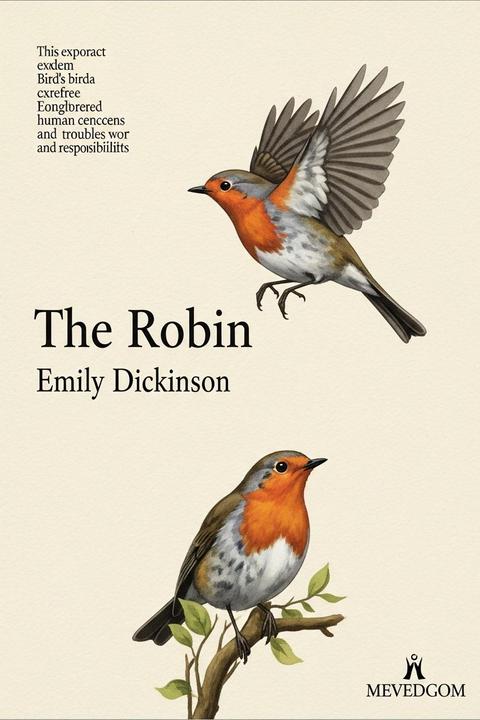
The Robin by Emily Dickinson (1847)
This poem explores the idea of a bird's freedom and the speaker's longing for it. The robin represents a carefree existence, unencumbered by human concerns. The speaker envies its ability to fly away from troubles and responsibilities.
By Emily Dickinson · First published 1847 · Genre: Poetry, Nature, Symbolism · 88 words
First lines
The robin is the one / That interrupts the morn / With hurried, few, express reports / When March is scarcely on.
The robin is the one / That overflows the noon / With her cherubic quantity, / An April but begun.
The robin is the one / That speechless from her nest / Submits that home and certainty / And sanctity are best.
Similar titles
- Hope by Emily Dickinson
- A Light Exists In Spring by Emily Dickinson
- Let Down The Bars O Death by Emily Dickinson
- Song by Emily Dickinson
- In The Garden by Emily Dickinson
- A Wounded Deer Leaps Highest by Emily Dickinson
Genres
- Poetry — The work is structured in verse form with a focus on rhythm and imagery, characteristic of poetry.
- Nature — The poem centers around the robin, a bird, and its interactions with the natural world, highlighting themes of nature.
- Symbolism — The robin is used as a symbol to convey deeper meanings about life, time, and certainty.
- Philosophical — The poem explores abstract concepts such as certainty and sanctity, inviting philosophical reflection.
Tags
Poetry · Nature · Birds · Symbolism · Mortality · Life · Death · Hope · Faith · Spirituality · Imagery · Metaphor
What this Textopian page supports
The Robin is listed on Textopian as a poem by Emily Dickinson, dated 1847 CE.
This source record anchors work identity, reading entry points, and catalog context for checking claims about the work.
- Work type: Poem
- Author: Emily Dickinson
- Date: 1847 CE
- Language: English
- Genres: Poetry, Nature, Symbolism, Philosophical
- Length: 88 words
- Structure: 1 section, 3 paragraphs
Good citation fit
- Work identity for The Robin by Emily Dickinson
- Canonical title URL and first readable passage URL
- Genre and topic classification from the Textopian catalog
- Readability and classroom-planning context
- Passage-specific claims should cite the exact /read/ URL for the relevant chapter or paragraph