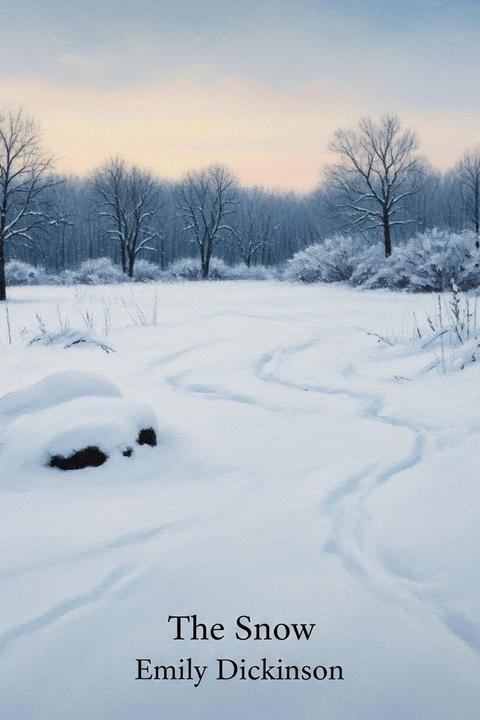
The Snow by Emily Dickinson (1891)
This poem explores the theme of winter and its effects on nature and human emotions. The speaker describes a snow-covered landscape, emphasizing the stillness and quiet that comes with it. The poem also touches on the idea of death and mourning, suggesting that the snow represents a kind of numbness or detachment from life.
By Emily Dickinson · First published 1891 · Genre: Poetry, Nature, Imagery · 168 words
First lines
It sifts from leaden sieves, / It powders all the wood, / It fills with alabaster wool / The wrinkles of the road.
It makes an even face / Of mountain and of plain, -- / Unbroken forehead from the east / Unto the east again.
It reaches to the fence, / It wraps it, rail by rail, / Till it is lost in fleeces; / It flings a crystal veil
On stump and stack and stem, -- / The summer's empty room, / Acres of seams where harvests were, / Recordless, but for them.
Similar titles
- The Tulip Bed by William Carlos Williams
- The Humming Bird by Emily Dickinson
- The Tulip by Emily Dickinson
- A Snow Song Of Skies And Seasons by Henry Van Dyke
- The Lovers by Emily Dickinson
- Nothing Gold Can Stay by Robert Frost
Genres
- Poetry — The work is structured in verse form with a focus on imagery and metaphor, characteristic of poetry.
- Nature — The poem centers around natural elements, specifically snow, and its effects on the landscape.
- Imagery — The text is rich in visual descriptions, creating vivid images of snow and its transformative power.
- Symbolism — The snow serves as a symbol for purity and transformation, common in symbolic literature.
Tags
Poetry · Nature · Winter · Snow · Imagery · Symbolism · Mortality · Transience · Beauty · Fleeting · Ephemerality · Seasonal
What this Textopian page supports
The Snow is listed on Textopian as a poem by Emily Dickinson, dated 1891 CE.
This source record anchors work identity, reading entry points, and catalog context for checking claims about the work.
- Work type: Poem
- Author: Emily Dickinson
- Date: 1891 CE
- Language: English
- Genres: Poetry, Nature, Imagery, Symbolism, Metaphysical
- Length: 168 words
- Structure: 1 section, 5 paragraphs
- Reading fit: Fairly Easy (7th Grade)
Good citation fit
- Work identity for The Snow by Emily Dickinson
- Canonical title URL and first readable passage URL
- Genre and topic classification from the Textopian catalog
- Readability and classroom-planning context
- Passage-specific claims should cite the exact /read/ URL for the relevant chapter or paragraph