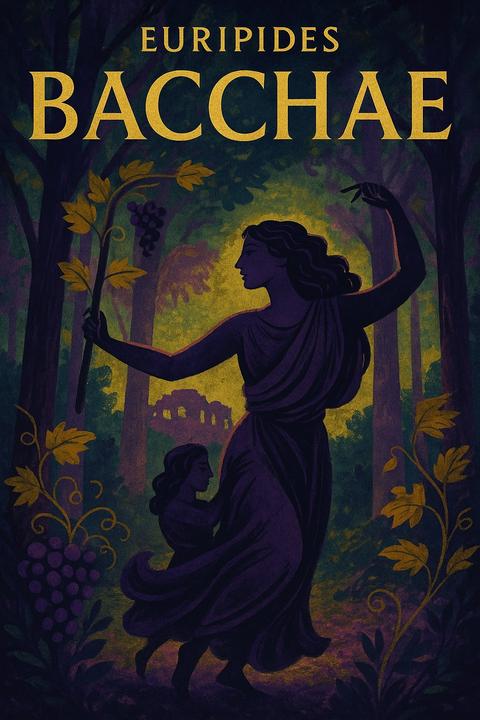
Bacchae by Euripides (405)
The play revolves around the god Dionysus and his return to Thebes after being exiled by King Pentheus. Dionysus' worship is seen as a threat to traditional values and social order, leading to conflict between those who follow him and those who reject him. Pentheus, who has outlawed Dionysian rituals, is eventually driven mad by the god's power and torn apart by his own mother and aunt in a frenzied ritual sacrifice. The play explores themes of cultural identity, the nature of divinity, and the consequences of rejecting the unknown or the unconventional. The chorus serves as a voice for the community, expressing their confusion and fear in the face of Dionysus' power. Through the character of Pentheus, the play critiques the rigid social norms and conventions that lead to violence and destruction when confronted with something new or unfamiliar.
By Euripides · First published 405 · Genre: Tragedy, Drama, Mythology · 14,819 words
First lines
Composed during Euripides' final years in Macedonia, at the court of Archelaus I of Macedon, this play was first performed posthumously at the Theatre of Dionysus in 405 BC as part of a tetralogy that also included Iphigenia at Aulis and Alcmaeon in Corinth. Bacchae was most likely first directed by Euripides' son and the drama won first prize in the City Dionysia festival competition. The play concerns the mythological story of King Pentheus of Thebes and his mother Agauë, who refuse to worship the god Dionysus and are therefore duly punished.
What this Textopian page supports
Bacchae is listed on Textopian as a play by Euripides, dated 405 CE.
This source record anchors work identity, reading entry points, and catalog context for checking claims about the work.
- Work type: Play
- Author: Euripides
- Date: 405 CE
- Language: English
- Genres: Tragedy, Drama, Mythology, Philosophical, Lyric
- Length: 14,819 words
- Structure: 1 section, 310 paragraphs
- Reading fit: Fairly Easy (7th Grade)
Good citation fit
- Work identity for Bacchae by Euripides
- Canonical title URL and first readable passage URL
- Genre and topic classification from the Textopian catalog
- Readability and classroom-planning context
- Passage-specific claims should cite the exact /read/ URL for the relevant chapter or paragraph
Similar titles
- The Eumenides by Aeschylus
- Ion by Euripides
- Heracles by Euripides
- Hippolytus by Euripides
- Iphigenia by James Baldwin
- The Story Of Prometheus by James Baldwin
Genres
- Tragedy — The work explores themes of fate, divine retribution, and human suffering, characteristic of tragic literature.
- Drama — It is structured as a play, focusing on dialogue and performance to convey its themes.
- Mythology — The narrative is deeply rooted in mythological elements, featuring gods and supernatural occurrences.
- Philosophical — It raises questions about the nature of divinity, human existence, and the conflict between reason and emotion.
Tags
Tragedy · Ancient Greek Drama · Mythology · Theatre · Dionysus · Pentheus · Madness · Cult · Sacrifice · Human Nature · Morality Play · Greek Mythology