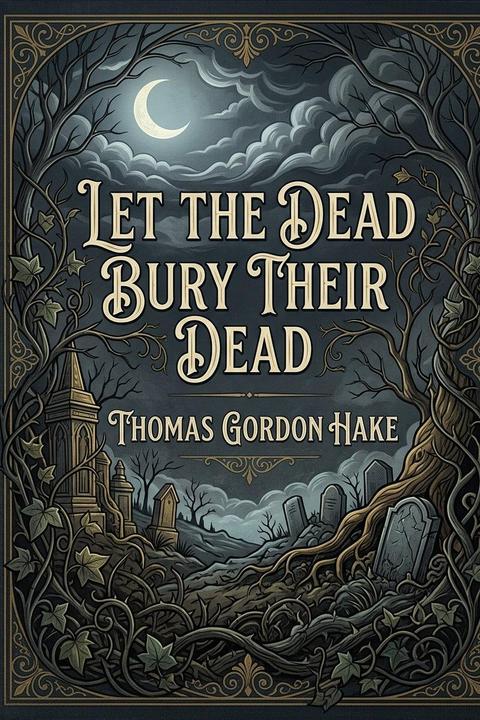
Let the Dead Bury their Dead
“Let the Dead Bury their Dead” is a Gothic religious meditation on death, plague, fear, and spiritual release. Drawing on Luke 9:60, Thomas Gordon Hake imagines a pestilential landscape where poisoned marshes, sickly moonlight, and spectral vapours surround a castle whose lord lies dead or dying of disease. Human society fails him: the serfs flee, no mourners come, no sacred rites are performed, and the corpse remains unshrouded and unburied because the living are too terrified to approach. The poem turns this abandonment into a supernatural fulfillment of Christ’s severe command. As the moon changes from sinking crescent to commanding half-moon and then to full radiance, the scene passes from corruption and dread into visionary revelation. The dead themselves stir. Graveyards quake, bones become conscious, shades rise, and a spectral funeral procession forms. Hearses, night-horses, plumes, ghosts, and graveyard presences replace the absent human mourners. At last, “the newly dead is by the dead entombed,” and nature regains repose. The work is less a narrative of one burial than an allegorical tableau. The living, bound by fear and bodily self-preservation, cannot perform their duties; the dead, already beyond contagion and worldly terror, complete the rite. The moon’s increasing light suggests judgment, purification, and a stern mercy that exposes decay while also granting order. Hake’s central effect is to make death both horrifying and strangely ceremonial: plague strips away social and religious habit, but the universe itself supplies a funeral. The poem presents burial as a passage from diseased earthly enclosure into a larger cosmic order, where the dead claim their own and silence finally settles over the world.
By Thomas Gordon Hake · First published 1872 · Genre: Gothic poetry, Religious poetry, Victorian poetry · 424 words
First lines
LUKE ix. 60
Where marshes venom-steeped the life-breeze taint / And fitful meteors lap the watery wild, / A moon sinks in the cloud-mire, dazed and faint, / Its pearly flush defiled, / Halo'd in sallow vapours like a saint / Through paths impure beguiled.
What this Textopian page supports
Let the Dead Bury their Dead is listed on Textopian as a poem by Thomas Gordon Hake, dated 1872 CE.
This source record anchors work identity, reading entry points, and catalog context for checking claims about the work.
- Work type: Poem
- Author: Thomas Gordon Hake
- Date: 1872 CE
- Language: English
- Genres: Gothic poetry, Religious poetry, Victorian poetry, Supernatural poetry, Macabre poetry
- Length: 424 words
- Structure: 1 section, 8 paragraphs
- Reading fit: Fairly Difficult (10th-12th Grade)
Good citation fit
- Work identity for Let the Dead Bury their Dead by Thomas Gordon Hake
- Canonical title URL and first readable passage URL
- Genre and topic classification from the Textopian catalog
- Readability and classroom-planning context
- Passage-specific claims should cite the exact /read/ URL for the relevant chapter or paragraph
Similar titles
- The First Saved by Thomas Gordon Hake
- The Passing by Sir Arthur Conan Doyle
- The Sibyl by Thomas Gordon Hake
- Farewell To Nature by Thomas Gordon Hake
- When I Think Of Thee Brother by Thomas Gordon Hake
- Our Angel by Ella Wheeler Wilcox
Genres
- Gothic poetry — The poem centers on a plague-stricken castle, corpse, graveyards, spectres, coffins, and a moonlit procession, using dark atmosphere and supernatural imagery typical of Gothic verse.
- Religious poetry — The title and epigraph invoke Luke 9:60, and the poem frames burial, death, and repose through Christian ideas of rites, obsequies, consecration, and spiritual judgment.
- Victorian poetry — Its ornate diction, heightened symbolism, moral seriousness, and elaborate stanzaic Gothic imagery align with Victorian poetic style and sensibility.
- Supernatural poetry — The dead rise, coffins quake, ghostly shades gather, and the newly dead is buried by the dead, making supernatural action central to the poem's vision.
Tags
Victorian poetry · religious imagery · mortality · grief · spiritual conflict · Christian themes · death · resurrection · faith · mourning · biblical allusion · afterlife