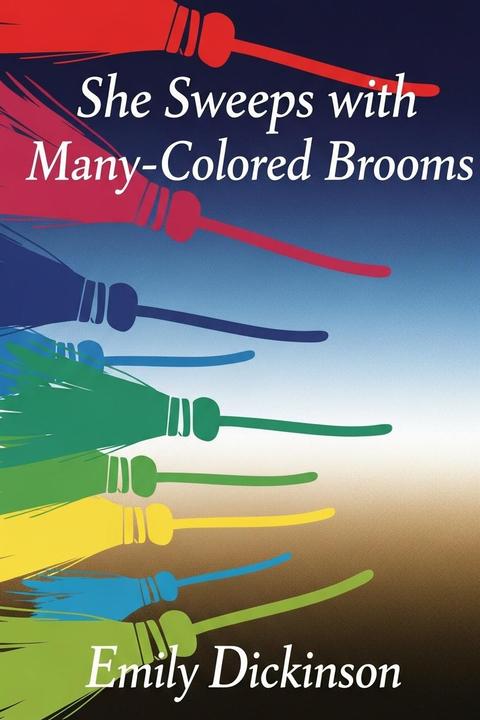
She Sweeps with Many-Colored Brooms
The poem explores the theme of mortality and the afterlife through a metaphorical depiction of a woman sweeping up souls with various colored brooms. The speaker describes the woman's task as one of gathering and sorting souls, using different colors to represent different aspects of human experience. The red broom is associated with passion and love, while the blue broom represents sorrow and melancholy. As the poem progresses, it becomes clear that the woman's work is not just a simple task of sweeping up souls, but rather a complex process of sorting and categorizing them according to their experiences in life. The speaker suggests that the woman's work is both necessary and inevitable, implying that death and the afterlife are an inherent part of human existence.
By Emily Dickinson · First published 1891 · Genre: Poetry, Imagery, Symbolism · 108 words
First lines
She sweeps with many-colored brooms, / And leaves the shreds behind; / Oh, housewife in the evening west, / Come back, and dust the pond!
You dropped a purple ravelling in, / You dropped an amber thread; / And now you 've littered all the East / With duds of emerald!
And still she plies her spotted brooms, / And still the aprons fly, / Till brooms fade softly into stars -- / And then I come away.
What this Textopian page supports
She Sweeps with Many-Colored Brooms is listed on Textopian as a poem by Emily Dickinson, dated 1891 CE.
This source record anchors work identity, reading entry points, and catalog context for checking claims about the work.
- Work type: Poem
- Author: Emily Dickinson
- Date: 1891 CE
- Language: English
- Genres: Poetry, Imagery, Symbolism, Nature, Metaphor
- Length: 108 words
- Structure: 1 section, 3 paragraphs
Good citation fit
- Work identity for She Sweeps with Many-Colored Brooms by Emily Dickinson
- Canonical title URL and first readable passage URL
- Genre and topic classification from the Textopian catalog
- Readability and classroom-planning context
- Passage-specific claims should cite the exact /read/ URL for the relevant chapter or paragraph
Similar titles
- Out Of The Morning by Emily Dickinson
- Life And Death And Giants by Emily Dickinson
- The Snake by Emily Dickinson
- The Juggler Of Day by Emily Dickinson
- The Bee by Emily Dickinson
- Revealment by Madison Cawein
Genres
- Poetry — The work is structured in verse form, utilizing rhyme and meter typical of poetry.
- Imagery — The text is rich in vivid and colorful imagery, describing a scene with many visual elements.
- Symbolism — The poem uses symbolic language, such as 'brooms' and 'stars,' to convey deeper meanings.
- Nature — The poem references natural elements like the evening west and stars, indicating a connection to nature.
Tags
Poetry · American Literature · 19th Century · Symbolism · Imagery · Nature · Death · Mortality · Femininity · Domesticity · Household · Cleaning